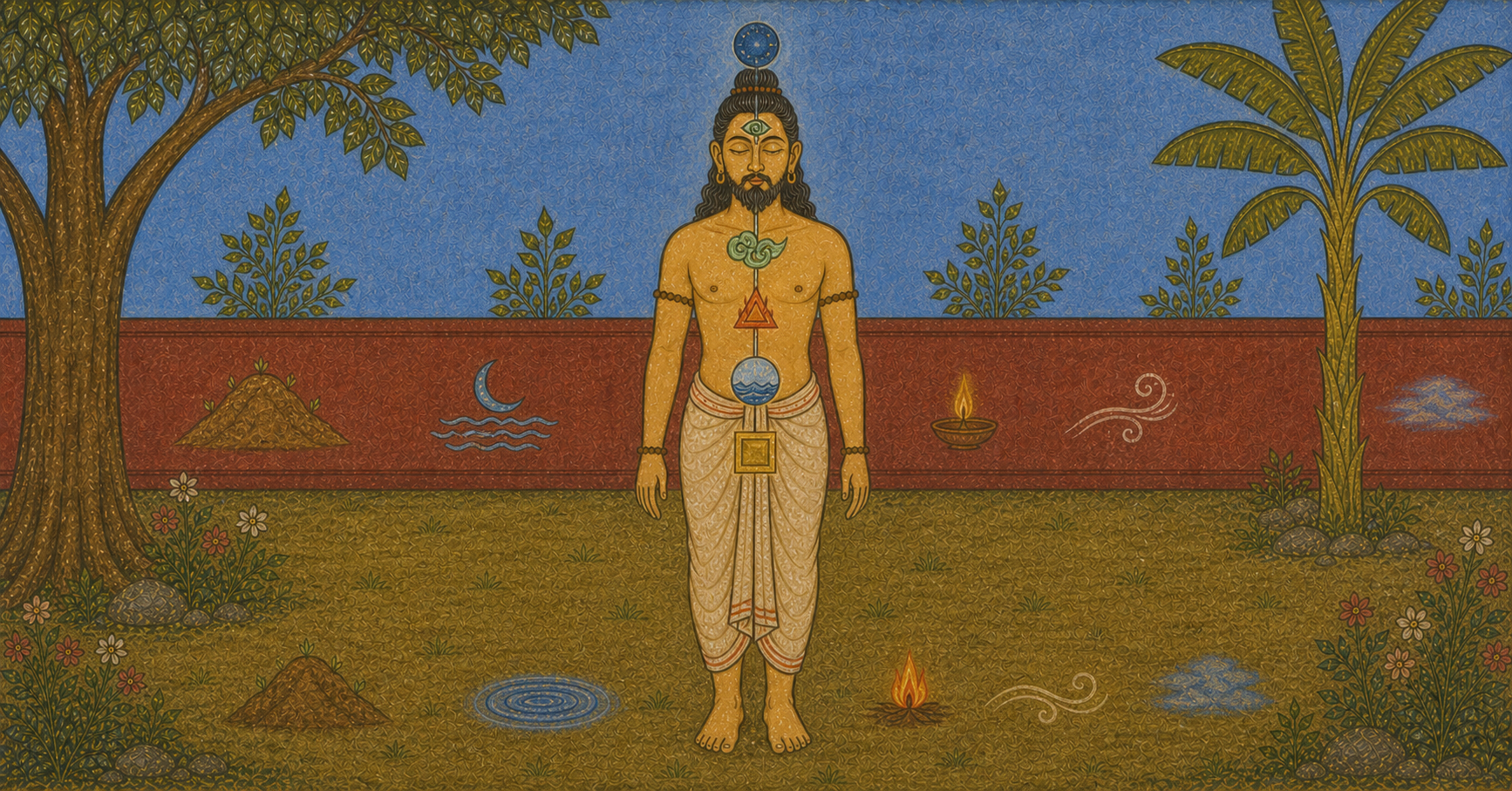
DYS 112–121: Five Elements

Dattātreyayogaśāstra 112–121: Dhāraṇā on Earth, Water, Fire, Air, and Space

The breath is held successively in five bodily regions. The fixations protect against the elements and death; DYŚ also promises the yogin a wondrous capacity.

Dr. Ronald Steiner Dr. Ronald Steiner Nils Jacob Liersch Nils Jacob Liersch
Dattātreyayogaśāstra 112
पञ्चधा धारणं कुर्यात्तत्तद्भूतभयापहम् |
pañcadhā dhāraṇaṃ kuryāt; tat-tad-bhūta-bhayāpaham | Analysis ▾ Analysis ▴
pañcadhā
adverb
fivefold
dhāraṇam
accusative singular
substantive neuter
fixation
kuryāt
3rd person singular aktive optative
verbal root
should perform
tat
dvandva-compound
pronoun
each
tat
tatpuruṣa-compound genitive
pronoun
respective
bhūta
tatpuruṣa-compound ablative
substantive neuter
element
bhaya
tatpuruṣa-compound accusative
substantive neuter
danger
apaham
accusative singular neuter
adjective
removing
पृथिवीधारणं वक्ष्ये पार्थिवेभ्यो भयावहम् ||112||
pṛthivī-dhāraṇaṃ vakṣye; pārthivebhyo bhayāvaham ||112|| Analysis ▾ Analysis ▴
pṛthivī
tatpuruṣa-compound genitive
substantive feminine
earth element
dhāraṇam
accusative singular
substantive neuter
fixation
vakṣye
1st person singular aktive future
verbal root
I shall teach
pārthivebhyaḥ
dative plural neuter
adjective
for things made of earth
bhaya
tatpuruṣa-compound accusative
substantive neuter
danger
āvaham
accusative singular neuter
adjective
bringing
Metre: Anuṣṭubh
He should perform (kuryāt | 3p sg act opt) fixation (dhāraṇam | acc sg) in five ways (pañcadhā), removing danger from each respective element (tat-tad-bhūta-bhayāpaham | acc sg). I shall teach (vakṣye | 1p sg act fut) fixation on earth (pṛthivī-dhāraṇam | acc sg); the critical text literally calls it “danger-bringing” (bhayāvaham | acc sg) for things made of earth (pārthivebhyaḥ | dat pl).
Dr. Ronald Steiner - 2026 - historically literal
The teaching now turns to five kinds of fixation, each removing danger from one of the elements. It begins with fixation on earth.
Dr. Ronald Steiner - 2026 - modern transfer
tattadbhūtabhayāpaham | JM2024 ] tattadbhūtabhayāpaham || DYŚ

bhayāvaham JM2024 ] bhayāpaham DYŚ
Critical Apparatus
Dattātreyayogaśāstra 113
नाभेरधो गुदस्योर्ध्वं घटिकाः पञ्च धारयेत् |
nābher adho gudasyordhvaṃ; ghaṭikāḥ pañca dhārayet | Analysis ▾ Analysis ▴
nābheḥ
genitive singular
substantive masculine
from the navel
adhas
adverb
below
gudasya
genitive singular
substantive masculine
of the anus
ūrdhvam
adverb
above
ghaṭikāḥ
accusative plural
substantive feminine
ghaṭikās
pañca
nominative plural
numeral
five
dhārayet
3rd person singular aktive optative
verbal root
he should hold
वायुं ततो लभेत्पृथ्वीधारणं तद्भयापहम् ||113||
vāyuṃ tato labhet pṛthvī;-dhāraṇaṃ tad-bhayāpaham ||113|| Analysis ▾ Analysis ▴
vāyum
accusative singular
substantive masculine
breath
tataḥ
adverb
then
labhet
3rd person singular aktive optative
verbal root
he should attain
pṛthivī
tatpuruṣa-compound lokative
substantive feminine
earth
dhāraṇam
accusative singular
substantive neuter
fixation
tat
tatpuruṣa-compound genitive
pronoun
its
bhaya
tatpuruṣa-compound accusative
substantive neuter
danger
apaham
accusative singular neuter
adjective
removing
Metre: Anuṣṭubh
Below (adhas) the navel (nābheḥ | gen sg) and above (ūrdhvam | acc sg) the anus (gudasya | gen sg), he should hold (dhārayet | 3p sg act opt) the breath (vāyum | acc sg) for five ghaṭikās (ghaṭikāḥ pañca | acc pl). From this (tataḥ) he should attain (labhet | 3p sg act opt) fixation on earth (pṛthivī-dhāraṇam | acc sg), which removes danger from it (tad-bhayāpaham | acc sg).
Dr. Ronald Steiner - 2026 - historically literal
For the earth fixation, the yogi holds the breath in the lower trunk for five ghaṭikās. This is said to remove danger arising from the earth element.
Dr. Ronald Steiner - 2026 - modern transfer
gudasyordhvaṃ JM2024 ] gudasthordhvaṃ DYŚ
Critical Apparatus
Dattātreyayogaśāstra 114
पृथिवीसंभवो मृत्युर्न भवेदस्य योगिनः |
pṛthivī-saṃbhavo mṛtyur; na bhaved asya yoginaḥ | Analysis ▾ Analysis ▴
pṛthivī
tatpuruṣa-compound ablative
substantive feminine
earth element
saṃbhavaḥ
nominative singular
substantive masculine
arising
mṛtyuḥ
nominative singular
substantive masculine
death
na
particle
not
bhavet
3rd person singular aktive optative
verbal root
should occur
asya
genitive singular masculine
pronoun
for him
yoginaḥ
genitive singular
substantive masculine
for the yogi
नाभिस्थाने ततो वायुं धारयेत्पञ्च नाडिकाः ||114||
nābhi-sthāne tato vāyuṃ; dhārayet pañca nāḍikāḥ ||114|| Analysis ▾ Analysis ▴
nābhi
tatpuruṣa-compound genitive
substantive masculine
navel
sthāne
lokative singular
substantive neuter
place
tataḥ
adverb
then
vāyum
accusative singular
substantive masculine
breath
dhārayet
3rd person singular aktive optative
verbal root
he should hold
pañca
nominative plural
numeral
five
nāḍikāḥ
accusative plural
substantive feminine
nāḍikās
Metre: Anuṣṭubh
For this yogi (asya yoginaḥ | gen sg), no (na) death (mṛtyuḥ | nom sg) arising from earth (pṛthivī-saṃbhavaḥ | nom sg) should occur (bhavet | 3p sg act opt). Then (tataḥ) he should hold (dhārayet | 3p sg act opt) the breath (vāyum | acc sg) at the navel (nābhi-sthāne | loc sg) for five nāḍikās (pañca nāḍikāḥ | acc pl).
Dr. Ronald Steiner - 2026 - historically literal
Earth fixation protects the yogi from death through earth. The breath is then held at the navel for five nāḍikās.
Dr. Ronald Steiner - 2026 - modern transfer
pṛthivīsaṃbhavo mṛtyur na bhaved asya yoginaḥ JM2024 ] pṛthivīsaṃbhavas tasya na mṛtyur yogino bhavet DYŚ

yoginaḥ | JM2024 ] bhavet || DYŚ

pañca nāḍikāḥ JM2024 ] pañcanāḍikāḥ DYŚ

nāḍikāḥ || JM2024 ] pañcanāḍikāḥ | DYŚ
Critical Apparatus
Dattātreyayogaśāstra 115
ततो जलाद्भयं नास्ति जलमृत्युर्न योगिनः |
tato jalād bhayaṃ nāsti; jala-mṛtyur na yoginaḥ | Analysis ▾ Analysis ▴
tataḥ
adverb
then
jalāt
ablative singular
substantive neuter
from water
bhayam
nominative singular
substantive neuter
danger
na
particle
not
asti
3rd person singular aktive present
verbal root
exists
jala
tatpuruṣa-compound ablative
substantive neuter
water
mṛtyuḥ
nominative singular
substantive masculine
death
na
particle
not
yoginaḥ
genitive singular
substantive masculine
for the yogi
नाभ्यूर्ध्वमण्डले वायुं धारयेत्पञ्च नाडिकाः ||115||
nābhy-ūrdhva-maṇḍale vāyuṃ; dhārayet pañca nāḍikāḥ ||115|| Analysis ▾ Analysis ▴
nābhi
tatpuruṣa-compound genitive
substantive masculine
navel
ūrdhva
karmadhāraya-compound
adjective
above
maṇḍale
lokative singular
substantive masculine
region
vāyum
accusative singular
substantive masculine
breath
dhārayet
3rd person singular aktive optative
verbal root
he should hold
pañca
nominative plural
numeral
five
nāḍikāḥ
accusative plural
substantive feminine
nāḍikās
Metre: Anuṣṭubh
Then (tataḥ) there is (asti | 3p sg act pres) no (na) danger (bhayam | nom sg n) from water (jalāt | abl sg), and no (na) death by water (jala-mṛtyuḥ | nom sg) for the yogi (yoginaḥ | gen sg). He should hold (dhārayet | 3p sg act opt) the breath (vāyum | acc sg) above the navel (nābhy-ūrdhva-maṇḍale | loc sg) for five nāḍikās (pañca nāḍikāḥ | acc pl).
Dr. Ronald Steiner - 2026 - historically literal
This removes danger from water. The yogi next holds the breath in the region above the navel for five nāḍikās.
Dr. Ronald Steiner - 2026 - modern transfer
yoginaḥ | JM2024 ] yoginaḥ || DYŚ

pañca nāḍikāḥ JM2024 ] pañcanāḍikāḥ DYŚ

nāḍikāḥ || JM2024 ] pañcanāḍikāḥ | DYŚ
Critical Apparatus
Dattātreyayogaśāstra 116
आग्नेयधारणा सेयं न मृत्युस्तस्य वह्निना |
āgneya-dhāraṇā seyaṃ; na mṛtyus tasya vahninā | Analysis ▾ Analysis ▴
āgneya
tatpuruṣa-compound genitive
adjective
fiery
dhāraṇā
nominative singular
substantive feminine
fixation
sā
nominative singular feminine
pronoun dem
this
iyam
nominative singular feminine
pronoun dem
this
na
particle
not
mṛtyuḥ
nominative singular
substantive masculine
death
tasya
genitive singular masculine
pronoun
for him
vahninā
instrumental case singular
substantive masculine
through fire
न दह्यते शरीरं च प्रविष्टस्याग्निकुण्डके ||116||
na dahyate śarīraṃ ca; praviṣṭasyāgni-kuṇḍake ||116|| Analysis ▾ Analysis ▴
na
particle
not
dahyate
3rd person singular passive present
verbal root
is burned
śarīram
nominative singular
substantive neuter
body
ca
particle
and
praviṣṭasya
genitive singular masculine past participle passive
previx
verbal root
of one who has entered
agni
tatpuruṣa-compound genitive
substantive masculine
fire
kuṇḍake
lokative singular
substantive neuter
in a pit
Metre: Anuṣṭubh
This (seyam | nom sg) is the fire fixation (āgneya-dhāraṇā | nom sg). For him (tasya | gen sg) there is no (na) death (mṛtyuḥ | nom sg) through fire (vahninā | ins sg), and (ca) the body (śarīram | nom sg n) of one who has entered (praviṣṭasya | gen sg m ppp) a fire pit (agni-kuṇḍake | loc sg) is not (na) burned (dahyate | 3p sg pas pres).
Dr. Ronald Steiner - 2026 - historically literal
This is the fire fixation. It protects against fire; the yogi’s body is said not to burn even when he enters a fire pit.
Dr. Ronald Steiner - 2026 - modern transfer
vahninā | JM2024 ] vahninā || DYŚ

praviṣṭasyāgnikuṇḍake JM2024 ] prakṣipto vahnikuṇḍake DYŚ
Critical Apparatus
Dattātreyayogaśāstra 116*1
सदा विचित्रसामर्थ्यं योगिनो जायते ध्रुवम् ||116*1||
sadā vicitra-sāmarthyaṃ; yogino jāyate dhruvam ||116*1|| Analysis ▾ Analysis ▴
sadā
adverb
always
vicitra
karmadhāraya-compound
adjective
wondrous
sāmarthyam
nominative singular
substantive neuter
capacity
yoginaḥ
genitive singular
substantive masculine
of the yogin
jāyate
3rd person singular medial present
verbal root
arises
dhruvam
adverb
certainly
Metre: Anuṣṭubh
The wondrous capacity (vicitra-sāmarthyam | nom sg n) of the yogin (yoginaḥ | gen sg) always (sadā) and certainly (dhruvam) arises (jāyate | 3p sg med pres).
Dr. Ronald Steiner - 2026 - historically literal
A wondrous capacity is sure to arise in the yogin.
Dr. Ronald Steiner - 2026 - modern transfer
sadā vicitrasāmarthyaṃ yogino jāyate dhruvam DYŚ ] om. JM2024
Critical Apparatus
Dattātreyayogaśāstra 117
नाभिभ्रूघ्राणमध्ये तु प्रदेशत्रयसंमिते |
nābhi-bhrū-ghrāṇa-madhye tu; pradeśa-traya-saṃmite | Analysis ▾ Analysis ▴
nābhi
tatpuruṣa-compound genitive
substantive feminine
navel
bhrū
tatpuruṣa-compound genitive
substantive feminine
eyebrows
ghrāṇa
tatpuruṣa-compound genitive
substantive neuter
nose
madhye
lokative singular
substantive neuter
between
tu
particle
but
pradeśa
tatpuruṣa-compound genitive
substantive masculine
span
traya
tatpuruṣa-compound genitive
adjective
three
saṃmite
lokative singular neuter past participle passive
previx
verbal root
measured; corresponding to
धारयेत्पञ्च घटिका वायुं सैषा हि वायवी ||117||
dhārayet pañca ghaṭikā; vāyuṃ saiṣā hi vāyavī ||117|| Analysis ▾ Analysis ▴
dhārayet
3rd person singular aktive optative
verbal root
he should hold
pañca
nominative plural
numeral
five
ghaṭikā
accusative plural
substantive feminine
ghaṭikās
vāyum
accusative singular
substantive masculine
breath
sa
nominative singular feminine
pronoun
that
eṣā
nominative singular feminine
pronoun dem
this
hi
particle
indeed
vāyavī
nominative singular feminine
adjective
relating to wind or air
Metre: Anuṣṭubh
Between the navel, eyebrows, and nose (nābhi-bhrū-ghrāṇa-madhye | loc sg), in an area measuring three handspans (pradeśa-traya-saṃmite | loc sg), he should hold (dhārayet | 3p sg act opt) the breath (vāyum | acc sg) for five ghaṭikās (pañca ghaṭikā | acc pl). This (saiṣā | nom sg) indeed (hi) is the air fixation (vāyavī | nom sg).
Dr. Ronald Steiner - 2026 - historically literal
Holding the breath for five ghaṭikās in the three-handspan region from the navel to the junction of brows and nose produces the air fixation.
Dr. Ronald Steiner - 2026 - modern transfer
nābhibhrūghrāṇamadhye tu pradeśatrayasaṃmite JM2024 ] nābhibhruvor hi madhye tu pradeśatrayasaṃyute DYŚ
Critical Apparatus
Dattātreyayogaśāstra 118
धारणा न तु वायोस्तु भयं भवति योगिनः |
dhāraṇā na tu vāyos tu; bhayaṃ bhavati yoginaḥ | Analysis ▾ Analysis ▴
dhāraṇā
nominative singular
substantive feminine
fixation
na
particle
not
tu
particle
indeed
vāyoḥ
genitive singular
substantive masculine
from air
tu
particle
however
bhayam
nominative singular
substantive neuter
danger
bhavati
3rd person singular aktive present
verbal root
arises
yoginaḥ
genitive singular
substantive masculine
for the yogi
भ्रूमध्यादुपरिष्टात्तु धारयेत्पञ्च नाडिकाः ||118||
bhrū-madhyād upariṣṭāt tu; dhārayet pañca nāḍikāḥ ||118|| Analysis ▾ Analysis ▴
bhrū
tatpuruṣa-compound genitive
substantive feminine
eyebrow
madhyāt
ablative singular
substantive masculine
from the midpoint
upariṣṭāt
above
tu
particle
however
dhārayet
3rd person singular aktive optative
verbal root
he should hold
pañca
nominative plural
numeral
five
nāḍikāḥ
accusative plural
substantive feminine
nāḍikās
Metre: Anuṣṭubh
In this fixation (dhāraṇā | nom sg), no (na) danger (bhayam | nom sg) from air (vāyoḥ | gen sg) occurs (bhavati | 3p sg act pres) for the yogi (yoginaḥ | gen sg). Above (upariṣṭāt | abl sg) the midpoint of the eyebrows (bhrū-madhyāt | abl sg), he should hold [the breath] (dhārayet | 3p sg act opt) for five nāḍikās (pañca nāḍikāḥ | acc pl).
Dr. Ronald Steiner - 2026 - historically literal
The air fixation removes danger from air. The breath is then held above the midpoint of the eyebrows for five nāḍikās.
Dr. Ronald Steiner - 2026 - modern transfer
dhāraṇā na tu vāyos tu bhayaṃ bhavati yoginaḥ JM2024 ] dhāraṇān na tu vāyos tu yogino hi bhayaṃ bhavet DYŚ
Critical Apparatus
Dattātreyayogaśāstra 119
वायुं योगी प्रयत्नेन सेयमाकाशधारणा |
vāyuṃ yogī prayatnena; seyam ākāśa-dhāraṇā | Analysis ▾ Analysis ▴
vāyum
accusative singular
substantive masculine
breath
yogī
nominative singular
substantive masculine
the yogi
prayatnena
instrumental case singular
substantive masculine
carefully
sā
nominative singular feminine
pronoun dem
this
iyam
nominative singular feminine
pronoun dem
this
ākāśa
tatpuruṣa-compound genitive
substantive masculine
space
dhāraṇā
nominative singular
substantive feminine
fixation
आकाशधारणां कुर्वन्मृत्युं जयति तत्त्वतः ||119||
ākāśa-dhāraṇāṃ kurvan; mṛtyuṃ jayati tattvataḥ ||119|| Analysis ▾ Analysis ▴
ākāśa
tatpuruṣa-compound genitive
substantive masculine
space
dhāraṇām
accusative singular
substantive feminine
fixation
kurvan
nominative singular masculine present participle active
verbal root
practising
mṛtyum
accusative singular
substantive masculine
death
jayati
3rd person singular aktive present
verbal root
conquers
tattvataḥ
adverb
truly
Metre: Anuṣṭubh
The yogi (yogī | nom sg) should carefully (prayatnena | ins sg) [hold] the breath (vāyum | acc sg). This (seyam | nom sg) is fixation on space (ākāśa-dhāraṇā | nom sg). One who practises (kurvān | nom sg) space fixation (ākāśa-dhāraṇām | acc sg) completely (tattvataḥ) conquers (jayati | 3p sg act pres) death (mṛtyum | acc sg).
Dr. Ronald Steiner - 2026 - historically literal
Carefully holding the breath there produces the space fixation. One who practises it is said to overcome death completely.
Dr. Ronald Steiner - 2026 - modern transfer
ākāśadhāraṇāṃ JM2024 ] ākāśadhāraṇaṃ DYŚ
Critical Apparatus
Dattātreyayogaśāstra 120
यत्र तत्र स्थितो वापि सुखमत्यन्तमश्नुते |
yatra tatra sthito vāpi; sukham atyantam aśnute | Analysis ▾ Analysis ▴
yatra
adverb
wherever
tatra
adverb
there
sthitaḥ
nominative singular masculine past participle passive
verbal root
remaining
vā
particle
or
api
particle
also
sukham
accusative singular
substantive neuter
happiness
atyantam
accusative singular neuter
adjective
boundless
aśnute
3rd person singular medial present
verbal root
he enjoys
एवं च धारणाः पञ्च कुर्याद्योगी विचक्षणः ||120||
evaṃ ca dhāraṇāḥ pañca; kuryād yogī vicakṣaṇaḥ ||120|| Analysis ▾ Analysis ▴
evam
adverb
thus
ca
particle
and
dhāraṇāḥ
nominative plural
substantive feminine
fixations
pañca
nominative plural
numeral
five
kuryāt
3rd person singular aktive optative
verbal root
should perform
yogī
nominative singular
substantive masculine
the yogi
vicakṣaṇaḥ
nominative singular masculine
adjective
discerning
Metre: Anuṣṭubh
Wherever (yatra tatra) he is (sthitaḥ | nom sg), he enjoys (aśnute | 3p sg med pres) boundless (atyantam | acc sg) happiness (sukham | acc sg). Thus (evam) the discerning yogi (yogī vicakṣaṇaḥ | nom sg) should perform (kuryāt | 3p sg act opt) the five (pañca | nom pl) fixations (dhāraṇāḥ | nom pl).
Dr. Ronald Steiner - 2026 - historically literal
Wherever the yogi may be, boundless happiness is experienced. In this way the discerning practitioner should cultivate all five fixations.
Dr. Ronald Steiner - 2026 - modern transfer
Dattātreyayogaśāstra 121
ततो दृढशरीरः स्यान्मृत्युस्तस्य न विद्यते |
tato dṛḍha-śarīraḥ syān; mṛtyus tasya na vidyate | Analysis ▾ Analysis ▴
tataḥ
adverb
then
dṛḍha
karmadhāraya-compound
adjective
firm
śarīraḥ
nominative singular
substantive masculine
body
syāt
3rd person singular aktive optative
verbal root
should become
mṛtyuḥ
nominative singular
substantive masculine
death
tasya
genitive singular masculine
pronoun
for him
na
particle
not
vidyate
3rd person singular medial present
verbal root
exists
इत्येवं पञ्चभूतानां धारणां यः समभ्यसेत् ||121||
ity evaṃ pañca-bhūtānāṃ; dhāraṇāṃ yaḥ samabhyaset ||121|| Analysis ▾ Analysis ▴
iti
particle
so
evam
adverb
thus
pañca
karmadhāraya-compound
numeral
five
bhūtānām
genitive plural
substantive neuter
elements
dhāraṇām
accusative singular
substantive feminine
fixation
yaḥ
nominative singular masculine
pronoun
whoever
samabhyaset
3rd person singular aktive optative
previx
previx
verbal root
should practise
Metre: Anuṣṭubh
Then (tataḥ) he becomes (syāt | 3p sg act opt) firm-bodied (dṛḍha-śarīraḥ | nom sg), and for him (tasya | gen sg) no (na) death (mṛtyuḥ | nom sg) is found (vidyate | 3p sg med pres). This is the result for one who (yaḥ | nom sg) steadily practises (samabhyaset | 3p sg act opt) fixation (dhāraṇām | acc sg) on the five elements (pañca-bhūtānām | gen pl).
Dr. Ronald Steiner - 2026 - historically literal
Through steady practice of the five elemental fixations, the body becomes firm and death loses its hold.
Dr. Ronald Steiner - 2026 - modern transfer
syān JM2024 ] syāt DYŚ

dhāraṇāṃ JM2024 ] dhāraṇaṃ DYŚ
Critical Apparatus

Continue with AYI Free

Illustrations: AI-generated.

Editor

Dr. Ronald Steiner

From Ulm

The "Yoga Doc" - Dr. Ronald Steiner is the founder of the AYI method. This method links traditional Ashtanga Yoga with innovative Yogatherapy and living Philosophy. This forms a practice that is personal for each and... more ›

Nils Jacob Liersch

Meine Begeisterung für Yoga, indische Philosophie und Sanskrit führte mich zum Studium der Indologie und Religionswissenschaft an der Universität Heidelberg. Seit 2004 befinde ich mich auf meinem persönlichen Yogaweg... more ›

Messages and ratings
0 messages

Please log in to write a message. Go to login

No messages yet.