DYS 2–8: Seeking a Teacher

Dattātreyayogaśāstra 2–8: Sāṃkṛti Meets Dattātreya in the Naimiṣa Forest

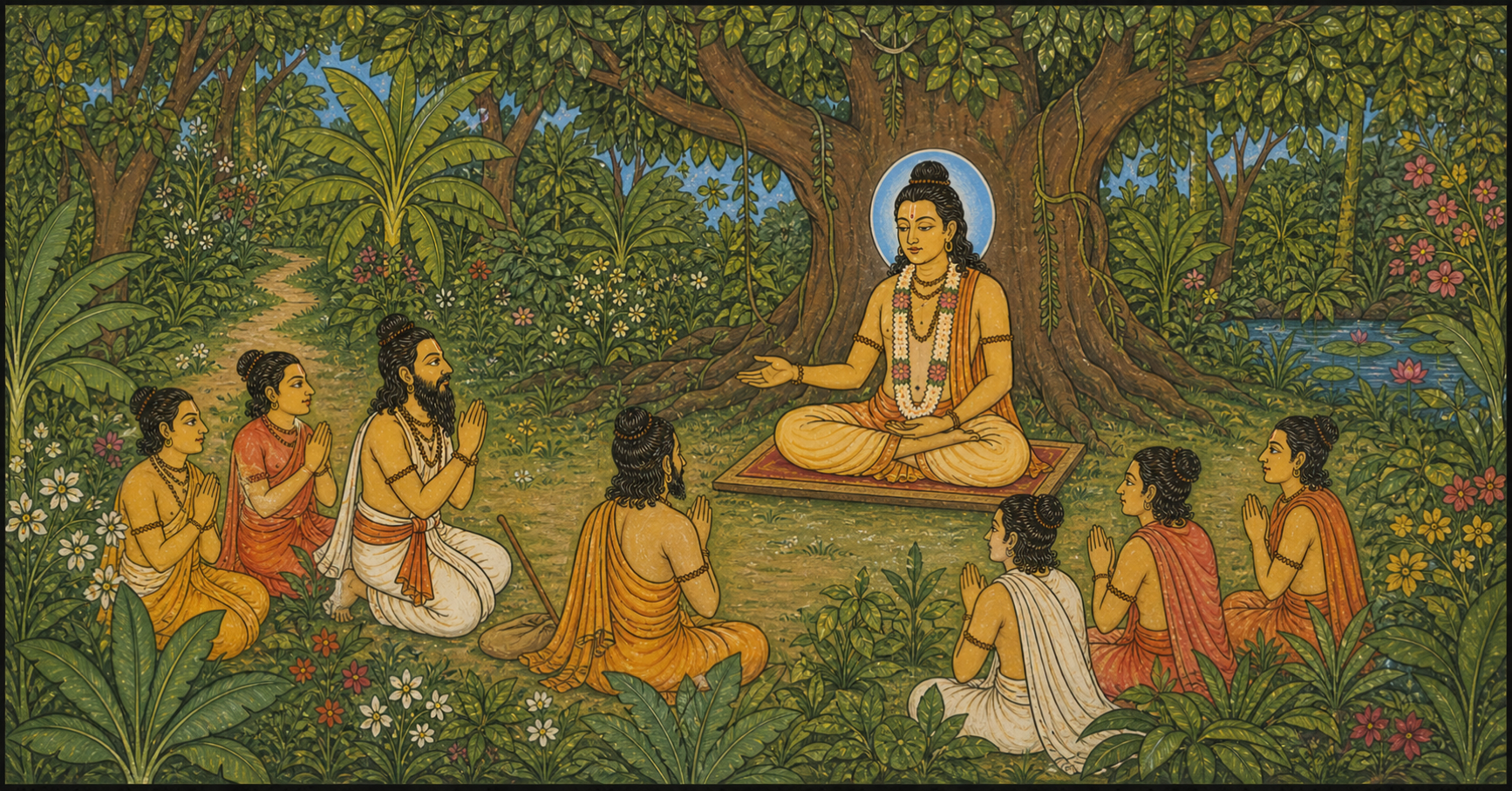
Searching for yoga, Sāṃkṛti finds Dattātreya absorbed in meditation, bows to him, and explains that he has come to learn the teaching.

Dr. Ronald Steiner Dr. Ronald Steiner Nils Jacob Liersch Nils Jacob Liersch
Dattātreyayogaśāstra 2
सांकृतिर्मुनिवर्यो ऽसौ भूतलं योगलिप्सया |
sāṃkṛtir muni-varyo 'sau; bhūtalaṃ yoga-lipsayā | Analysis ▾ Analysis ▴
sāṃkṛtiḥ
nominative singular
substantive masculine
Sāṃkṛti
muni
tatpuruṣa-compound genitive
substantive masculine
of sages
varyaḥ
nominative singular masculine
adjective
the best
asau
nominative singular masculine
pronoun dem
that man
bhūtalam
accusative singular
substantive neuter
the earth
yoga
tatpuruṣa-compound genitive
substantive masculine
yoga
lipsayā
instrumental case singular
substantive feminine
out of desire for
सकलं परिचङ्क्रम्य नैमिषारण्यमाप्तवान् ||2||
sakalaṃ paricaṅkramya; naimiṣāraṇyam āptavān ||2|| Analysis ▾ Analysis ▴
sakalam
accusative singular neuter
adjective
the whole
paricaṅkramya
absolutus
previx
verbal root
having traversed all around
naimiṣa
karmadhāraya-compound
substantive neuter
Naimiṣa
araṇyam
accusative singular
substantive neuter
forest
āptavān
nominative singular masculine past participle active
verbal root
reached
Metre: Anuṣṭubh
From a desire for yoga (yoga-lipsayā | ins sg), that foremost sage Sāṃkṛti (sāṃkṛtir muni-varyo ’sau | nom sg), having traversed (paricaṅkramya | abs) the whole earth (bhūtalaṃ sakalam | acc sg), reached (āptavān | nom sg) Naimiṣa Forest (naimiṣāraṇyam | acc sg).
Dr. Ronald Steiner - 2026 - historically literal
The eminent sage Sāṃkṛti sought knowledge of yoga. After travelling across the whole earth, he eventually reached Naimiṣa Forest.
Dr. Ronald Steiner - 2026 - modern transfer
bhūtalaṃ JM2024 ] bhūtaye DYŚ

paricaṅkramya JM2024 ] bhū? paribhrāmyān DYŚ
Critical Apparatus
Dattātreyayogaśāstra 3
सुगन्धिनानाकुसुमैः स्वादुमत्फलसंयुतैः |
sugandhi-nānā-kusumaiḥ; svādumat-phala-saṃyutaiḥ | Analysis ▾ Analysis ▴
sugandhin
karmadhāraya-compound
adjective
fragrant
nānā
karmadhāraya-compound
adjective
various
kusumaiḥ
instrumental case plural
substantive neuter
with flowers
svādumat
karmadhāraya-compound
adjective
sweet-tasting
phala
tatpuruṣa-compound instrumental case
substantive neuter
fruit
saṃyutaiḥ
instrumental case plural masculine past participle passive
previx
verbal root
endowed with
शाखिभिः शोभितं पुण्यं जलकासारमण्डितम् ||3||
śākhibhiḥ śobhitaṃ puṇyaṃ; jala-kāsāra-maṇḍitam ||3|| Analysis ▾ Analysis ▴
śākhibhiḥ
instrumental case plural
substantive masculine
with trees
śobhitam
accusative singular neuter past participle passive
verbal root
adorned
puṇyam
accusative singular neuter
adjective
sacred; lovely
jala
karmadhāraya-compound
substantive neuter
water
kāsāra
tatpuruṣa-compound instrumental case
substantive masculine
pond
maṇḍitam
accusative singular neuter past participle passive
verbal root
adorned
Metre: Anuṣṭubh
That sacred [forest] (puṇyam | acc sg n) was adorned (śobhitam | acc sg n) with trees (śākhibhiḥ | ins pl) bearing many kinds of fragrant flowers (sugandhi-nānā-kusumaiḥ | ins pl) and sweet fruit (svādumat-phala-saṃyutaiḥ | ins pl), and embellished with pools of water (jala-kāsāra-maṇḍitam | acc sg n).
Dr. Ronald Steiner - 2026 - historically literal
The forest was filled with fragrant blossoms, delicious fruit, beautiful trees, and clear pools.
Dr. Ronald Steiner - 2026 - modern transfer
svādumatphalasaṃyutaiḥ JM2024 ] svādusatphalasaṃyutaiḥ DYŚ

jalakāsāramaṇḍitam JM2024 ] jalakāsāramaṃḍitam DYŚ
Critical Apparatus
Dattātreyayogaśāstra 4
स मुनिस्तत्र विचरन्ददर्शाम्रतरोरधः |
sa munis tatra vicaran; dadarśāmra-taror adhaḥ | Analysis ▾ Analysis ▴
saḥ
nominative singular masculine
pronoun
he
muniḥ
nominative singular
substantive masculine
the sage
tatra
adverb
there
vicaran
nominative singular masculine present participle active
previx
verbal root
wandering
dadarśa
3rd person singular aktive perfekte
verbal root
saw
āmra
tatpuruṣa-compound genitive
substantive masculine
mango
taroḥ
genitive singular
substantive masculine
of the tree
adhaḥ
adverb
beneath
वेदिकायां समासीनं दत्तात्रेयं महामुनिम् ||4||
vedikāyāṃ samāsīnaṃ; dattātreyaṃ mahā-munim ||4|| Analysis ▾ Analysis ▴
vedikāyām
lokative singular
substantive feminine
on a platform
samāsīnam
accusative singular masculine past participle passive
previx
verbal root
seated
dattātreyam
accusative singular
substantive masculine
Dattātreya
mahā
karmadhāraya-compound
adjective
great
munim
accusative singular
substantive masculine
sage
Metre: Anuṣṭubh
While the sage (sa muniḥ | nom sg) wandered (vicaran | nom sg m pca) there (tatra), he saw (dadarśa | 3p sg act perf), beneath a mango tree (āmra-taroḥ adhaḥ | gen sg), the great sage Dattātreya (dattātreyaṃ mahā-munim | acc sg) seated on a platform (vedikāyāṃ samāsīnam | acc sg).
Dr. Ronald Steiner - 2026 - historically literal
As Sāṃkṛti wandered through the forest, he saw the great sage Dattātreya seated on a platform beneath a mango tree.
Dr. Ronald Steiner - 2026 - modern transfer
munis tatra vicaran JM2024 ] munir vicaraṃs tatra DYŚ
Critical Apparatus
Dattātreyayogaśāstra 5
दृढपद्मासनेनापि नासाग्रार्पितया दृशा |
dṛḍha-padmāsanenāpi; nāsāgrārpitayā dṛśā | Analysis ▾ Analysis ▴
dṛḍha
karmadhāraya-compound
adjective
firm
padma
tatpuruṣa-compound genitive
substantive neuter
lotus
āsanena
instrumental case singular
substantive neuter
posture
api
particle
also
nāsā
tatpuruṣa-compound genitive
substantive feminine
nose
agra
tatpuruṣa-compound lokative
substantive neuter
at the tip
arpitayā
instrumental case singular feminine past participle passive
verbal root
directed
dṛśā
instrumental case singular
substantive feminine
gaze
ऊरुमध्यगतोत्तानपाणियुग्मेन शोभितम् ||5||
ūru-madhya-gatottāna;-pāṇi-yugmena śobhitam ||5|| Analysis ▾ Analysis ▴
ūru
tatpuruṣa-compound genitive
substantive masculine
thigh
madhya
tatpuruṣa-compound lokative
substantive neuter
in the middle, in the central channel
gata
karmadhāraya-compound past participle passive
verbal root
gone, situated
uttāna
karmadhāraya-compound
adjective
extended, upward
pāṇi
tatpuruṣa-compound genitive
substantive masculine
with both hands
yugmena
instrumental case singular
substantive neuter
the pair, both together
śobhitam
accusative singular masculine past participle passive
verbal root
splendid; adorned
Metre: Anuṣṭubh
[Dattātreya was] adorned (śobhitam | acc sg) by a firm lotus posture (dṛḍha-padmāsanena api), with his gaze directed to the tip of his nose (nāsāgrārpitayā dṛśā | ins sg) and with the pair of his upturned hands placed between his thighs (ūru-madhya-gatottāna-pāṇi-yugmena | ins sg).
Dr. Ronald Steiner - 2026 - historically literal
Dattātreya sat firmly in the lotus posture. His gaze rested on the tip of his nose, and his upturned hands lay in his lap.
Dr. Ronald Steiner - 2026 - modern transfer
dṛḍhapadmāsanenāpi JM2024 ] baddhapadmāsanāsīnaṃ DYŚ

ūrumadhyagatottānapāṇiyugmena JM2024 ] urumadhyagatottānamaṇiyugmena DYŚ
Critical Apparatus
Dattātreyayogaśāstra 6
ततः प्रणम्य तमृषिं दत्तात्रेयं स सांकृतिः |
tataḥ praṇamya tam ṛṣiṃ; dattātreyaṃ sa sāṃkṛtiḥ | Analysis ▾ Analysis ▴
tataḥ
adverb
then
praṇamya
absolutus
previx
verbal root
having bowed
tam
accusative singular masculine
pronoun dem
to him
ṛṣim
accusative singular
substantive masculine
to the sage
dattātreyaṃ
accusative singular
substantive masculine
Dattātreya
saḥ
nominative singular masculine
pronoun
that man
sāṃkṛtiḥ
nominative singular
substantive masculine
Sāṃkṛti
तच्छिष्यैः सह तत्रैव सम्मुखं चोपविष्टवान् ||6||
tac-chiṣyaiḥ saha tatraiva; sammukhaṃ copaviṣṭavān ||6|| Analysis ▾ Analysis ▴
tat
tatpuruṣa-compound genitive
pronoun dem
his
śiṣyaiḥ
instrumental case plural
substantive masculine
with disciples
saha
particle
together with
tatra
adverb
there
eva
particle
indeed
sammukham
accusative singular neuter
adjective
facing him
ca
particle
and
upaviṣṭavān
nominative singular masculine past participle active
previx
verbal root
sat down
Metre: Anuṣṭubh
Then (tataḥ), after this Sāṃkṛti (saḥ sāṃkṛtiḥ | nom sg) had bowed (praṇamya | abs) to that seer (tam ṛṣiṃ | acc sg), Dattātreya (dattātreyaṃ | acc sg), he sat down (upaviṣṭavān | nom sg) right there (tatraiva), together (saha) with his disciples (tacchiṣyaiḥ | ins pl), facing him (saṃmukham | acc sg n).
Dr. Ronald Steiner - 2026 - historically literal
Sāṃkṛti bowed respectfully to Dattātreya and sat down facing him, together with Dattātreya’s disciples.
Dr. Ronald Steiner - 2026 - modern transfer
praṇamya tam ṛṣiṃ dattātreyaṃ sa sāṃkṛtiḥ JM2024 ] praṇamyam akhilaṃ dattātreyaṃ mahāmunim DYŚ
Critical Apparatus
Dattātreyayogaśāstra 7
तदैव स मुनिर्योगाद्विरम्य स्वपुरःस्थितम् |
tadaiva sa munir yogād; viramya sva-puraḥ-sthitam | Analysis ▾ Analysis ▴
tadā
adverb
then
eva
particle
indeed
saḥ
nominative singular masculine
pronoun pers 3p
he
muniḥ
nominative singular
substantive masculine
the sage
yogāt
ablative singular
substantive masculine
from yoga
viramya
absolutus
previx
verbal root
having ceased
sva
karmadhāraya-compound
adjective
own
puraḥ
karmadhāraya-compound
adverb
in front
sthitam
accusative singular masculine past participle passive
verbal root
standing
उवाच सांकृतिं प्रीतिपूर्वकं स्वागतं वचः ||7||
uvāca sāṃkṛtiṃ prīti;-pūrvakaṃ svāgataṃ vacaḥ ||7|| Analysis ▾ Analysis ▴
uvāca
3rd person singular aktive perfekte
verbal root
spoke
sāṃkṛtim
accusative singular
substantive masculine
to Sāṃkṛti
prīti
tatpuruṣa-compound instrumental case
substantive feminine
affection
pūrvakam
accusative singular neuter
adjective
preceded
svāgatam
accusative singular neuter
adjective
welcome
vacaḥ
accusative singular
substantive neuter
words
Metre: Anuṣṭubh
At that very moment (tadaiva), that sage (saḥ muniḥ | nom sg), having ceased (viramya | abs) from yoga (yogāt | abl sg), affectionately (prīti-pūrvakam | acc sg) addressed (uvāca | 3p sg act perf) to Sāṃkṛti (sāṃkṛtiṃ | acc sg), who stood before him (sva-puraḥ-sthitam | acc sg m ppp), the word (vacaḥ | acc sg), “Welcome” (svāgatam | acc sg).
Dr. Ronald Steiner - 2026 - historically literal
Dattātreya ended his yoga practice, welcomed Sāṃkṛti warmly, and turned his attention to him.
Dr. Ronald Steiner - 2026 - modern transfer
Dattātreyayogaśāstra 8
सांकृते कथय त्वं मां किमुद्दिश्य इहागतः |
sāṃkṛte kathaya tvaṃ māṃ; kim uddiśya ihāgataḥ | Analysis ▾ Analysis ▴
sāṃkṛte
vokative singular
substantive masculine
O Sāṃkṛti
kathaya
2nd person singular aktive imperative
verbal root
tell
tvam
nominative singular
pronoun pers 2p
you
mām
accusative singular
pronoun pers 1p
me
kim
accusative singular neuter
pronoun inter
what
uddiśya
absolutus
previx
verbal root
with what purpose
iha
adverb
here
āgataḥ
nominative singular masculine past participle passive
previx
verbal root
come
इति पृष्टः स तं प्राह योगं ज्ञातुमिहागतः ||8||
iti pṛṣṭaḥ sa taṃ prāha; yogaṃ jñātum ihāgataḥ ||8|| Analysis ▾ Analysis ▴
iti
particle
thus
pṛṣṭaḥ
nominative singular masculine past participle passive
verbal root
asked
saḥ
nominative singular masculine
pronoun pers 3p
he
tam
accusative singular masculine
pronoun dem
to him
prāha
3rd person singular aktive perfekte
previx
verbal root
said
yogam
accusative singular
substantive masculine
yoga
jñātum
infinitive
verbal root
in order to learn
iha
adverb
here
āgataḥ
nominative singular masculine past participle passive
previx
verbal root
come
Metre: Anuṣṭubh
“O Sāṃkṛti (sāṃkṛte | voc sg), tell me (kathaya tvaṃ mām): with what purpose (kim uddiśya | abs) have you come here (ihāgataḥ | nom sg)?” Asked thus (iti pṛṣṭaḥ | nom sg m ppp), he told him (sa taṃ prāha) that he had come here to learn yoga (yogaṃ jñātum ihāgataḥ).
Dr. Ronald Steiner - 2026 - historically literal
Dattātreya asked, “Sāṃkṛti, what brings you here?” Sāṃkṛti replied that he had come to learn yoga.
Dr. Ronald Steiner - 2026 - modern transfer
pṛṣṭaḥ sa taṃ JM2024 ] pṛṣṭas tu sa DYŚ
Critical Apparatus

Continue with AYI Free

Illustrations: AI-generated.

Editor

Dr. Ronald Steiner

From Ulm

The "Yoga Doc" - Dr. Ronald Steiner is the founder of the AYI method. This method links traditional Ashtanga Yoga with innovative Yogatherapy and living Philosophy. This forms a practice that is personal for each and... more ›

Nils Jacob Liersch

Meine Begeisterung für Yoga, indische Philosophie und Sanskrit führte mich zum Studium der Indologie und Religionswissenschaft an der Universität Heidelberg. Seit 2004 befinde ich mich auf meinem persönlichen Yogaweg... more ›

Messages and ratings
10 messages Ø

Please log in to write a message. Go to login

Herzlichen Dank für die inspirierende erste Stunde mit Dattatreya auf der Yogamatte. Über eine Call-und-Response-Aufnahme des Mantras würde ich mich auch sehr freuen.
Hallo Ronald, die erste Stunde mit Dattareya auf der Matte wirkt bei mir noch nach. Mit dem Ego, dass sich anklebt, mit aatman und vor allem auch die Verbindung in der Yogapraxis immer wieder im Samasthitih anzukommen. Das ist einfach wunderschön. Vielen Dank dafür.
Der Text / die Worte / der Klang mit dem Metrum gefallen mir. Falls Du tatsächlich noch Tonaufnahmen einfügen könntest, würde ich mich sehr freuen.
Liebe Grüße
Bettina
Hallo Bettina,
wau. Da geht es mir genau wie Dir. Der Text ist für mich eine absolutes Erleuchtungserlebnis. Viel Freude beim Eintauchen wünscht Dir
Ronald
Bin sehr erfreut über diesen Text!
Freue mich schon auf nächste Woche!
Namaste
Morgen!! - Morgen ist schon die erste "Mit Dattatreya auf der Yogamatte" Stunde. Ich freue mich schon sehr.
... und nächste Woche der erste / nächste Sinnabschnitt. :)
Sitze in den italienischen Bergen auf einer Hütte im nirgendwo mit sporadisch Internet…zum streamen ziemlich ungeeignet. Schade!
Ansonsten unterrichte ich Donnerstagabend selbst, daher werde ich den Genuss leider nicht wahrnehmen können…

Gibt’s zum Text eigentlich noch ein „call and response“ dazu? Und hat der Text einen Rhythmus?


Viel Freude euch heute Abend!
Hallo Martina,
wir zeichnen die Stunde auf. Du kannst sie dann also auch mit etwas Zeitversatz über die Aufzeichnung besuchen.
- Der Text hat ein Metrum. Ich versuche noch Tonaufnahmen einzufügen. In der Aufzeichnung hörst Du es auch.
Namaste und beste Grüße
Ronald