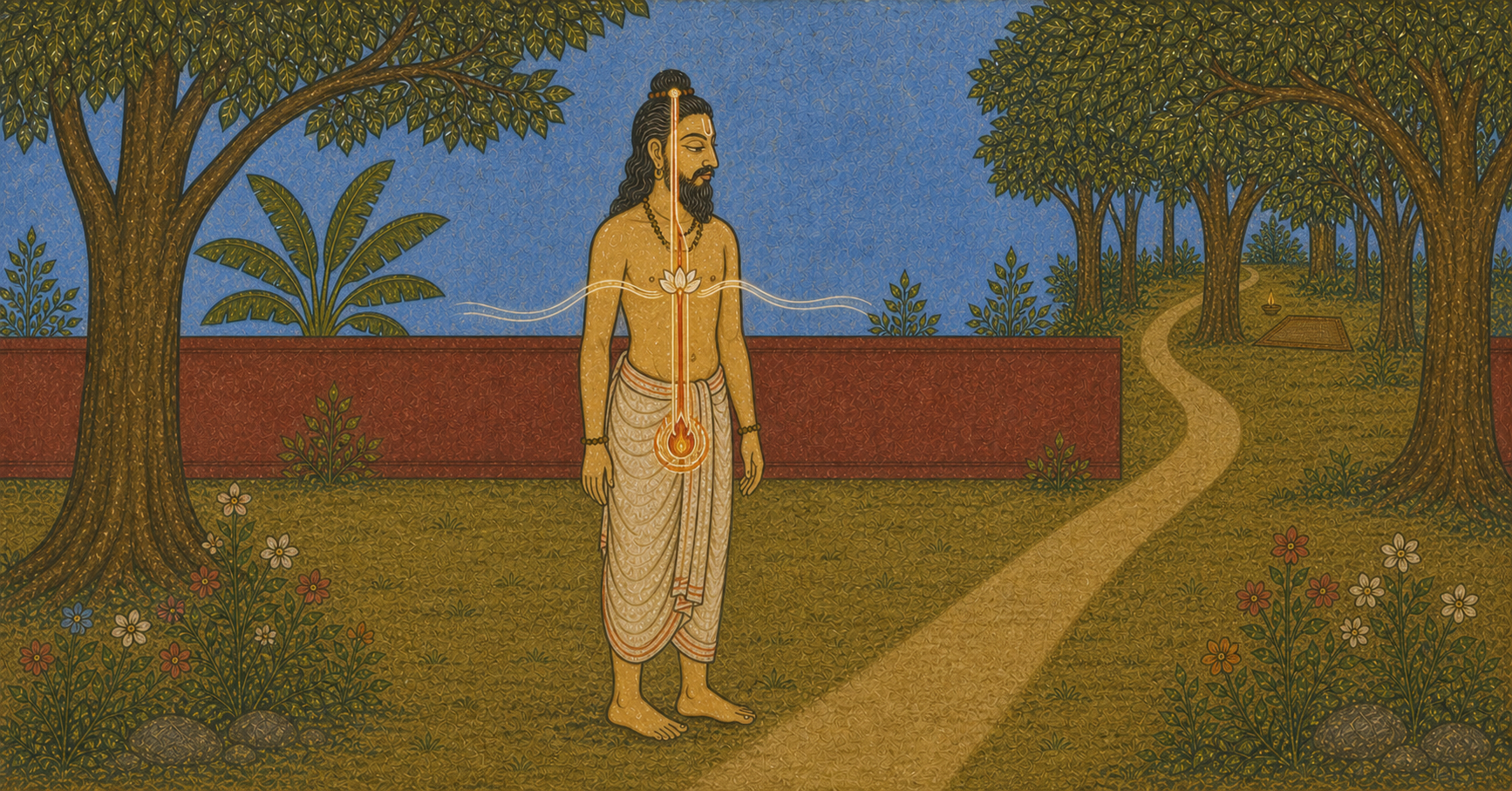
DYS 108–111: Suṣumnā

Dattātreyayogaśāstra 108–111: The Breath Enters the Central Channel

The cultivated breath awakens Kuṇḍalī and enters Suṣumnā together with the mind; knowledge of the three times and careful practice in seclusion follow.

Dr. Ronald Steiner Dr. Ronald Steiner Nils Jacob Liersch Nils Jacob Liersch
Dattātreyayogaśāstra 108
वायुः परिचितो यत्नादग्निना सह कुण्डलीम् |
vāyuḥ paricito yatnād; agninā saha kuṇḍalīm | Analysis ▾ Analysis ▴
vāyuḥ
nominative singular
substantive masculine
breath, wind
paricitaḥ
nominative singular masculine past participle passive
previx
verbal root
accumulated, practised
yatnāt
ablative singular
substantive masculine
carefully
agninā
instrumental case singular
substantive masculine
with fire
saha
particle
together with
kuṇḍalīm
accusative singular
substantive feminine
Kuṇḍalinī
बोधयित्वा सुषुम्नायां प्रविशेदनिरोधतः ||108||
bodhayitvā suṣumnāyāṃ; praviśed anirodhataḥ ||108|| Analysis ▾ Analysis ▴
bodhayitvā
absolutus
verbal root
having awakened
suṣumnāyāṃ
lokative singular
substantive feminine
in Suṣumnā
praviśet
3rd person singular aktive optative
previx
verbal root
should enter
anirodhataḥ
ablative singular
substantive masculine
suffix
without obstruction
Metre: Anuṣṭubh
The breath (vāyuḥ | nom sg), carefully (yatnāt | abl sg) cultivated (paricitaḥ | nom sg), should, after awakening (bodhayitvā | abs) Kuṇḍalinī (kuṇḍalīm | acc sg) together (saha) with fire (agninā | ins sg), enter (praviśet | 3p sg act opt) Suṣumnā (suṣumnāyām | loc sg) without restraint (anirodhataḥ | abl sg).
Dr. Ronald Steiner - 2026 - historically literal
Cultivated with care, the breath awakens Kuṇḍalinī together with the inner fire and enters Suṣumnā without obstruction.
Dr. Ronald Steiner - 2026 - modern transfer
paricito JM2024 ] saṃprerito DYŚ
Critical Apparatus
Dattātreyayogaśāstra 109
वायुना सह चित्तं च प्रविशेच्च महापथम् |
vāyunā saha cittaṃ ca; praviśec ca mahā-patham | Analysis ▾ Analysis ▴
vāyunā
instrumental case singular
substantive masculine
with the breath
saha
particle
together with
cittam
nominative singular
substantive neuter
mind
ca
particle
and
praviśet
3rd person singular aktive optative
previx
verbal root
should enter
ca
particle
also
mahā
karmadhāraya-compound
adjective
great
patham
accusative singular
substantive masculine
pathway
महापथं श्मशानं च सुषुम्नाप्येकमेव हि ||109||
mahā-pathaṃ śmaśānaṃ ca; suṣumnāpy ekam eva hi ||109|| Analysis ▾ Analysis ▴
mahā
karmadhāraya-compound
adjective
great
patham
accusative singular
substantive masculine
pathway
śmaśānam
accusative singular
substantive neuter
cremation ground
ca
particle
and
suṣumnā
nominative singular
substantive feminine
Suṣumnā
api
particle
also
ekam
nominative singular
numeral
one
eva
particle
precisely
hi
particle
indeed
Metre: Anuṣṭubh
Together (saha) with the breath (vāyunā | ins sg), the mind (cittam | nom sg) too (ca) should enter (praviśet | 3p sg act opt) the great channel (mahā-patham | acc sg). The great path (mahā-patham | acc sg), the cremation ground (śmaśānam | acc sg), and (ca) Suṣumnā (suṣumnā | nom sg) too (api) are indeed (hi) just (eva) one (ekam | nom sg).
Dr. Ronald Steiner - 2026 - historically literal
Breath and mind enter the great channel together. “Great Path,” “Cremation Ground,” and “Suṣumnā” are different names for that same inner passage.
Dr. Ronald Steiner - 2026 - modern transfer
vāyunā saha cittaṃ ca praviśec ca mahāpatham JM2024 ] vāyunā saha cittaṃ tu praviśec ca mahāpatham DYŚ
Critical Apparatus
Dattātreyayogaśāstra 110
नाम्ना मतान्तरे भेदः फलभेदो न विद्यते |
nāmnā matāntare bhedaḥ; phala-bhedo na vidyate | Analysis ▾ Analysis ▴
nāmnā
instrumental case singular
substantive neuter
by name
mata
karmadhāraya-compound
substantive neuter
teachings, opinions
antare
lokative singular neuter
adjective
in another
bhedaḥ
nominative singular
substantive masculine
difference
phala
tatpuruṣa-compound genitive
substantive neuter
result
bhedaḥ
nominative singular
substantive masculine
difference
na
particle
not
vidyate
3rd person singular medial present
verbal root
exists
वर्तमानं भविष्यं च भूतार्थं चापि वेत्त्यसौ ||110||
vartamānaṃ bhaviṣyaṃ ca; bhūtārthaṃ cāpi vetty asau ||110|| Analysis ▾ Analysis ▴
vartamānam
accusative singular
substantive neuter
the present
bhaviṣyam
accusative singular
substantive neuter
the future
ca
particle
and
bhūta
karmadhāraya-compound
adjective
past
artham
accusative singular
substantive masculine
matter
ca
particle
and
api
particle
also
vetti
3rd person singular aktive present
verbal root
knows
asau
nominative singular masculine
pronoun
that one
Metre: Anuṣṭubh
By name (nāmnā | ins sg) there is a difference (bhedaḥ | nom sg) in other teachings (matāntare | loc sg), but no (na) difference in result (phala-bhedaḥ | nom sg) is found (vidyate | 3p sg med pres). That person (asau | nom sg) knows (vetti | 3p sg act pres) the present (vartamānam | acc sg), the future (bhaviṣyam | acc sg), and (ca) also (api) the past (bhūtārtham | acc sg).
Dr. Ronald Steiner - 2026 - historically literal
Traditions may use different names, but the result does not change. One who reaches this state knows the present, the future, and the past.
Dr. Ronald Steiner - 2026 - modern transfer
nāmnā matāntare bhedaḥ phalabhedo JM2024 ] nāmnāṃ matāntare bhedaḥ phale bhedo DYŚ
Critical Apparatus
Dattātreyayogaśāstra 111
यस्य चित्तं सपवनं सुषुम्नां प्रविशेदिह |
yasya cittaṃ sa-pavanaṃ; suṣumnāṃ praviśed iha | Analysis ▾ Analysis ▴
yasya
genitive singular masculine
pronoun
whose
cittam
nominative singular
substantive neuter
mind
sa
karmadhāraya-compound
previx
together with
pavanam
accusative singular
substantive masculine
breath
suṣumnām
accusative singular
substantive feminine
Suṣumnā
praviśet
3rd person singular aktive optative
previx
verbal root
should enter
iha
adverb
here
भाव्याननर्थान्विज्ञाय योगी रहसि यत्नतः ||111||
bhāvyān anarthān vijñāya; yogī rahasi yatnataḥ ||111|| Analysis ▾ Analysis ▴
bhāvyān
accusative plural masculine
adjective
future
anarthān
accusative plural
substantive masculine
misfortunes
vijñāya
absolutus
previx
verbal root
having recognised
yogī
nominative singular
substantive masculine
the yogi
rahasi
lokative singular
substantive neuter
in seclusion
yatnataḥ
instrumental case singular
substantive masculine
suffix
carefully
Metre: Anuṣṭubh
The yogi (yogī | nom sg) whose (yasya | gen sg) mind (cittam | nom sg), together with the breath (sa-pavanam | nom sg n), enters (praviśet | 3p sg act opt) Suṣumnā (suṣumnām | acc sg) here (iha), should, after recognising (vijñāya | abs) future misfortunes (bhāvyān anarthān | acc pl), practise carefully (yatnataḥ) in seclusion (rahasi | loc sg).
Dr. Ronald Steiner - 2026 - historically literal
When mind and breath enter Suṣumnā, the yogi recognises what lies ahead and withdraws to a secluded place to practise carefully.
Dr. Ronald Steiner - 2026 - modern transfer
iha | JM2024 ] iha || DYŚ

bhāvyān anarthān JM2024 ] bhāvyānarthān sa DYŚ
Critical Apparatus

Continue with AYI Free

Illustrations: AI-generated.

Editor

Dr. Ronald Steiner

From Ulm

The "Yoga Doc" - Dr. Ronald Steiner is the founder of the AYI method. This method links traditional Ashtanga Yoga with innovative Yogatherapy and living Philosophy. This forms a practice that is personal for each and... more ›

Nils Jacob Liersch

Meine Begeisterung für Yoga, indische Philosophie und Sanskrit führte mich zum Studium der Indologie und Religionswissenschaft an der Universität Heidelberg. Seit 2004 befinde ich mich auf meinem persönlichen Yogaweg... more ›

Messages and ratings
1 messages Ø

Please log in to write a message. Go to login

Vielen Dank für eure wertvolle Arbeit. Besonders die wörtlichen, aufklappbaren , genauen Übersetzungen sind ich so hilfreich!