DYS 20–26: Practising Laya

Dattātreyayogaśāstra 20–26: Simple Ways to Dissolve the Mind

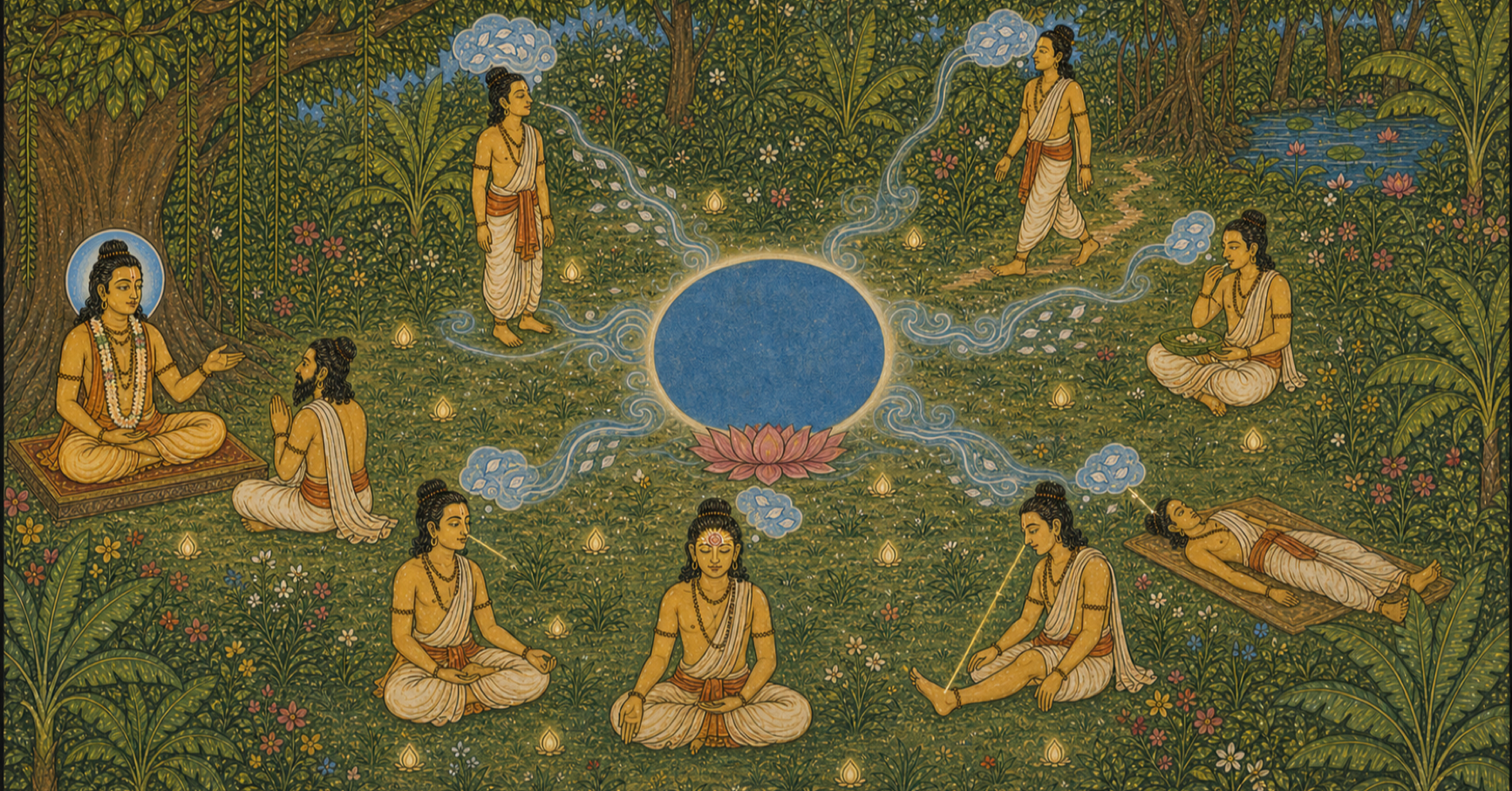
Meditation on emptiness, the nose tip, the back of the head, the brow centre or the big toe, together with relaxed lying down, are presented as accessible Laya methods.

Dr. Ronald Steiner Dr. Ronald Steiner Nils Jacob Liersch Nils Jacob Liersch
Dattātreyayogaśāstra 20
तानि सर्वाणि वक्तुं हि नान्यः शक्नोति तं विना |
tāni sarvāṇi vaktuṃ hi; nānyaḥ śaknoti taṃ vinā | Analysis ▾ Analysis ▴
tāni
accusative plural neuter
pronoun dem
those
sarvāṇi
accusative plural neuter
adjective
all
vaktum
infinitive
verbal root
to teach
hi
particle
indeed
na
particle
not
anyaḥ
nominative singular masculine
adjective
the other
śaknoti
3rd person singular aktive present
verbal root
is able
tam
accusative singular masculine
pronoun dem
him
vinā
adverb
except
कानि चित्कथयिष्यामि सहजाभ्यासवत्सुखम् ||20||
kāni cit kathayiṣyāmi; sahajābhyāsavat sukham ||20|| Analysis ▾ Analysis ▴
kāni
accusative plural neuter
pronoun inter
some
cit
particle
indefinite: some
kathayiśyāmi
1st person singular future
verbal root
I shall explain
sahaja
karmadhāraya-compound
adjective
natural, innate
abhyāsavat
nominative accusative singular neuter
adjective
consisting of practice
sukham
accusative singular neuter
adjective
easy
Metre: Anuṣṭubh
No one other than him (na anyaḥ taṃ vinā) can teach all those [techniques] (tāni sarvāṇi vaktum śaknoti). I shall explain (kathayiṣyāmi) some (kāni cit | acc pl) that consist of natural practices (sahajābhyāsavat) and are easy (sukham).
Dr. Ronald Steiner - 2026 - historically literal
No one but Ādinātha can teach all of them. Dattātreya therefore selects a few methods made up of natural practices that are easy to perform.
Dr. Ronald Steiner - 2026 - modern transfer
nānyaḥ śaknoti taṃ vinā JM2024 ] na śaknomi tu vistarāt DYŚ
Critical Apparatus
Dattātreyayogaśāstra 21
तिष्ठन्गच्छन्स्वपन्भुञ्जन्ध्यायेच्छून्यमहर्निशम् |
tiṣṭhan gacchan svapan bhuñjan; dhyāyec chūnyam ahar niśam | Analysis ▾ Analysis ▴
tiṣṭhan
nominative singular masculine present participle active
verbal root
standing
gacchan
nominative singular masculine present participle active
verbal root
walking
svapan
nominative singular masculine present participle active
verbal root
sleeping
bhuñjan
nominative singular masculine present participle active
verbal root
eating
dhyāyet
3rd person singular aktive optative
verbal root
one should meditate
śūnyam
accusative singular neuter
adjective
on emptiness
ahar
accusative singular
substantive neuter
by day
niśam
accusative singular
substantive feminine
by night
अयमेको हि संकेत आदिनाथेन भाषितः ||21||
ayam eko hi saṃketa; ādināthena bhāṣitaḥ ||21|| Analysis ▾ Analysis ▴
ayam
nominative singular masculine
pronoun
this
ekaḥ
nominative singular masculine
numeral
single
hi
particle
indeed
saṃketaḥ
nominative singular
substantive masculine
technique
ādināthena
instrumental case singular
substantive masculine
by Ādinātha
bhāṣitaḥ
nominative singular masculine past participle passive
verbal root
was spoken, proclaimed
Metre: Anuṣṭubh
Standing (tiṣṭhan | nom sg), walking (gacchan | nom sg), sleeping (svapan | nom sg), and eating (bhuñjan | nom sg), one should meditate (dhyāyet | 3p sg act opt) on emptiness (śūnyam | acc sg) day and night (aharniśam | acc sg). This (ayam | nom sg) is indeed (hi) one (ekaḥ | nom sg) technique (saṃketaḥ | nom sg) proclaimed (bhāṣitaḥ | nom sg) by the First Lord (ādināthena | ins sg).
Dr. Ronald Steiner - 2026 - historically literal
Whether standing, walking, sleeping, or eating, one can meditate on emptiness day and night. This is one of the methods proclaimed by Śiva.
Dr. Ronald Steiner - 2026 - modern transfer
dhyāyec JM2024 ] dhyāyan DYŚ
Critical Apparatus
Dattātreyayogaśāstra 22
नासाग्रदृष्टिमात्रेण अपरः परिकीर्तितः |
nāsāgra-dṛṣṭi-mātreṇa; aparaḥ parikīrtitaḥ | Analysis ▾ Analysis ▴
nāsā
tatpuruṣa-compound genitive
substantive feminine
nose
agra
tatpuruṣa-compound lokative
substantive neuter
at the tip
dṛṣṭi
tatpuruṣa-compound instrumental case
substantive feminine
sight, vision
mātreṇa
instrumental case singular neuter
adjective
merely by
aparaḥ
nominative singular masculine
adjective
another
parikīrtitaḥ
nominative singular masculine past participle passive
previx
verbal root
is proclaimed
शिरःपाश्चात्यभागस्य ध्यानं मृत्युंजयो ऽपरः ||22||
śiraḥ-pāścātya-bhāgasya; dhyānaṃ mṛtyuṃ-jayo 'paraḥ ||22|| Analysis ▾ Analysis ▴
śiras
tatpuruṣa-compound genitive
substantive neuter
of the head
pāścātya
karmadhāraya-compound
adjective
posterior
bhāgasya
genitive singular
substantive masculine
of the part
dhyānam
nominative singular
substantive neuter
meditation
mṛtyum
tatpuruṣa-compound accusative
substantive masculine
death
jayaḥ
nominative singular
substantive masculine
mastery
aparaḥ
nominative singular masculine
adjective
another method
Metre: Anuṣṭubh
Another [method] is proclaimed as consisting merely in gazing at the tip of the nose (nāsāgra-dṛṣṭi-mātreṇa aparaḥ parikīrtitaḥ). Another is meditation on the back part of the head (śiraḥ-pāścātya-bhāgasya dhyānam), which conquers death (mṛtyuṃ-jayaḥ).
Dr. Ronald Steiner - 2026 - historically literal
One method fixes the gaze on the tip of the nose. Another meditates on the back of the head and is said to conquer death.
Dr. Ronald Steiner - 2026 - modern transfer
śiraḥpāścātyabhāgasya dhyānaṃ mṛtyuṃjayo ’paraḥ JM2024 ] śiraḥ paścāc ca bhāgasya dhyānaṃ mṛtyuṃ jayet param DYŚ
Critical Apparatus
Dattātreyayogaśāstra 23
भ्रूमध्यदृष्टिमात्रेण परः संकेत उच्यते |
bhrū-madhya-dṛṣṭi-mātreṇa; paraḥ saṃketa ucyate | Analysis ▾ Analysis ▴
bhrū
tatpuruṣa-compound genitive
substantive feminine
eyebrow
madhya
tatpuruṣa-compound lokative
substantive neuter
in the middle, in the central channel
dṛṣṭi
tatpuruṣa-compound instrumental case
substantive feminine
sight, vision
mātreṇa
instrumental case singular neuter
adjective
merely by
paraḥ
nominative singular masculine
adjective
another
saṃketaḥ
nominative singular
substantive masculine
technique
ucyate
3rd person singular passive present
verbal root
is taught
लीलाविभूतिलेपश्च उत्तमः परिकीर्तितः ||23||
līlā-vibhūti-lepaś ca; uttamaḥ parikīrtitaḥ ||23|| Analysis ▾ Analysis ▴
līlā
karmadhāraya-compound
substantive feminine
†līlā†
vibhūti
tatpuruṣa-compound instrumental case
substantive feminine
ash
lepaḥ
nominative singular
substantive masculine
application, smearing
ca
particle
and
uttamaḥ
nominative singular masculine
adjective
the foremost
parikīrtitaḥ
nominative singular masculine past participle passive
previx
verbal root
is proclaimed
Metre: Anuṣṭubh
Another esoteric technique (paraḥ saṃketaḥ | nom sg) is taught as consisting merely in gazing between the eyebrows (bhrū-madhya-dṛṣṭi-mātreṇa | ins sg). The application of †līl↠ash (līlā-vibhūti-lepaḥ | nom sg) too is proclaimed to be excellent (uttamaḥ parikīrtitaḥ).
Dr. Ronald Steiner - 2026 - historically literal
Another practice directs the gaze between the eyebrows. Applying a special ash whose reading is uncertain in the text is also considered an excellent method.
Dr. Ronald Steiner - 2026 - modern transfer
līlāvibhūtilepaś ca uttamaḥ parikīrtitaḥ JM2024 ] lalāṭe bhrūtale yaś ca uttamaḥ saḥ prakīrtitaḥ DYŚ
Critical Apparatus
Dattātreyayogaśāstra 24
स्वस्य दक्षिणपादस्य अङ्गुष्ठे लय उत्तमः |
svasya dakṣiṇa-pādasya; aṅguṣṭhe laya uttamaḥ | Analysis ▾ Analysis ▴
svasya
genitive singular masculine
adjective
of one’s own
dakṣiṇa
karmadhāraya-compound
adjective
right
pādasya
genitive singular
substantive masculine
foot
aṅguṣṭhe
lokative singular
substantive masculine
on the big toe
layaḥ
nominative singular
substantive masculine
dissolution of mind
uttamaḥ
nominative singular masculine
adjective
excellent
उत्तानशववद्भूमौ शयनं चोत्तमोत्तमः ||24||
uttāna-śavavad bhūmau; śayanaṃ cottamottamaḥ ||24|| Analysis ▾ Analysis ▴
uttāna
karmadhāraya-compound
adjective
supine
śavavat
adverb
like a corpse
bhūmau
lokative singular
substantive feminine
on the ground
śayanam
nominative singular
substantive neuter
lying
ca
particle
and
uttama
tatpuruṣa-compound genitive
adjective
highest
uttamaḥ
nominative singular masculine
adjective
the highest, best
Metre: Anuṣṭubh
An excellent dissolution [of mind] (laya uttamaḥ | nom sg) takes place in the big toe of one’s own right foot (svasya dakṣiṇa-pādasya aṅguṣṭhe | loc sg). Lying on the ground like a corpse on its back (uttāna-śavavad bhūmau śayanam | nom sg) is the very best (uttamottamaḥ).
Dr. Ronald Steiner - 2026 - historically literal
The mind can be dissolved in the big toe of one’s own right foot. Even more highly praised is lying relaxed on the ground like a corpse on its back.
Dr. Ronald Steiner - 2026 - modern transfer
svasya dakṣiṇapādasya aṅguṣṭhe laya uttamaḥ JM2024 ] savyadakṣiṇapādasya aṅguṣṭhe layam uttamam DYŚ
Critical Apparatus
Dattātreyayogaśāstra 25
शिथिलो निर्जने देशे कुर्याच्चेत्सिद्धिमाप्नुयात् |
śithilo nirjane deśe; kuryāc cet siddhim āpnuyāt | Analysis ▾ Analysis ▴
śithilaḥ
nominative singular masculine
adjective
relaxed
nirjane
lokative singular masculine
adjective
in a solitary
deśe
lokative singular
substantive masculine
place
kuryāt
3rd person singular aktive optative
verbal root
one should do
cet
particle
if
siddhim
accusative singular
substantive feminine
accomplishment
āpnuyāt
3rd person singular aktive optative
verbal root
one would attain
एवं च बहुसंकेतान्कथयामास शङ्करः ||25||
evaṃ ca bahu-saṃketān; kathayām āsa śaṅkaraḥ ||25|| Analysis ▾ Analysis ▴
evam
adverb
thus
ca
particle
and
bahu
karmadhāraya-compound
adjective
many
saṃketān
accusative plural
substantive masculine
methods
kathayām
word formation
verbal root
related
āsa
3rd person singular aktive perfekte
verbal root
did
śaṅkaraḥ
nominative singular
substantive masculine
Śaṅkara
Metre: Anuṣṭubh
If (cet) one were to perform [this] (kuryāt | 3p sg act opt), relaxed (śithilaḥ | nom sg), in a solitary place (nirjane deśe | loc sg), one would attain (āpnuyāt | 3p sg act opt) accomplishment (siddhim | acc sg). Thus (evam) Śaṅkara (śaṅkaraḥ | nom sg) related (kathayām āsa | 3p sg act perf) many techniques (bahu-saṃketān | acc pl).
Dr. Ronald Steiner - 2026 - historically literal
Those who perform such exercises in a relaxed way in a solitary place can attain accomplishment. In this manner Śaṅkara taught many methods of inner dissolution.
Dr. Ronald Steiner - 2026 - modern transfer
kuryāc JM2024 ] kuryāt DYŚ
Critical Apparatus
Dattātreyayogaśāstra 26
संकेतैर्बहुभिश्चान्यैर्यश्चित्तस्य लयो भवेत् |
saṃketair bahubhiś cānyair; yaś cittasya layo bhavet | Analysis ▾ Analysis ▴
saṃketaiḥ
instrumental case plural
substantive masculine
through techniques
bahubhiḥ
instrumental case plural masculine
adjective
through many
ca
particle
and
anyaiḥ
instrumental case plural masculine
adjective
other
yaḥ
nominative singular masculine
pronoun rel
by which
cittasya
genitive singular
substantive neuter
of the mind
layaḥ
nominative singular
substantive masculine
dissolution
bhavet
3rd person singular aktive optative
verbal root
may arise
स एव लययोगः स्याधठयोगमतः शृणु ||26||
sa eva laya-yogaḥ syād; haṭha-yogam ataḥ śṛṇu ||26|| Analysis ▾ Analysis ▴
saḥ
nominative singular masculine
pronoun
that
eva
particle
precisely
laya
tatpuruṣa-compound genitive
substantive masculine
of dissolution
yogaḥ
nominative singular
substantive masculine
yoga
syāt
3rd person singular aktive optative
verbal root
would be
haṭha
tatpuruṣa-compound genitive
substantive masculine
Haṭha
yogam
accusative singular
substantive masculine
yoga
ataḥ
adverb
now; therefore
śṛṇu
2nd person singular aktive imperative
verbal root
hear
Metre: Anuṣṭubh
The dissolution of mind (cittasya layaḥ | nom sg) that arises through [these and] many other techniques (saṃketair bahubhiś cānyaiḥ | ins pl) is precisely Layayoga (sa eva laya-yogaḥ syāt). Now hear Haṭhayoga (haṭha-yogam ataḥ śṛṇu).
Dr. Ronald Steiner - 2026 - historically literal
When the mind dissolves through such methods, this is called Layayoga. Haṭhayoga comes next.
Dr. Ronald Steiner - 2026 - modern transfer
yaś cittasya layo JM2024 ] yasya cittalayo DYŚ
Critical Apparatus

Continue with AYI Free

Illustrations: AI-generated.

Editor

Dr. Ronald Steiner

From Ulm

The "Yoga Doc" - Dr. Ronald Steiner is the founder of the AYI method. This method links traditional Ashtanga Yoga with innovative Yogatherapy and living Philosophy. This forms a practice that is personal for each and... more ›

Nils Jacob Liersch

Meine Begeisterung für Yoga, indische Philosophie und Sanskrit führte mich zum Studium der Indologie und Religionswissenschaft an der Universität Heidelberg. Seit 2004 befinde ich mich auf meinem persönlichen Yogaweg... more ›

Messages and ratings
0 messages

Please log in to write a message. Go to login

No messages yet.