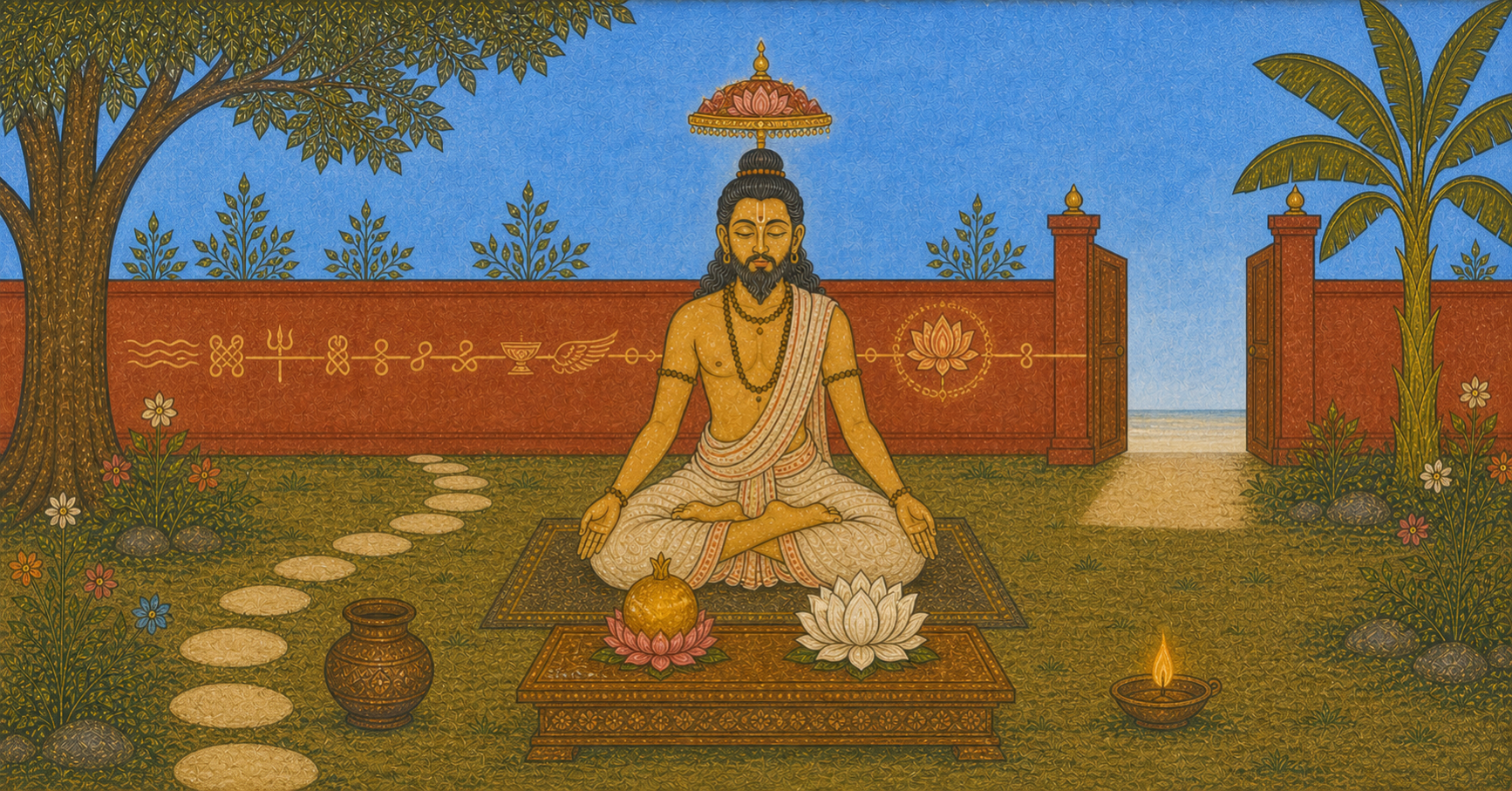
DYS 184–187: Rāja Yoga and Perfection

Dattātreyayogaśāstra 184–187: From Sustained Practice to Niṣpatti

One reaches Rāja Yoga by practising the taught methods at the proper time, not through knowledge alone, and gains freedom of action; from this arises the Niṣpatti stage, which bestows enjoyment and liberation.

Dr. Ronald Steiner Dr. Ronald Steiner Nils Jacob Liersch Nils Jacob Liersch
Dattātreyayogaśāstra 184
एतैः सर्वैस्तु कथितैरभ्यसेत्कालकालतः |
etaiḥ sarvais tu kathitair; abhyaset kāla-kālataḥ | Analysis ▾ Analysis ▴
etaiḥ
instrumental case plural masculine
pronoun dem
with these
sarvaiḥ
instrumental case plural masculine
pronoun quant
all
tu
particle
now
kathitaiḥ
instrumental case plural masculine past participle passive
verbal root
taught
abhyaset
3rd person singular aktive optative
verbal root
one should practise
kāla
karmadhāraya-compound
substantive masculine
appropriate
kālatas
adverb
at the proper time
ततो भवेद्राजयोगो नान्तरा भवति ध्रुवम् ||184||
tato bhaved rāja-yogo; nāntarā bhavati dhruvam ||184|| Analysis ▾ Analysis ▴
tatas
adverb
from that
bhavet
3rd person singular aktive optative
verbal root
would arise
rāja
tatpuruṣa-compound genitive
substantive masculine
Royal
yogaḥ
nominative singular
substantive masculine
Yoga
na
particle
not
antarā
adverb
otherwise
bhavati
3rd person singular aktive present
verbal root
arises
dhruvam
adverb
certainly
Metre: Anuṣṭubh
[The yogi] should practise (abhyaset | 3p sg act opt) with all these taught [methods] (etaiḥ sarvaiḥ kathitaiḥ | ins pl m), each at its proper time (kāla-kālataḥ). From that (tataḥ) Royal Yoga (rāja-yogaḥ | nom sg) would arise (bhavet | 3p sg act opt); it certainly (dhruvam) does not (na) arise (bhavati | 3p sg act pres) otherwise (antarā).
Dr. Ronald Steiner - 2026 - historically literal
Each of the techniques should be practised at the appropriate time. Only from their proper use, the text insists, does Royal Yoga arise.
Dr. Ronald Steiner - 2026 - modern transfer
kālakālataḥ | JM2024 ] kālakālataḥ || DYŚ

dhruvam || JM2024 ] dhruvam | DYŚ
Critical Apparatus
Dattātreyayogaśāstra 185
न दिङ्मात्रेण सिद्धिः स्यादभ्यासेनैव जायते |
na diṅ-mātreṇa siddhiḥ syād; abhyāsenaiva jāyate | Analysis ▾ Analysis ▴
na
particle
not
diś
tatpuruṣa-compound genitive
substantive feminine
an indication, a hint
mātreṇa
instrumental case singular
substantive neuter
merely by
siddhiḥ
nominative singular
substantive feminine
success
syāt
3rd person singular aktive optative
verbal root
would arise
abhyāsena
instrumental case singular
substantive masculine
through practice
eva
particle
alone
jāyate
3rd person singular medial present
verbal root
arises
राजयोगपदं प्राप्य सर्वसत्त्ववशंकरम् ||185||
rāja-yoga-padaṃ prāpya; sarva-sattva-vaśaṃ-karam ||185|| Analysis ▾ Analysis ▴
rāja
tatpuruṣa-compound genitive
substantive masculine
Royal
yoga
tatpuruṣa-compound genitive
substantive masculine
Yoga
padam
accusative singular
substantive neuter
the level
prāpya
absolutus
previx
verbal root
having reached
sarva
karmadhāraya-compound
adjective
all
sattva
tatpuruṣa-compound accusative
substantive neuter
beings
vaśam
tatpuruṣa-compound accusative
substantive masculine
under control
karam
accusative singular neuter
adjective
bringing
Metre: Anuṣṭubh
Success (siddhiḥ | nom sg) would not (na) arise (syāt | 3p sg act opt) through a mere hint (diṅ-mātreṇa | ins sg); it arises (jāyate | 3p sg med pres) only (eva) through practice (abhyāsena | ins sg). Having reached (prāpya | abs) the level of Royal Yoga (rāja-yoga-padam | acc sg), which brings all beings under his control (sarva-sattva-vaśaṃ-karam | acc sg n),
Dr. Ronald Steiner - 2026 - historically literal
A mere hint cannot bring success; repeated practice is essential. On reaching Royal Yoga, the yogi gains mastery over all beings.
Dr. Ronald Steiner - 2026 - modern transfer
jāyate | JM2024 ] jāyate || DYŚ

rājayogapadaṃ JM2024 ] rājayogaṃ varaṃ DYŚ

sarvasattvavaśaṃkaram || JM2024 ] sarvasattvavaśaṃkaram | DYŚ
Critical Apparatus
Dattātreyayogaśāstra 186
सर्वं कुर्यान्न वा कुर्याद्यथारुचि विचेष्टितम् |
sarvaṃ kuryān na vā kuryād; yathā-ruci viceṣṭitam | Analysis ▾ Analysis ▴
sarvam
accusative singular neuter
pronoun quant
anything
kuryāt
3rd person singular aktive optative
verbal root
may do
na
particle
not
vā
particle
or
kuryāt
3rd person singular aktive optative
verbal root
may do
yathā
avyayībhāva-compund
adverb
according to
ruci
substantive feminine
liking
viceṣṭitam
accusative singular neuter past participle passive
previx
verbal root
behaving
यदा तु राजयोगेन निष्पन्ना योगिनः क्रिया ||186||
yadā tu rāja-yogena; niṣpannā yoginaḥ kriyā ||186|| Analysis ▾ Analysis ▴
yadā
adverb
when
tu
particle
now
rāja
tatpuruṣa-compound genitive
substantive masculine
Royal
yogena
instrumental case singular
substantive masculine
through Yoga
niṣpannā
nominative singular feminine past participle passive
previx
verbal root
perfected
yoginaḥ
genitive singular
substantive masculine
of the yogin
kriyā
nominative singular
substantive feminine
activity
Metre: Anuṣṭubh
he may do (kuryāt | 3p sg act opt) anything (sarvam | acc sg n) or (vā) not (na) do it (kuryāt | 3p sg act opt), behaving as he pleases (yathā-ruci viceṣṭitam | acc sg n). When (yadā) the yogi’s activity (yoginaḥ kriyā | nom sg) has been perfected (niṣpannā | nom sg f) through Royal Yoga (rāja-yogena | ins sg),
Dr. Ronald Steiner - 2026 - historically literal
Such a yogi is free to act or refrain from acting and to live as he chooses. In Royal Yoga, all his activity reaches completion.
Dr. Ronald Steiner - 2026 - modern transfer
yathāruci viceṣṭitam JM2024 ] yathāruciviceṣṭitam DYŚ

viceṣṭitam | JM2024 ] yathāruciviceṣṭitam || DYŚ

yadā tu rājayogena JM2024 ] yathāntarā ca yogena DYŚ
Critical Apparatus
Dattātreyayogaśāstra 187
तदावस्था हि निष्पत्तिर्भुक्तिमुक्तिप्रदा भवेत् |
tadāvasthā hi niṣpattir; bhukti-mukti-pradā bhavet | Analysis ▾ Analysis ▴
tadā
adverb
then
avasthā
nominative singular
substantive feminine
the stage
hi
particle
indeed
niṣpattiḥ
nominative singular
substantive feminine
perfection
bhukti
dvandva-compound
substantive feminine
enjoyment
mukti
tatpuruṣa-compound dative
substantive feminine
liberation
pradā
nominative singular feminine
adjective
bestowing
bhavet
3rd person singular aktive optative
verbal root
would arise
सर्वं ते कथितं ब्रह्मन्सांकृते योगमाचर ||187||
sarvaṃ te kathitaṃ brahman; sāṃkṛte yogam ācara ||187|| Analysis ▾ Analysis ▴
sarvam
nominative singular neuter
pronoun quant
everything
te
dative singular
pronoun pers 2p
to you
kathitam
nominative singular neuter past participle passive
verbal root
taught
brahman
vokative singular
substantive masculine
O Brahmin
sāṃkṛte
vokative singular
substantive masculine
O Sāṃkṛti
yogam
accusative singular
substantive masculine
yoga
ācara
2nd person singular aktive imperative
previx
verbal root
practise
Metre: Anuṣṭubh
then (tadā) the perfection stage (avasthā hi niṣpattiḥ | nom sg) arises (bhavet | 3p sg act opt), bestowing enjoyment and liberation (bhukti-mukti-pradā | nom sg f). Everything (sarvam | nom sg n) has been explained (kathitam | nom sg n ppp) to you (te | dat sg), O Brahmin (brahman | voc sg). Sāṃkṛti (sāṃkṛte | voc sg), practise (ācara | 2p sg act imp) yoga (yogam | acc sg)!”
Dr. Ronald Steiner - 2026 - historically literal
The stage of Niṣpatti then arises, bestowing enjoyment and liberation. Dattātreya closes his instruction and tells Sāṃkṛti to practise yoga.
Dr. Ronald Steiner - 2026 - modern transfer
bhuktimuktipradā bhavet JM2024 ] bhuktimuktiphalapradā DYŚ

bhavet | JM2024 ] bhuktimuktiphalapradā || DYŚ

ācara || JM2024 ] ācara | DYŚ
Critical Apparatus

Continue with AYI Free

Illustrations: AI-generated.

Editor

Dr. Ronald Steiner

From Ulm

The "Yoga Doc" - Dr. Ronald Steiner is the founder of the AYI method. This method links traditional Ashtanga Yoga with innovative Yogatherapy and living Philosophy. This forms a practice that is personal for each and... more ›

Nils Jacob Liersch

Meine Begeisterung für Yoga, indische Philosophie und Sanskrit führte mich zum Studium der Indologie und Religionswissenschaft an der Universität Heidelberg. Seit 2004 befinde ich mich auf meinem persönlichen Yogaweg... more ›

Messages and ratings
0 messages

Please log in to write a message. Go to login

No messages yet.