

sūrya सूर्य – Sonne
Adjektiv · Substantiv Maskulin · Worttyp nicht bestimmt
Wörterbuchquellen
AYI Wörterbuch Substantiv Maskulin
Sonne
Cappeller 1891 Substantiv Maskulin
Originaltext · Englisch · Substantiv Maskulin
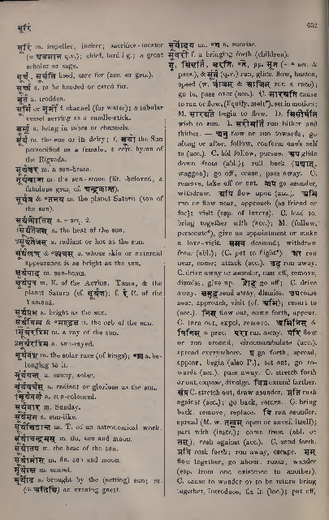
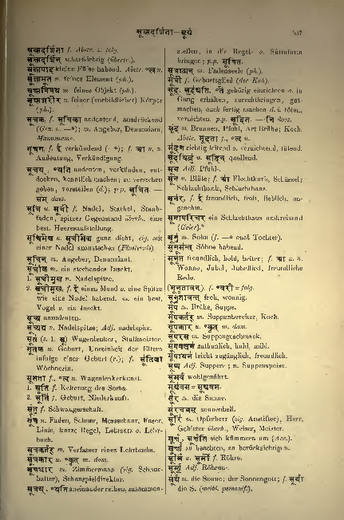
sū́rya ·m. the sun or its deity; f. sūryā́ the Sun personified as a female, a cert. hymn of the Rigveda.
Monier-Williams 1872 Substantiv Maskulin · Worttyp nicht bestimmt
Originaltext · Englisch · Substantiv Maskulin
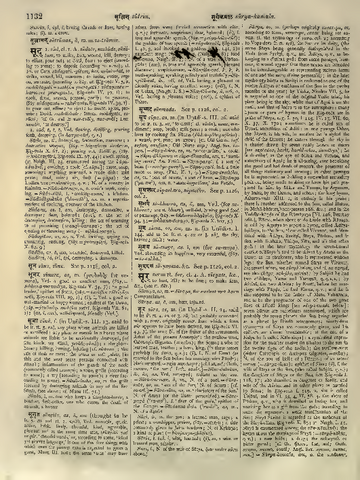
Sūrya, as, m. (perhaps originally suvar-ya, or according to some, savar-ya, savar being for sa- van, cf. the etymology of sūra, col. 2; according to Vopa-deva fr. rt. sṛ), the Sun or its deity, (the name Sūrya being generally distinguished in the Veda from Savitṛ, q. v., and Āditya, q. v., as be- longing to a distinct god; from some passages, how- ever, it would appear that these names are intended to be interchangeable as representing various forms of one and the same divine personality; in the later mythology Sūrya as Savitṛ is reckoned as one of the twelve Ādityas or emblems of the Sun in the twelve months of the year; by Yāska, Nirukta VII. 5, he is regarded as one of the original Vedic triad, his place being in the sky, while that of Agni is on the earth, and that of Indra is in the atmosphere; many hymns or parts of hymns in the Ṛg-veda are in praise of Sūrya, e. g. I. 50, I. 115, IV. 13, VII. 60, X. 37, X. 170; sometimes he is called son of Dyaus, sometimes of Aditi; in one passage Uṣas, the Dawn, is his wife, in another he is styled the child of the Dawns; he moves through the sky in a chariot drawn by seven ruddy horses or mares [see saptāśva, harit, harid-aśva, śundhyu]; he is described as the eye of Mitra and Varuṇa, and sometimes of Agni; he is all-seeing, ever beholding the good and bad deeds of mortals, the preserver of all things stationary and moving; in other passages he is represented as holding a somewhat secondary position, being made to shine or have his path pre- pared for him by Mitra and Varuṇa, by Aryaman, by Indra, by the Dawns, and others; the long hymn, Atharva-veda XIII. 2, is entirely in his praise; there is another addressed to the Sun, called Bhānu, in Mahā-bhārata, Vana-parvan 166, &c.; and in the Yuddha-kāṇḍa of the Rāmāyaṇa [VI. 106, Bombay edit.], Rāma, when about to do battle with Rāvaṇa, is told by Agastya to repeat a hymn, called Āditya- hṛdaya, to the Sun, there called Vivasvat, and iden- tified with Āditya, Savitṛ, Sūrya, Pūṣan, and in fact with Brahmā, Viṣṇu, Śiva, and all the other gods; in the later mythology the seven-horsed chariot of Sūrya is said to be driven by Aruṇa or the Dawn as its charioteer, who is represented without legs; the Sun, whether named Sūrya or Vivasvat, has several wives, see sūryā below, and cf. sa-varṇā, see also chāyā, sañ-jñā, aśvinī; by Sañjñā he had two children, Yama and Yamunā, q. q. v. v.; by Aśvinī, the two Aśvins; by Kuntī, before her mar- riage with Pāṇḍu, he had Karṇa, q. v.; and he is also supposed to be the father of Manu Vaivasvata, and to be the progenitor of one of the two great lines of Hindū kings [see sūrya-vaṃśa below]; seven Sūryas are sometimes mentioned, which are probably the seven planets, the Sun being regarded as a planet by Hindū astronomers; ninety-four synonyms of Sūrya are commonly given, and his epithets are almost innumerable; at the end of a Kalpa he is called Kāla-sūrya); a symbolical expres- sion for the number twelve (in allusion to the sun in the twelve signs of the zodiac); the swallow-wort (either Calotropis or Asclepias Gigantea, = arka); N. of the son of Bali; of a Dānava; of an astro- nomer (= sūrya-dāsa); epithet of Śiva; (ā), f. the wife of Sūrya or the Sun, (also called Sañjñā, q. v.); the daughter of Sūrya or the Sun, (see Ṛg-veda I. 116, 17; also described as daughter of Savitṛ and wife of the Aśvins, and in other places as married to Soma; in Ṛg-veda I. 119, 2. she is called Ūrjānī, and in VI. 55, 4, VI. 58, 4. the sister of Pūṣan, q. v., who is described as loving her, and receiving her as a gift from the gods; according to some she represents a weak manifestation of the Sun; Sūryā Sāvitrī is regarded as the authoress of the Sūryā-sūkta, Ṛg-veda X. 85; in Naigh. I. 11. Sūryā is enumerated among the vāṅ-nāmāni); the hymn about the marriage of Sūryā (= sūryā-sūkta, q. v.); a new bride; a drug; the colocynth or bitter gourd; [cf. Gr. ἥλιος; Lat. sol; Goth. sunna, sunno, sanil; Angl. Sax. sunna, sunne, sun.]
Originaltext · Englisch · Worttyp nicht bestimmt
sūrya sūrya. See p. 1132, col. 3.
Petersburger 1855 Adjektiv · Substantiv Maskulin
Originaltext · Deutsch · Adjektiv · Substantiv Maskulin
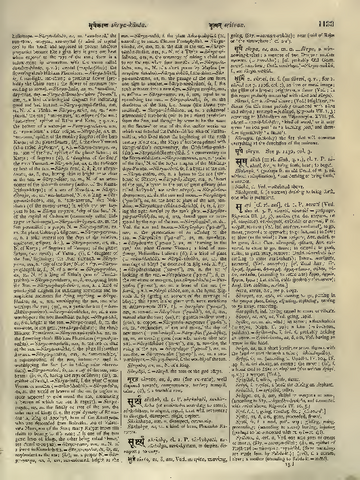
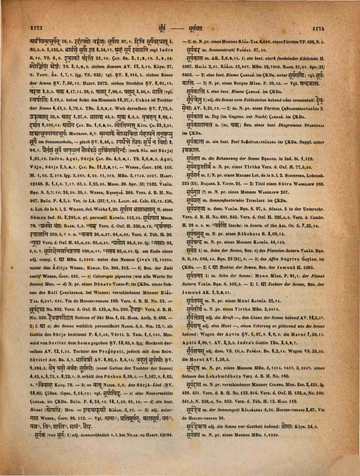
sū́rya (von svar) P. 3,1,114. VOP. 26,20. 1〉 m. a〉 = sūra die Sonne (auch persönlich gedacht) NAIGH. 5,6. NIR. 12,14. KĀŚ._zu_P. 5,4,30. AK. 1,1,2,29. H. 95. MED. y. 62. HALĀY. 1,35. HALĀY. 5,53. ā sūryò bṛha̱tastìṣṭha̱dajrā̀n ṚV. 4,1,17. utsūryo̱ jyotìṣā de̱va èti ṚV. 4,13,1. fgg. ṚV. 7,60,1. fgg. ṚV. 7,63,1. fgg. indra̱ḥ sūryàmarocayat ṚV. 8,3,6. vi ra̱śmibhìḥ sasṛje̱ sūryo̱ gāḥ ṚV. 7,36,1. ṚV. 7,81,2. (uṣasaḥ) ajī̀jana̱tsūryàm ṚV. 7,78,3. radàtpa̱tho varùṇa̱ḥ sūryā̀ya ṚV. 7,87,1. di̱vi sūryàmadadhāt ṚV. 5,85,2. ṚV. 5,85,5. ṚV. 1,125,6. bhrājànte̱ sūryā̀ iva ṚV. 8,34,17. a̱haṃ sūryà ivājani sagt Indra ṚV. 8,6,10. VS. 8,9. e̱kā̱kī càrati VS. 23,10. ŚAT. BR. 2,1,2,19. ŚAT. BR. 2,3,1,33. jyotìṣā̱ṃ śreṣṭhàḥ TS. 3,1,1,2. sieben Sonnen AV. 13,3,10. KĀṬH. 37,9. TAITT. ĀR. 1,7,1. fgg. VS. 632; vgl. ṚV. 9,114,3. sieben Rosse der Sonne ṚV. 7,66,15. HARIV. 2472. sieben Strahlen ṚV. 8,61,16. caraṇa ṚV. 3,5,5. cakra ṚV. 4,17,14. ṚV. 4,28,2. cakṣas ṚV. 7,98,6. cakṣus ṚV. 5,40,8. sāti (vgl. svarṣāti) ṚV. 2,19,4. heisst Sohn des Himmels ṚV. 10,37,1. Uṣas ist Tochter der Sonne ṚV. 4,43,2. ṚV. 5,79,8. TBR. 2,6,1,2. Weib derselben ṚV. 7,75,5. urucakṣas ṚV. 7,35,8. ajara ṚV. 5,27,6. saptāśva ṚV. 5,45,9. śukra ṚV. 6,4,3. vṛtrahan ṚV. 8,82,4. darśata ṚV. 9,101,12. āgneya ŚAT. BR. 1,6,3,24. jyotiṣmant KĀTY. ŚR. 25,3,21. śaśvatsūyamānātsūryaḥ MAITRYUP. 6,7. a̱smākàṃ bodhyavi̱tā màhādha̱ne ta̱nūṣva̱psu sūryè im Sonnenschein, — gluth ṚV. 6,46,4. spardhànte̱ dhiya̱ḥ sūrye̱ na viśàḥ ṚV. 9,94,1. praitàśa̱ṃ sūryè paspṛdhā̱naṃ sauvàśvye̱ suṣvìmāva̱dindràḥ (nach SĀY. mit Sūrya) ṚV. 1,61,15. Indra, Agni, Sūrya ŚAT. BR. 4,5,4,1. TS. 6,6,8,3. Agni, Vāyu, Sūrya TS. 3,5,4,1. ŚAT. BR. 11,2,3,11. -- WEBER, JYOT. 106. WEBER, JYOT. 110. M. 1,65. fgg. M. 2,219. M. 3,280. fgg. M. 4,52. fgg. M. 11,219. MBH. 3,1749. MBH. 3,2827. HARIV. 12148. R. 1,1,6. R. 1,7,17. R. 1,63,2. R. 5,25,26. MEGH. 39. Spr. (II) 7162. VARĀH. BṚH. S. 5,7. VARĀH. BṚH. S. 5,10. VARĀH. BṚH. S. 24,30. VARĀH. BṚH. S. 30,1. WEBER, KṚṢṆAJ. 264. Verz. d. B. H. No. 947. BHĀG. P. 4,5,3. VET. in LA. (III) 1,12. LALIT. ed. Calc. 43,18. LALIT. ed. Calc. 136,2. Lot. de la b. l. 2. WILSON, Sel. Works 1,20. sūryasya bhrājābhrājam N. eines Sāman Ind. St. 3,245,a. pl. personif. KATHĀS. 115,58. sūryāpāya MEGH. 78. ˚prabhavo vaṃśaḥ RAGH. 1,2. ˚cāra Verz. d. Oxf. H. 330,a,13. ˚darśanacāraphalāni Verz. d. Oxf. H. 329,b,7 v. u. ˚kavaca Verz. d. Oxf. H. 26,a,37. Verz. d. Oxf. H. 94,a,35. Verz. d. Tüb. H. 20. ˚pūjā Verz. d. Oxf. H. 45,a,22. Verz. d. Oxf. H. 85,a,41. ˚prayoga Verz. d. Oxf. H. 94,b,20. fg. ˚mantrāḥ Verz. d. Oxf. H. 93,b,6. Verz. d. Oxf. H. 93,b,7. sūryādimantranirūpaṇa Verz. d. Oxf. H. 100,a,11. ˚stava Verz. d. Oxf. H. 85,a,40. fg. am Ende eines adj. comp. f. ā MBH. 1,2269. unter den Namen Śivaʼs MBH. 12,10360. unter den Āditya WEBER, RĀMAT. UP. 304. WEBER, RĀMAT. UP. 313. — b〉 Bez. der Zahl zwölf WEBER, JYOT. 101. — c〉 Calotropis gigantea (wie alle Worte für Sonne) MED. — d〉 N. pr. eines Dānava VAHNI-P._im_ŚKDR. eines Sohnes des Bali ŚABDĀRTHAK._bei_WILSON; verschiedener Männer RĀJA-TAR. 8,347. RĀJA-TAR. 8,651. Vie de HIOUEN-THSANG 189. Verz. d. B. H. No. 53. = sūryadāsa Verz. d. B. H. No. 832. Verz. d. Oxf. H. 132,a, No. 240. daivajña˚ Verz. d. B. H. No. 539. daivajñapaṇḍita Notices of Skt Mss. 1,42. HAEB. Anth. S. 468. — 2〉 f. ā a〉 die Sonne weiblich personificirt NAIGH. 5,6. NIR. 12,7. als Gattin des Sūrya bestimmt P. 4,1,48, Vārtt. 2. TRIK. 1,1,101. MED. wird von Savitar dem Soma gegeben ṚV. 10,85,9. fgg. Hochzeit derselben AV. 12,1,24. Tochter des Prajāpati, jedoch mit dem Beiw. Sāvitrī AIT. BR. 4,7. sāvitrī AV. 6,82,2. AV. 9,4,14. va̱ha̱tuṃ sū̱ryāyā̀ḥ ṚV. 1,184,3. yena̱ patī̱ bhavàthaḥ sū̱ryāyā̀ḥ (sonst Gatten der Tochter der Sonne) ṚV. 4,43,6. ṚV. 5,73,5. ṚV. 8,22,1. S. erhält den Pūṣan ṚV. 6,58,4. -- ṚV. 1,167,5. ṚV. 6,63,6. ˚vivāha KAUŚ. 79. — b〉 = vāc NAIGH. 1,6. das Sūryā — Lied ? (ṚV. 10,85) ŚĀṄKH. GṚHY. 1,14,12; vgl. sūryāvid. — c〉 eine Neuvermählte ŚABDAR._im_ŚKDR. BHĀG. P. 4,24,12. BHĀG. P. 10,1,29. BHĀG. P. 10,61,40. — d〉 ein best. Kraut (oṣadhi) MED. = indravāruṇī RĀJAN. 3,57. — 3〉 adj. solar: māsa WEBER, JYOT. 88. WEBER, JYOT. 112. — Vgl. nānā˚, pratisūryam, bālasūrya, yama˚, vajra˚, vi˚, śāli˚, sāyaṃ˚, saura.
Böhtlingk 1879 Adjektiv · Substantiv Maskulin
Originaltext · Deutsch · Adjektiv · Substantiv Maskulin
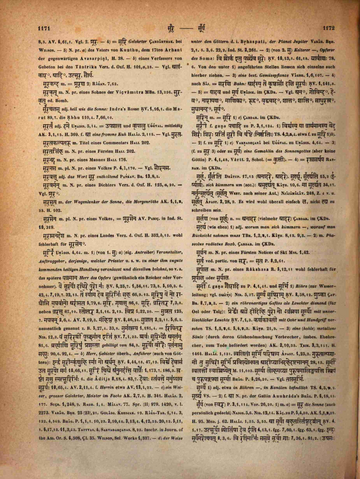
sū́rya, sū́riā — 1〉 m. — a〉 die Sonne, der Sonnengott. Loc. im Sonnenschein, in der Sonnengluth. Auch Pl. am Ende eines adj. Comp. f. ā. Wird auch auf Śiva übertragen. — b〉 ein Āditya und Bez. eines best. Āditya. — c〉 Bez. der Zahl zwölf HEMĀDRI 1,137,4. — d〉 Calotropis gigantea. — e〉 N. pr. — α〉 eines Dānava. — β〉 eines Sohnes des Bali. — γ〉 verschiedener Männer — 2〉 f. sūryā sūriā́ — a〉 die Sonne weiblich personificirt. — b〉 das Sūrya Lied ṚV. 10,85 = vāc NIGH. — c〉 eine Neuvermählte. — d〉 Koloquinthengurke. — 3〉 Adj. solar; richtiger. saurya.
Apte 1890 Substantiv Maskulin
Originaltext · Englisch · Substantiv Maskulin
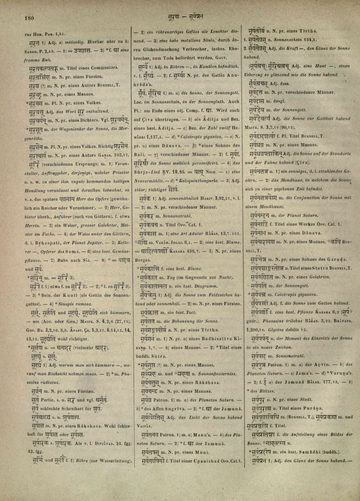
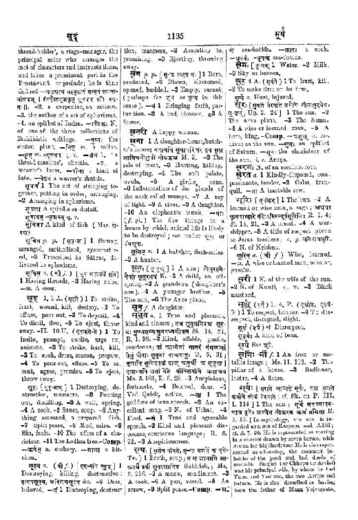
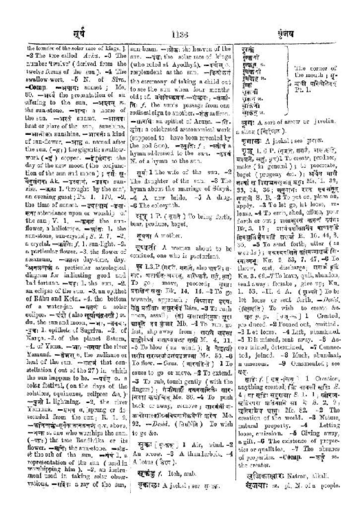
sūryaḥ [sarati ākāśe sūryaḥ, yadvā suvati karmaṇi lokaṃ prerayati; cf. Sk. on P. III. 1. 114] 1 The sun; sūrye tapatyāvaraṇāya ṭṭaṣṭeḥ kalpeta lokasya kathaṃ tamisrā R. 5. 13. [In mythology, the sun is regarded as a son of Kaśyapa and Aditi; cf. Ś. 7. 20. He is represented as moving in a chariot drawn by seven horses, with Aruṇa for his charioteer. He is also represented as all-seeing, the constant beholder of the good and bad deeds of mortals. Saṃjñā (or Chāyā or Aśvinī) was his principal wife, by whom he had Yama and Yamunā, the two Aśvins and Saturn. He is also described as having been the father of Manu Vaivasvata, ([Page 1136-a]) the founder of the solar race of kings,]. 2 The tree called Arka. 3 The number ‘twelve’ (derived from the twelve forms of the sun). 4 The swallow-wort. 5 N. of Śiva. Comp. — apāyaḥ sunset; Me. 80. — ardhyaṃ the presentation of an offering to the sun. — aśman m. the sun-stone. — aśvaḥ a horse of the sun. — astaṃ sunset. — ātapaḥ heat or glare of the sun, sunshine. — ālokaḥ sunshine. — āvartaḥ a kind of sun-flower. — āhva a. named after the sun. — (hvaḥ) the gigantic swallowwort. — (hvaṃ) copper. — iṃdusaṃgamaḥ the day of the new moon (the conjunction of the sun and moon); darśaḥ sūryeṃdusaṃgamaḥ Ak. — utthānaṃ, -udayaḥ sunrise. — ūḍhaḥ 1 ‘brought by the sun’, an evening guest; Pt. 1. 170. 2 the time of sunset. — upasthānaṃ — upāsanā attendance upon or worship of the sun; V. 1. — kamalaṃ the sunflower, a heliotrope. — kāṃtaḥ 1 the sun-stone, sun-crystal; Ś. 2. 7. 2 a crystal. — kāṃtiḥ f. 1 sun-light. 2 a particular flower. 3 the flower of sesamum. — kālaḥ day-time, day. ˚analacakraṃ a particular astrological diagram for indicating good and bad fortune. — grahaḥ 1 the sun. 2 an eclipse of the sun. 3 an epithet of Rāhu and Ketu. 4 the bottom of a water-jar. — grahaṇaṃ a solar eclipse. — caṃdrau (also sūryācaṃdramasau) m. du. the sun and moon. — jaḥ, -tanayaḥ, — putraḥ 1 epithets of Sugrīva. 2 of Karṇa. 3 of the planet Saturn. 4 of Yama. — jā, -tanayā the river Yamunā. — tejas n. the radiance or heat of the sun. — nakṣatraṃ that constellation (out of the 27) in which the sun happens to be. — parvan n. a solar festival, (on the days of the solstices, equinoxes, eclipses &c.). — putrī 1 lightning. 2 the river Yamunā. — prabhava a. sprung or descended from the sun; R. 1. 2. — phaṇicakraṃ = sūryakālānalacakraṃ q. v. above. — bhakta a. one who worships the sun. — (ktaḥ) the tree Bandhūka or its flower. — maṇiḥ the sun-stone. — maṃḍalaṃ the orb of the sun. — yaṃtraṃ 1 a representation of the sun (used in worshipping him). 2 an instrument used in taking solar observations, — raśmiḥ a ray of the sun, ([Page 1136-b]) sun beam. — lokaḥ the heaven of the sun. — vaṃśaḥ the solar race of kings (who ruled at Ayodhyā). — varcas a. resplendent as the sun. — vilokanaṃ the ceremony of taking a child out to see the sun when four months old; cf. uṃpaniṣkramaṇaṃ. — saṃkramaḥ, — saṃkrāṃtiḥ f. the sun's passage from one zodiacal sign to another. — saṃjñaṃ saffron. — sārathiḥ an epithet of Aruṇa. — siddhāṃtaḥ a celebrated astronomical work (supposed to have been revealed by the god Sun). — stutiḥ f., — stotraṃ a hymn addressed to the sun. — hṛdayaṃ N. of a hymn to the sun.
Cappeller 1887 Substantiv Maskulin
Originaltext · Deutsch · Substantiv Maskulin
sū́rya m. die Sonne; der Sonnengott; f. suryā die S. (weibl. personif.).
Burnouf 1866 Substantiv Maskulin
Originaltext · Französisch · Substantiv Maskulin
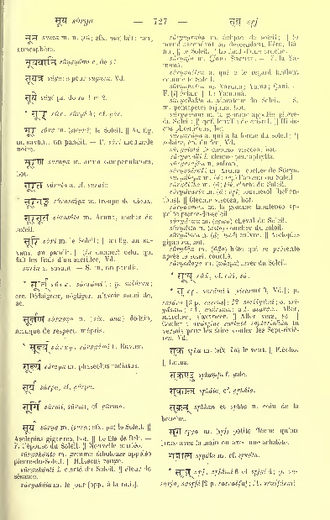
sūrya sūrya m. (sūra; sfx. ya) le Soleil. Asclepias gigantea, bot. Le fils de Bali. — F. l'épouse du Soleil. Nouvelle mariée. sūryakānta m. gemme fabuleuse appelée pierre-du-Soleil. Hibiscus rouge. sūryakānti f. clarté du Soleil. Fleur de sésame. sūryakāla m. le jour [opp. à la nuit]. [Page727-2] sūryagraha m. éclipse de soleil; le nœud ascendant ou descendant, Ketu, Rāhu; le Soleil. Le fond d'une cruche. sūryaja m. (jan) Sugrīva. — F. la Yamunā. sūryanetra a. qui a le regard brillant comme le Soleil. sūryaputra m. Varuṇa; Yama; Śani. — F. [ī] éclair. La Yamunā. sūryabhakta a. adorateur du Soleil. — S. m. pentapetes arjuna, bot. sūryamaṇi m. la gemme appelée pierredu Soleil; qqf. lentille de cristal. Hibiscus phœniceus, bot. sūryarūpa a. qui a la forme du soleil; solaire, ép. du feu, Vd. sūryalatā f. cleome viscosa, bot. sūryavallī f. cleome pentaphylla. sūryasajña n. safran. sūryasārathi m. Aruṇa, cocher de Sūrya. sūryātapa m. (ā; tap) l'ardeur du Soleil. sūryāloka m. (ā; lok) clarté du Soleil. sūryāvarta m. (ā; vṛt) tournesol [helianthus]. Cleome viscosa, bot. sūryāśman m. la gemme fabuleuse appelée pierre-du-soleil. sūryāśva m. (aśva) cheval du Soleil. sūryāsta n. (asta) coucher du Soleil. sūryāhva n. (ā; hve) cuivre. Asclepias gigantea, bot. sūryoḍha m. (ūḍha) hôte qui se présente après le soleil couché. sūryodaya m. (udaya) lever du Soleil.
Quelltextfundstellen (51)
AsSu 2 Fundstellen
GoS 4 Fundstellen
HP 17 Fundstellen
HP 2.7-2.10: Nāḍīśodhana 3 Fundstellen
Direkt belegt
Weitere 6 Quelltextseiten
HP 4.11*5-4.11*14: Khecarī im Raum 2 Fundstellen
Direkt belegt
-
HP 4.11*9 Segment 2
-
HP 4.11*14 Segment 2
HTK 9 Fundstellen
HTK 10.5*1–6*1: Sūryabhedana / Sūryabheda 3 Fundstellen
Direkt belegt
-
HTK 10.5*1 Segment 2
-
HTK 10.6 Segment 37
-
HTK 10.6*1 Segment 12
HTK 10.26–29*1: Cakra, Śaṅkha, Vāmāvartta, Vartmagati und Gadā 2 Fundstellen
Direkt belegt
HTK 10.30–33*1: Nāḍī-viśudhy-ākhyaka-kumbha und Nāḍīśuddhi 1 Fundstelle
Direkt belegt
-
HTK 10.31 Segment 3
IVU 1 Fundstelle
PYS 1 Fundstelle
SiSa 15 Fundstellen
SiSa 2.6-2.12: Mond und Sonne 3 Fundstellen
Direkt belegt
Weitere 5 Quelltextseiten
SiSa 5.132-5.143: Innere Vārāṇasī 2 Fundstellen
Direkt belegt
-
SiSa 5.140 Segment 16
-
SiSa 5.141 Segment 2
SVU 1 Fundstelle
VBT 1 Fundstelle
Mit AYI Free weitermachen
Bildquelle: AYI Archiv.