DYS 137: Khecarī
DYS 137: Khecarī

Dattātreyayogaśāstra 137: Turning Tongue and Gaze Inward

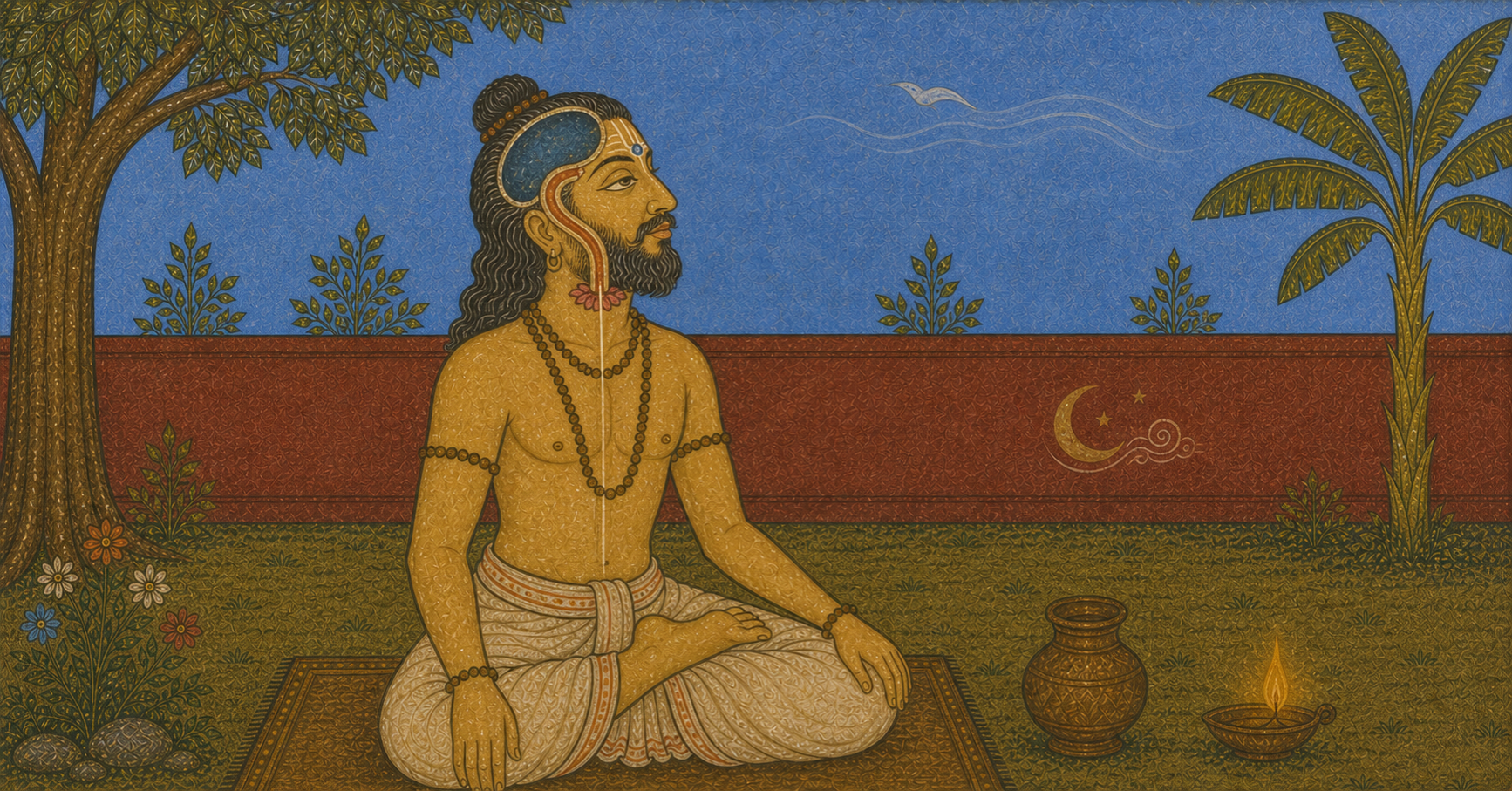
For Khecarī, the tongue is turned back and inserted into the cavity of the skull while the gaze rests at the midpoint between the eyebrows.

Dr. Ronald Steiner Dr. Ronald Steiner Nils Jacob Liersch Nils Jacob Liersch
Dattātreyayogaśāstra 137
अन्तःकपालविवरे जिह्वां व्यावृत्य चार्पयेत् |
antaḥ-kapāla-vivare; jihvāṃ vyāvṛtya cārpayet | Analysis ▾ Analysis ▴
antaḥ
karmadhāraya-compound
adverb
inside
kapāla
tatpuruṣa-compound genitive
substantive masculine
of the skull
vivare
lokative singular
substantive neuter
in the cavity
jihvām
accusative singular
substantive feminine
the tongue
vyāvṛtya
absolutus
previx
previx
verbal root
having turned back
ca
particle
and
arpayet
3rd person singular aktive optative
verbal root
should insert
भ्रूमध्यदृष्टिरप्येषा मुद्रा भवति खेचरी ||137||
bhrū-madhya-dṛṣṭir apy eṣā; mudrā bhavati khecarī ||137|| Analysis ▾ Analysis ▴
bhrū
tatpuruṣa-compound genitive
substantive feminine
eyebrow
madhya
tatpuruṣa-compound lokative
substantive masculine
midpoint
dṛṣṭiḥ
nominative singular
substantive feminine
gaze
api
particle
also
eṣā
nominative singular feminine
pronoun dem
this
mudrā
nominative singular
substantive feminine
seal
bhavati
3rd person singular aktive present
verbal root
becomes
khecarī
nominative singular
substantive feminine
Khecarī
Metre: Anuṣṭubh
Within the cavity of the skull (antaḥ-kapāla-vivare | loc sg), having turned back (vyāvṛtya | abs) the tongue (jihvām | acc sg), he should insert it (cārpayet | 3p sg act opt). This (eṣā | nom sg f) gaze at the midpoint of the eyebrows (bhrū-madhya-dṛṣṭiḥ | nom sg) is (bhavati | 3p sg act pres) the seal (mudrā | nom sg) Khecarī (khecarī | nom sg).
Dr. Ronald Steiner - 2026 - historically literal
Khecarī Mudrā is formed by turning the tongue back into the cavity of the skull while resting the gaze between the eyebrows.
Dr. Ronald Steiner - 2026 - modern transfer
antaḥkapālavivare jihvāṃ vyāvṛtya cārpayet JM2024 ] antaḥ kapālakuhare jihvāṃ vyāvarttya bandhayet DYŚ
Critical Apparatus

Continue with AYI Free

Illustrations: AI-generated.

Editor

Dr. Ronald Steiner

From Ulm

The "Yoga Doc" - Dr. Ronald Steiner is the founder of the AYI method. This method links traditional Ashtanga Yoga with innovative Yogatherapy and living Philosophy. This forms a practice that is personal for each and... more ›

Nils Jacob Liersch

Meine Begeisterung für Yoga, indische Philosophie und Sanskrit führte mich zum Studium der Indologie und Religionswissenschaft an der Universität Heidelberg. Seit 2004 befinde ich mich auf meinem persönlichen Yogaweg... more ›

Messages and ratings
1 messages Ø

Please log in to write a message. Go to login

Wow! Ich habe Khecarīmudrā durch Zufall entdeckt, als ich es namentlich noch gar nicht kannte. In den Kumbhakas bei Pranayama ist mir aufgefallen, dass die geistigen Bewegungen schlagartig abnahmen, als sich mir bei nach unten gesunkenem Kopf die Zunge automatisch einrollte und sich der Blick (innerlich) nach oben führte . Erst auf weitere Recherche hin fand ich die Erklärung für dieses Mudra. Bei starker Versenkung entsteht dieses Mudra also automatisch! Eine meiner stärksten Erfahrungen!