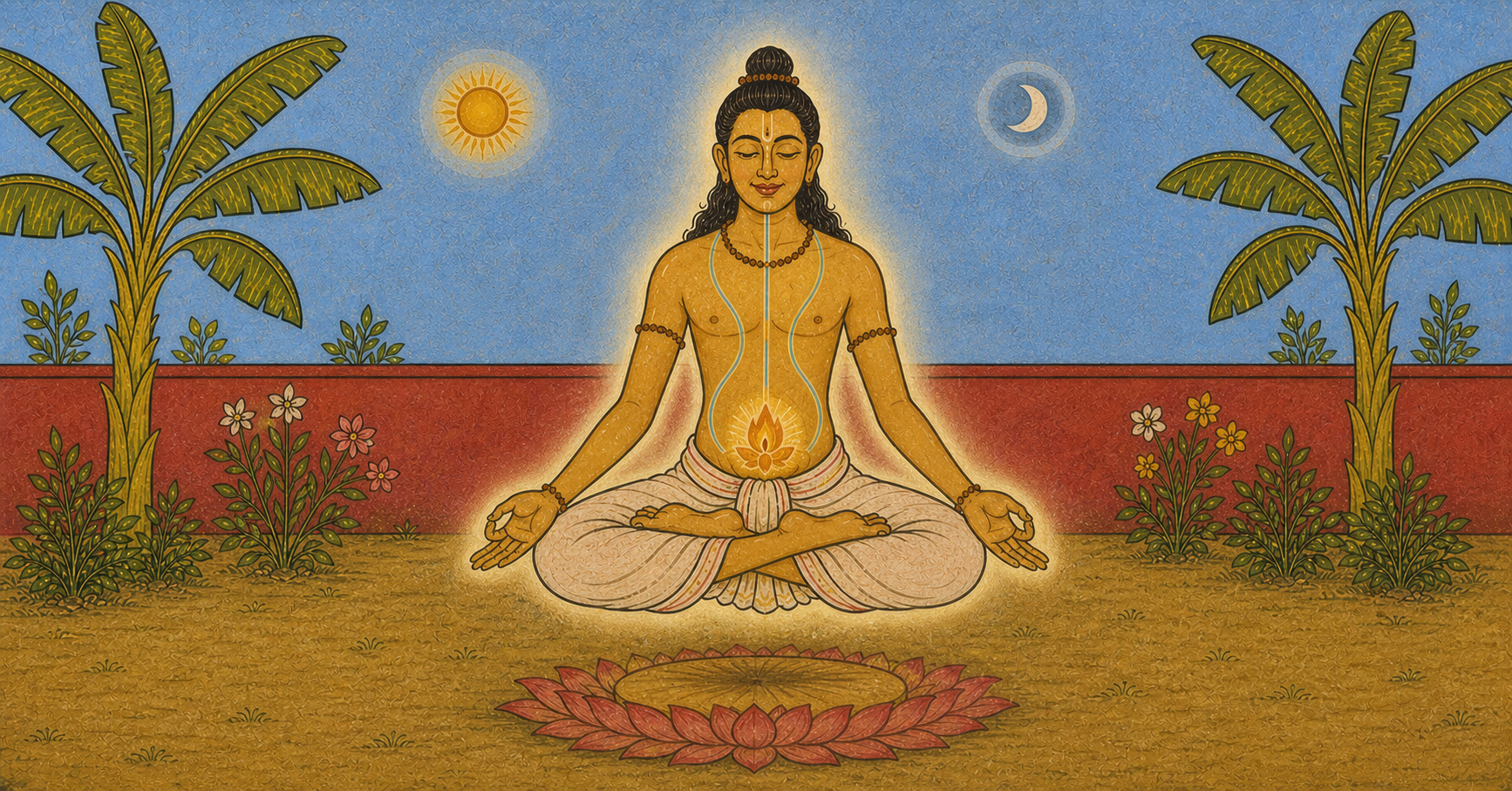
DYS 67–68: Fruits of Prāṇāyāma

Dattātreyayogaśāstra 67–68: Bodily Signs of Purified Breath Channels

After three months the breath channels are said to be purified. Their perceptible signs are lightness of the body, radiance, and strengthened digestive fire.

Dr. Ronald Steiner Dr. Ronald Steiner Nils Jacob Liersch Nils Jacob Liersch
Dattātreyayogaśāstra 67
एवं मासत्रयं कुर्यान्नाडीशुद्धिस्ततो भवेत् |
evaṃ māsa-trayaṃ kuryān; nāḍī-śuddhis tato bhavet | Analysis ▾ Analysis ▴
evam
adverb
thus
māsa
tatpuruṣa-compound genitive
substantive masculine
month
trayam
accusative singular
numeral
three
kuryāt
3rd person singular aktive optative
verbal root
should perform
nāḍī
tatpuruṣa-compound genitive
substantive feminine
channel
śuddhiḥ
nominative singular
substantive feminine
purification
tataḥ
adverb
then
bhavet
3rd person singular aktive optative
verbal root
becomes
यदा तु नाडीशुद्धिः स्यात्तदा चिह्नानि बाह्यतः ||67||
yadā tu nāḍī-śuddhiḥ syāt; tadā cihnāni bāhyataḥ ||67|| Analysis ▾ Analysis ▴
yadā
adverb
when
tu
particle
but
nāḍī
tatpuruṣa-compound genitive
substantive feminine
channel
śuddhiḥ
nominative singular
substantive feminine
purification
syāt
3rd person singular aktive optative
verbal root
would be
tadā
adverb
then
cihnāni
nominative plural
substantive neuter
signs, characteristics
bāhyataḥ
adverb
perceptibly, outwardly
Metre: Anuṣṭubh
If he practises (kuryāt | 3p sg act opt) in this way (evam) for three months (māsatrayam | acc sg), purification of the channels (nāḍīśuddhiḥ | nom sg) should arise (bhavet | 3p sg act opt) thereafter (tataḥ). When (yadā) purification of the channels (nāḍīśuddhiḥ | nom sg) has occurred (syāt | 3p sg act opt), perceptible signs (cihnāni | nom pl) then (tadā) appear (bāhyataḥ).
Dr. Ronald Steiner - 2026 - historically literal
After three months of such practice, the channels are said to be purified. Perceptible signs then begin to appear.
Dr. Ronald Steiner - 2026 - modern transfer
Dattātreyayogaśāstra 68
जायन्ते योगिनो देहे तानि वक्ष्याम्यशेषतः |
jāyante yogino dehe; tāni vakṣyāmy aśeṣataḥ | Analysis ▾ Analysis ▴
jāyante
3rd person plural medial present
verbal root
arise
yoginaḥ
genitive singular
substantive masculine
for the yogi
dehe
lokative singular
substantive masculine
in the body
tāni
accusative plural neuter
pronoun
those
vakṣyāmi
1st person singular future
verbal root
I shall teach
aśeṣataḥ
adverb
completely, without remainder
शरीरलघुता दीप्तिर्जठराग्निविवर्धनम् ||68||
śarīra-laghutā dīptir; jaṭharāgni-vivardhanam ||68|| Analysis ▾ Analysis ▴
śarīra
tatpuruṣa-compound genitive
substantive neuter
body
laghutā
nominative singular
substantive feminine
lightness, nimbleness
dīptiḥ
nominative singular
substantive feminine
radiance
jaṭhara
tatpuruṣa-compound genitive
substantive neuter
digestive
agni
tatpuruṣa-compound genitive
substantive masculine
fire
vivardhanam
nominative singular
substantive neuter
increase, intensification
Metre: Anuṣṭubh
They arise (jāyante | 3p pl med pres) in the body (dehe | loc sg) of the yogi (yoginaḥ | gen sg); I shall describe (vakṣyāmi | 1p sg fut) them all (tāni | acc pl n) completely (aśeṣataḥ): nimbleness of the body (śarīralaghutā | nom sg), radiance (dīptiḥ | nom sg), and an increase in the digestive fire (jaṭharāgnivivardhanam | nom sg).
Dr. Ronald Steiner - 2026 - historically literal
The yogi’s body becomes light and radiant, and the digestive fire grows stronger.
Dr. Ronald Steiner - 2026 - modern transfer
dīptir JM2024 ] dīptiḥ DYŚ
Critical Apparatus

Continue with AYI Free

Illustrations: AI-generated.

Editor

Dr. Ronald Steiner

From Ulm

The "Yoga Doc" - Dr. Ronald Steiner is the founder of the AYI method. This method links traditional Ashtanga Yoga with innovative Yogatherapy and living Philosophy. This forms a practice that is personal for each and... more ›

Nils Jacob Liersch

Meine Begeisterung für Yoga, indische Philosophie und Sanskrit führte mich zum Studium der Indologie und Religionswissenschaft an der Universität Heidelberg. Seit 2004 befinde ich mich auf meinem persönlichen Yogaweg... more ›

Messages and ratings
7 messages Ø

Please log in to write a message. Go to login

Frage: ist mit der Aussage "Er möge täglich die begleiteten (Kumbhakas) mit Ausatmung und Einatmung durchführen" Atemverhalten nach Ein und Ausatmung gemeint? Also auch in der Atemleere anhalten? Bin ratlos...
Hallo Gunnar,
die Technik wirkt eher harmonisierend, durch die Wechselatmung, die wechselnd die Gehirnhälften aktiviert und miteinander verbindet. Wenn Du tiefer in die physiologischen Wirkungen von Pranayama eintauchen möchtest, empfehle ich Dir das MTC Atem, Pranayama, Psyche.
Viel Freude beim Üben und ein tolles neues Jahr wünscht Dir
Ronald
Danke für die schnelle Antwort, Ronald. Es hilft mir etwas weiter.
Also ist diese Technik eher Energie anregend als beruhigend?
Lieber Gruß, Gunnar
Hallo Gunnar,
wie ich diesen Text verstehe geht es hier nur um das Anhalten in der Fülle. Ein Anhalten in der Leere ist in diesem Text nicht beschrieben.
Ich hoffe das hilft Dir weiter.
Viel Freude beim Üben und erfahren. In meiner Donnerstags-Stunde (mit Dattatreya auf der Yogamatte) wird diese Technik sicher nochmal vorkommen. Du bist herzlich eingeladen.
Namaste und herzliche Grüße
Ronald
Y
Danke für die Erinnerung an diese tolle Technik, jetzt kann Weihnachten kommen!
Es geht doch kaum etwas über eine Wechselatmung mit Atemverhalt nach der Einatmung. Einer meiner absoluten Favoriten!
Meine Lieblings-Atemübung! Sie wirkt wie ein Zauberspruch um den Geist zu klären.