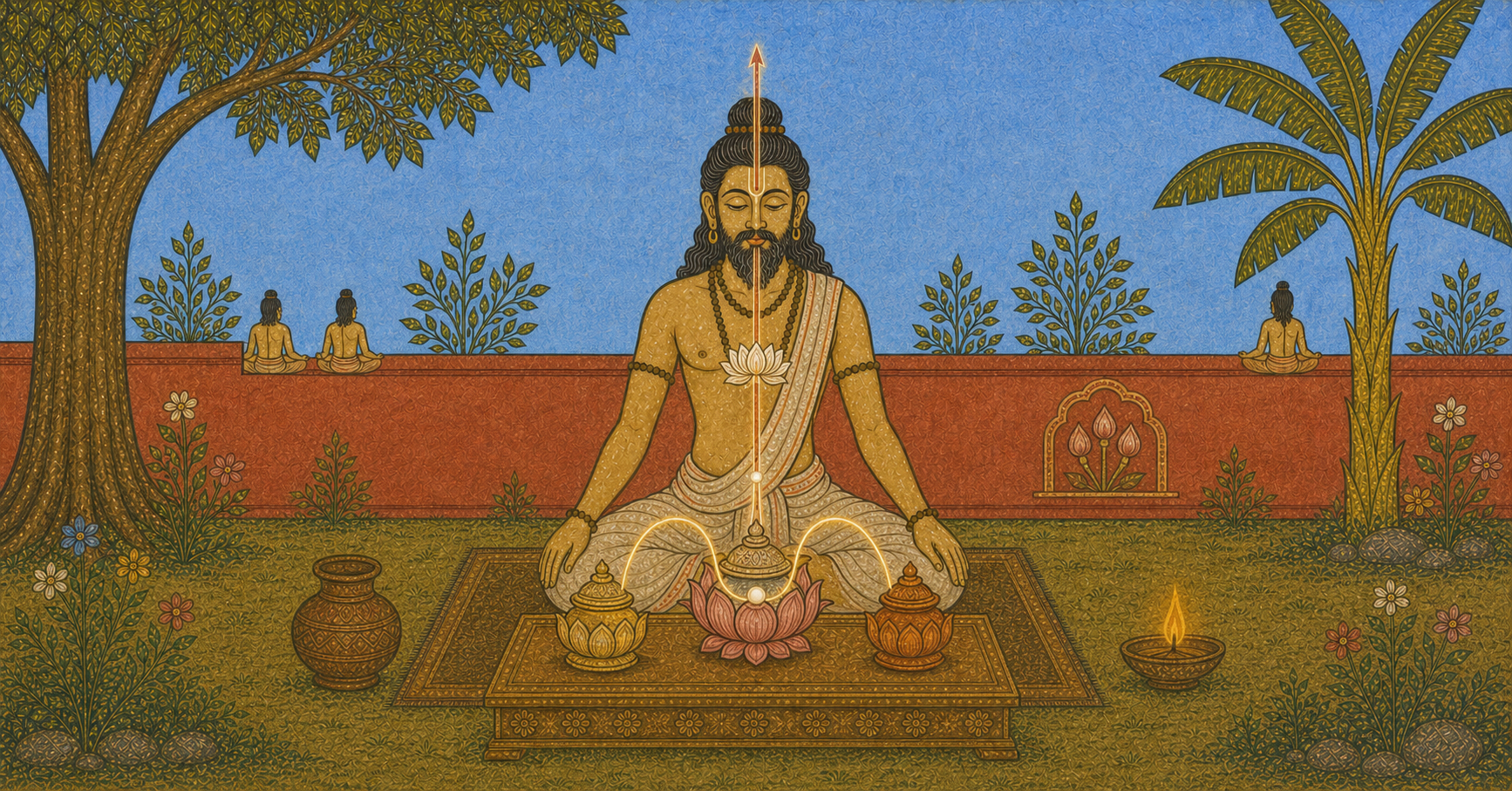
DYS 180–183*1: Amarolī and Sahajolī

Dattātreyayogaśāstra 180–183*1: Two Continuations of Vajrolī Practice

Amarolī involves drinking Amarī, while Sahajolī uses ash and a bodily practice; the DYŚ star passage traces the procedure to the tradition of the Siddhas.

Dr. Ronald Steiner Dr. Ronald Steiner Nils Jacob Liersch Nils Jacob Liersch
Dattātreyayogaśāstra 180
तस्मात्पुण्यवतामेव अयं योगः प्रसिध्यति |
tasmāt puṇyavatām eva; ayaṃ yogaḥ prasidhyati | Analysis ▾ Analysis ▴
tasmāt
ablative singular masculine
pronoun dem
therefore
puṇyavatām
genitive plural masculine
adjective
for the meritorious
eva
particle
only
ayam
nominative singular masculine
pronoun dem
this
yogaḥ
nominative singular
substantive masculine
yoga
prasidhyati
3rd person singular aktive present
previx
verbal root
succeeds
अमरीं यः पिबेन्नित्यं नस्यं कुर्वन्दिने दिने ||180||
amarīṃ yaḥ piben nityaṃ; nasyaṃ kurvan dine dine ||180|| Analysis ▾ Analysis ▴
amarīm
accusative singular
substantive feminine
Amarī, urine
yaḥ
nominative singular masculine
pronoun rel
whoever
pibet
3rd person singular aktive optative
verbal root
should drink
nityam
adverb
regularly
nasyam
accusative singular
substantive neuter
nasal application
kurvan
nominative singular masculine present participle active
verbal root
performing
dine
lokative singular
substantive neuter
day
dine
lokative singular
substantive neuter
by day
Metre: Anuṣṭubh
Therefore (tasmāt), this yoga (ayaṃ yogaḥ | nom sg) succeeds (prasidhyati | 3p sg act pres) only (eva) for the meritorious (puṇyavatām | gen pl m). Whoever (yaḥ | nom sg m) should regularly (nityam) drink (pibet | 3p sg act opt) Amarī, that is, urine (amarīm | acc sg), while performing (kurvan | nom sg m pca) a nasal application (nasyam | acc sg) day after day (dine dine | loc sg),
Dr. Ronald Steiner - 2026 - historically literal
This yoga is said to succeed only for the meritorious. The Amarolī practitioner regularly drinks urine and also applies it through the nose each day.
Dr. Ronald Steiner - 2026 - modern transfer
tasmāt puṇyavatām eva ayaṃ yogaḥ prasidhyati JM2024 ] om. DYŚ

amarīṃ yaḥ piben nityaṃ nasyaṃ kurvan dine dine JM2024 ] om. DYŚ
Critical Apparatus
Dattātreyayogaśāstra 181
वज्रोलीमभ्यसेच्चैवममरोलीति कथ्यते |
vajrolīm abhyasec caivam; amarolīti kathyate | Analysis ▾ Analysis ▴
vajrolīm
accusative singular
substantive feminine
Vajrolī
abhyaset
3rd person singular aktive optative
verbal root
should practise
ca
particle
and
evam
adverb
in this way
amarolī
nominative singular
substantive feminine
Amarolī
iti
particle
thus
kathyate
3rd person singular passive present
verbal root
is called
पूर्वोक्तजीर्णवस्त्रं तु प्रक्षिपेच्च मिते जले ||181||
pūrvokta-jīrṇa-vastraṃ tu; prakṣipec ca mite jale ||181|| Analysis ▾ Analysis ▴
pūrva
karmadhāraya-compound
adjective
previously
ukta
karmadhāraya-compound past participle passive
verbal root
mentioned
jīrṇa
karmadhāraya-compound past participle passive
verbal root
worn
vastram
accusative singular
substantive neuter
cloth
tu
particle
now
prakṣipet
3rd person singular aktive optative
previx
verbal root
he should put
ca
particle
and
mite
lokative singular neuter past participle passive
verbal root
in a little
jale
lokative singular
substantive neuter
water
Metre: Anuṣṭubh
and (ca) practises (abhyaset | 3p sg act opt) Vajrolī (vajrolīm | acc sg) in this way (evam), [his practice] is called Amarolī (amarolīti kathyate | 3p sg pas pres). He should now (tu) put (prakṣipet | 3p sg act opt) the previously mentioned old cloth (pūrvokta-jīrṇa-vastram | acc sg) in a little water (mite jale | loc sg).
Dr. Ronald Steiner - 2026 - historically literal
When combined with Vajrolī, this practice is called Amarolī. The cloth previously used to collect bodily fluids is placed in a little water.
Dr. Ronald Steiner - 2026 - modern transfer
vajrolīm abhyasec caivam amarolīti kathyate JM2024 ] om. DYŚ

pūrvoktajīrṇavastraṃ tu prakṣipec ca mite jale JM2024 ] om. DYŚ
Critical Apparatus
Dattātreyayogaśāstra 182
तज्जले भस्म संक्षिप्य दग्धगोमयसंभवम् |
taj-jale bhasma saṃkṣipya; dagdha-go-maya-saṃbhavam | Analysis ▾ Analysis ▴
tat
karmadhāraya-compound
pronoun dem
that
jale
lokative singular
substantive neuter
in the water
bhasma
accusative singular
substantive neuter
ash
saṃkṣipya
absolutus
previx
verbal root
having thrown in
dagdha
karmadhāraya-compound past participle passive
verbal root
burnt
go
tatpuruṣa-compound genitive
substantive feminine
cow
maya
tatpuruṣa-compound genitive
substantive neuter
dung
saṃbhavam
accusative singular neuter
adjective
produced from
वज्रोलीमैथुनादूर्ध्वं स्त्रीपुंसोरङ्गलेपनम् ||182||
vajrolī-maithunād ūrdhvaṃ; strī-puṃsor aṅga-lepanam ||182|| Analysis ▾ Analysis ▴
vajrolī
tatpuruṣa-compound genitive
substantive feminine
Vajrolī
maithunāt
ablative singular
substantive neuter
intercourse
ūrdhvam
adverb
after
strī
dvandva-compound
substantive feminine
of the woman
puṃsoḥ
genitive dual
substantive masculine
and the man
aṅga
tatpuruṣa-compound genitive
substantive neuter
of the limbs
lepanam
nominative singular
substantive neuter
rubbing
Metre: Anuṣṭubh
Having thrown (saṃkṣipya | abs) into that water (taj-jale | loc sg) ash (bhasma | acc sg) made from burnt cow dung (dagdha-gomaya-saṃbhavam | acc sg n), [one performs] after Vajrolī intercourse (vajrolī-maithunāt | abl sg) the rubbing (aṅga-lepanam | nom sg) of the limbs of the woman and the man (strī-puṃsoḥ | gen du).
Dr. Ronald Steiner - 2026 - historically literal
Ash made from burnt cow dung is added to the water. After Vajrolī intercourse, the woman and man rub this mixture over their bodies.
Dr. Ronald Steiner - 2026 - modern transfer
tajjale bhasma saṃkṣipya dagdhagomayasaṃbhavam JM2024 ] om. DYŚ

vajrolīmaithunād ūrdhvaṃ strīpuṃsor aṅgalepanam JM2024 ] om. DYŚ
Critical Apparatus
Dattātreyayogaśāstra 183
आसीनयोः सुखेनैव मुक्तव्यापरयोः क्षणम् |
āsīnayoḥ sukhenaiva; mukta-vyāparayoḥ kṣaṇam | Analysis ▾ Analysis ▴
āsīnayoḥ
genitive dual masculine past participle passive
verbal root
of the two seated
sukhena
instrumental case singular
substantive neuter
at ease
eva
particle
indeed
mukta
karmadhāraya-compound past participle passive
verbal root
completed
vyāpārayoḥ
genitive dual
substantive masculine
activity
kṣaṇam
accusative singular
substantive masculine
for a moment
सहजोली च संप्रोक्ता श्रद्धेया योगिभिः सदा ||183||
sahajolī ca saṃproktā; śraddheyā yogibhiḥ sadā ||183|| Analysis ▾ Analysis ▴
sahajolī
nominative singular
substantive feminine
Sahajolī
ca
particle
and
saṃproktā
nominative singular feminine past participle passive
previx
previx
verbal root
called
śraddheyā
nominative singular feminine future participle passive
verbal root
to be trusted
yogibhiḥ
instrumental case plural
substantive masculine
by yogins
sadā
adverb
always
Metre: Anuṣṭubh
[The rubbing is performed] while both are sitting (āsīnayoḥ | gen du m), entirely at ease (sukhenaiva | ins sg), their activity having ended (mukta-vyāpārayoḥ | gen du) a moment before (kṣaṇam | acc sg). This is called (saṃproktā | nom sg f ppp) Sahajolī (sahajolī | nom sg), and (ca) yogis (yogibhiḥ | ins pl) should always (sadā) put their trust in it (śraddheyā | nom sg f pfp).
Dr. Ronald Steiner - 2026 - historically literal
They sit at ease immediately after their sexual activity has ended. This practice is called Sahajolī and is commended to yogis as worthy of trust.
Dr. Ronald Steiner - 2026 - modern transfer
āsīnayoḥ sukhenaiva muktavyāparayoḥ kṣaṇam JM2024 ] om. DYŚ

sahajolī ca saṃproktā śraddheyā yogibhiḥ sadā JM2024 ] om. DYŚ
Critical Apparatus
Dattātreyayogaśāstra 183*1
तदभ्यासक्रमः शस्यः सिद्धानां सम्प्रदायतः ||183*1||
tad-abhyāsa-kramaḥ śasyaḥ; siddhānāṃ sampradāyataḥ ||183*1|| Analysis ▾ Analysis ▴
tat
tatpuruṣa-compound genitive
pronoun
of that
abhyāsa
tatpuruṣa-compound genitive
substantive masculine
practice
kramaḥ
nominative singular
substantive masculine
sequence
śasyaḥ
nominative singular masculine
adjective
should be taught
siddhānām
genitive plural
substantive masculine
of the Siddhas
sampradāyataḥ
substantive masculine
suffix
according to tradition
Metre: Anuṣṭubh
The procedure of that practice (tad-abhyāsa-kramaḥ | nom sg) should be taught (śasyaḥ | nom sg m) as it comes from the tradition (sampradāyataḥ) of the Siddhas (siddhānām | gen pl).
Dr. Ronald Steiner - 2026 - historically literal
This procedure is to be taught as it has been handed down in the tradition of the Siddhas.
Dr. Ronald Steiner - 2026 - modern transfer
tadabhyāsakramaḥ śasyaḥ siddhānāṃ sampradāyataḥ DYŚ ] om. JM2024
Critical Apparatus

Continue with AYI Free

Illustrations: AI-generated.

Editor

Dr. Ronald Steiner

From Ulm

The "Yoga Doc" - Dr. Ronald Steiner is the founder of the AYI method. This method links traditional Ashtanga Yoga with innovative Yogatherapy and living Philosophy. This forms a practice that is personal for each and... more ›

Nils Jacob Liersch

Meine Begeisterung für Yoga, indische Philosophie und Sanskrit führte mich zum Studium der Indologie und Religionswissenschaft an der Universität Heidelberg. Seit 2004 befinde ich mich auf meinem persönlichen Yogaweg... more ›

Messages and ratings
0 messages

Please log in to write a message. Go to login

No messages yet.