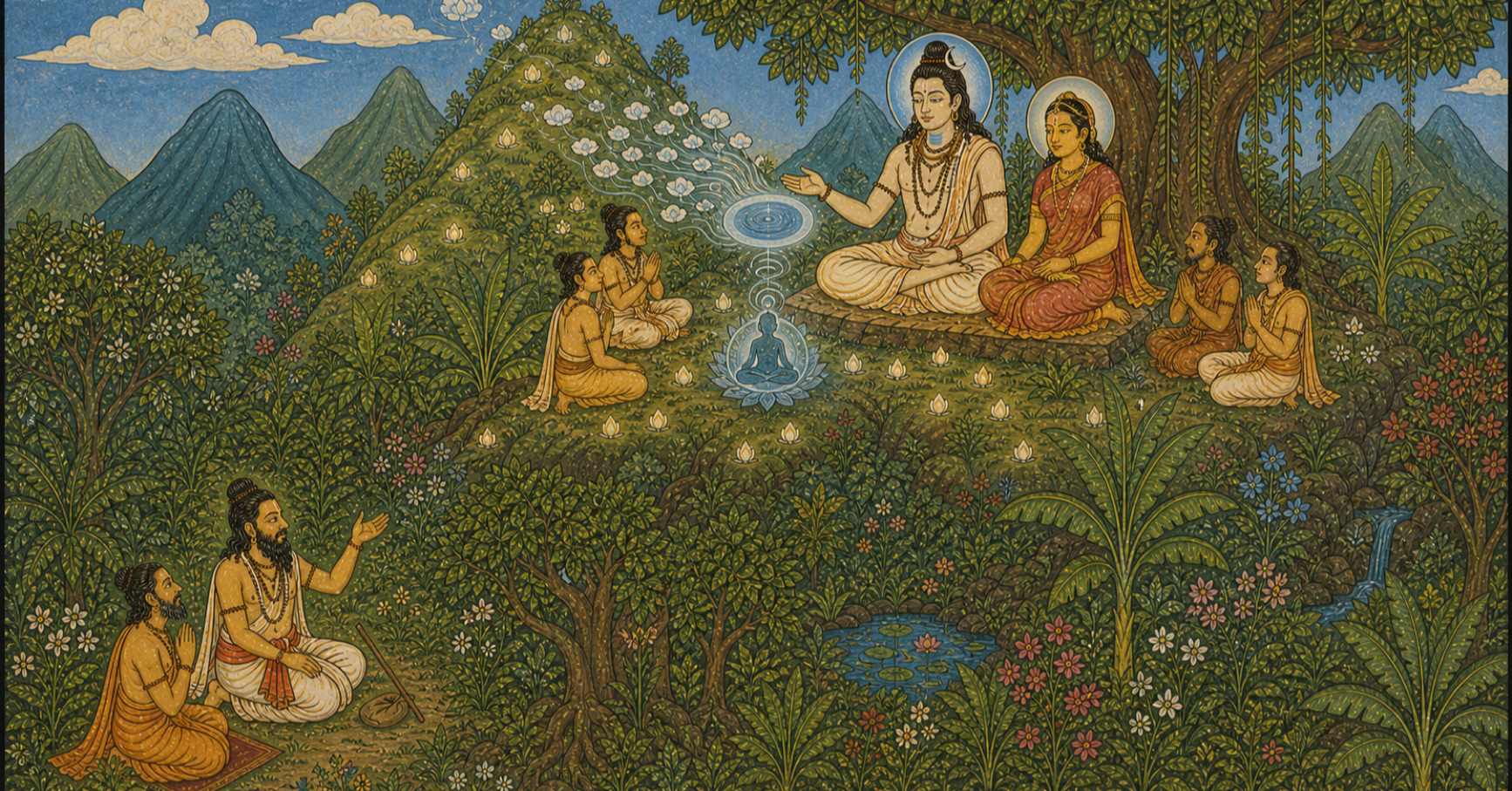
DYS 15–19: Śiva’s Laya

Dattātreyayogaśāstra 15–19: The Innumerable Methods of Dissolution

Laya Yoga dissolves the mind through esoteric techniques traced to Ādinātha, or Śiva, and to his instruction of the Śabaras.

Dr. Ronald Steiner Dr. Ronald Steiner Nils Jacob Liersch Nils Jacob Liersch
Dattātreyayogaśāstra 15
लययोगश्चित्तलयात्संकेतैस्तु प्रजायते |
laya-yogaś citta-layāt; saṃketais tu prajāyate | Analysis ▾ Analysis ▴
laya
tatpuruṣa-compound genitive
substantive masculine
of dissolution
yogaḥ
nominative singular
substantive masculine
yoga
citta
tatpuruṣa-compound genitive
substantive neuter
Citta
layāt
ablative singular
substantive masculine
dissolution
saṃketaiḥ
instrumental case plural
substantive masculine
through esoteric techniques
tu
particle
indeed
prajāyate
3rd person singular medial present
previx
verbal root
arises
आदिनाथेन संकेताः सार्धकोटिः प्रकीर्तिताः ||15||
ādi-nāthena saṃketāḥ; sārdha-koṭiḥ prakīrtitāḥ ||15|| Analysis ▾ Analysis ▴
ādi
karmadhāraya-compound
adjective
original, first
nāthena
instrumental case singular
substantive masculine
lord
saṃketāḥ
nominative plural
substantive masculine
techniques
sārdha
karmadhāraya-compound
adjective
one and a half
koṭiḥ
nominative singular
substantive feminine
crore (ten million)
prakīrtitāḥ
nominative plural feminine past participle passive
previx
verbal root
were proclaimed
Metre: Anuṣṭubh
The yoga of dissolution (laya-yogaḥ | nom sg) arises through esoteric techniques (saṃketaiḥ | ins pl) from the dissolution of mind (citta-layāt | abl sg). Ādinātha is said to have proclaimed one and a half crore—that is, fifteen million—such techniques (sārdha-koṭiḥ prakīrtitāḥ).
Dr. Ronald Steiner - 2026 - historically literal
Layayoga dissolves the mind through esoteric techniques. Ādinātha is said to have taught fifteen million such methods.
Dr. Ronald Steiner - 2026 - modern transfer
prajāyate | JM2024 ] prajāyate || DYŚ

saṃketāḥ sārdhakoṭiḥ JM2024 ] saṃketā aṣṭakoṭiḥ DYŚ
Critical Apparatus
Dattātreyayogaśāstra 16
सांकृतिरुवाच |
sāṃkṛtir uvāca | Analysis ▾ Analysis ▴
sāṃkṛtiḥ
nominative singular
substantive masculine
Sāṃkṛti
uvāca
3rd person singular aktive perfekte
verbal root
spoke
भगवन्नादिनाथो हि को ऽयं पुरुष उच्यते ||16||
bhagavann ādinātho hi; ko 'yaṃ puruṣa ucyate ||16|| Analysis ▾ Analysis ▴
bhagavan
vokative singular
substantive masculine
O Lord
ādināthaḥ
nominative singular
substantive masculine
Ādinātha
hi
particle
indeed
kaḥ
nominative singular masculine
pronoun inter
who
ayam
nominative singular masculine
pronoun dem
this
puruṣaḥ
nominative singular
substantive masculine
person
ucyate
3rd person singular passive present
verbal root
is called
Metre: Anuṣṭubh; speaker and title lines: prose
Sāṃkṛti spoke: “O Lord (bhagavan | voc sg), who is this person (ko ’yaṃ puruṣaḥ | nom sg) who is called Ādinātha (ādināthaḥ ucyate)?”
Dr. Ronald Steiner - 2026 - historically literal
Sāṃkṛti asked, “Lord, who is this man called Ādinātha?”
Dr. Ronald Steiner - 2026 - modern transfer
sāṃkṛtiruvāca JM2024 ] om. DYŚ

bhagavann ādinātho hi ko ’yaṃ puruṣa ucyate JM2024 ] bhagavan ādināthaḥ saḥ kiṃ rūpaḥ kaḥ sa ucyatām DYŚ
Critical Apparatus
Dattātreyayogaśāstra 17
दत्तात्रेय उवाच |
dattātreya uvāca | Analysis ▾ Analysis ▴
dattātreyaḥ
nominative singular
substantive masculine
Dattātreya
uvāca
3rd person singular aktive perfekte
verbal root
spoke
महादेवस्य नामानि आदिनाथश्च भैरवः |
mahā-devasya nāmāni; ādi-nāthaś ca bhairavaḥ | Analysis ▾ Analysis ▴
mahā
karmadhāraya-compound
adjective
great
devasya
genitive singular
substantive masculine
god
nāmāni
nominative plural
substantive neuter
the names
ādi
karmadhāraya-compound
adjective
original, first
nāthaḥ
nominative singular
substantive masculine
lord, master
ca
particle
and
bhairavaḥ
nominative singular
substantive masculine
Bhairava
शबरेशश्च देवो ऽयं लीलया विचरन्प्रभुः ||17||
śabareśaś ca devo 'yaṃ; līlayā vicaran prabhuḥ ||17|| Analysis ▾ Analysis ▴
śabareśaḥ
nominative singular
substantive masculine
Śabareśa
ca
particle
and
devaḥ
nominative singular
substantive masculine
the god
ayam
nominative singular masculine
pronoun
this
līlayā
instrumental case singular
substantive feminine
playfully
vicaran
nominative singular masculine present participle active
previx
verbal root
wandering
prabhuḥ
nominative singular
substantive masculine
the Lord
Metre: Anuṣṭubh; speaker and title lines: prose
Dattātreya (dattātreyaḥ | nom sg) spoke (uvāca | 3p sg act perf): The names (nāmāni | nom pl) of the Great God (mahā-devasya | gen sg) [include] Ādinātha (ādi-nāthaḥ | nom sg), Bhairava (bhairavaḥ | nom sg), and Śabareśa (śabareśaḥ | nom sg). In this form, the god (devo ’yam | nom sg) is the powerful Lord (prabhuḥ | nom sg), wandering (vicaran | nom sg) playfully (līlayā | ins sg).
Dr. Ronald Steiner - 2026 - historically literal
Dattātreya replied: Ādinātha, Bhairava, and Śabareśa are names of the Great God. In the form of Śabareśa, this powerful Lord roams the world in play.
Dr. Ronald Steiner - 2026 - modern transfer
dattātreya uvāca JM2024 ] om. DYŚ

ādināthaś ca bhairavaḥ JM2024 ] ādināthādikāny api DYŚ

śabareśaś ca devo ’yaṃ līlayā vicaran JM2024 ] śiveśvaraś ca devo ’sau līlayā vyacarat DYŚ
Critical Apparatus
Dattātreyayogaśāstra 18
श्रीकण्ठपर्वते गौर्या सह प्रमथनायकैः |
śrīkaṇṭha-parvate gauryā; saha pramatha-nāyakaiḥ | Analysis ▾ Analysis ▴
śrīkaṇṭha
karmadhāraya-compound
substantive masculine
Śrīkaṇṭha
parvate
lokative singular
substantive masculine
on the mountain
gauryā
instrumental case singular
substantive feminine
with Gaurī
saha
particle
together with
pramatha
tatpuruṣa-compound genitive
substantive masculine
of the Pramathas
nāyakaiḥ
instrumental case plural
substantive masculine
with the leaders
विन्ध्ये श्रीपर्वते चैव कदलीवनगोचरे ||18||
vindhye śrī-parvate caiva; kadalī-vana-gocare ||18|| Analysis ▾ Analysis ▴
vindhye
lokative singular
substantive masculine
in the Vindhyas
śrī
karmadhāraya-compound
adjective
venerable, glorious
parvate
lokative singular
substantive masculine
on the mountain
ca
particle
and
eva
particle
indeed
kadalī
tatpuruṣa-compound genitive
substantive feminine
plantain tree
vana
tatpuruṣa-compound genitive
substantive neuter
forest
gocare
lokative singular
substantive masculine
in the region
Metre: Anuṣṭubh
[Śabareśa wandered] on Mount Śrīkaṇṭha (śrīkaṇṭha-parvate | loc sg), together with Gaurī (gauryā saha | ins sg) and the leaders of the Pramathas (pramatha-nāyakaiḥ | ins pl), in the Vindhyas (vindhye | loc sg), on Śrīparvata (śrī-parvate | loc sg), and in the region of the banana grove (kadalī-vana-gocare | loc sg).
Dr. Ronald Steiner - 2026 - historically literal
As Śabareśa, he travelled with Gaurī and the leaders of his retinue across Śrīkaṇṭha, through the Vindhyas, over Śrīparvata, and through the banana grove.
Dr. Ronald Steiner - 2026 - modern transfer
pramathanāyakaiḥ JM2024 ] pramathanāyakān DYŚ
Critical Apparatus
Dattātreyayogaśāstra 19
गिरिकूटे चित्रकूटे सपादनियते गिरौ |
giri-kūṭe citra-kūṭe; sa-pāda-niyate girau | Analysis ▾ Analysis ▴
giri
tatpuruṣa-compound genitive
substantive masculine
mountain
kūṭe
lokative singular
substantive masculine
on the peak
citra
karmadhāraya-compound
adjective
bright, variegated
kūṭe
lokative singular
substantive masculine
on the peak
sa
bahuvrīhi-compund
previx
with
pāda
tatpuruṣa-compound instrumental case
substantive masculine
foot
niyate
lokative singular masculine past participle passive
previx
verbal root
marked
girau
lokative singular
substantive masculine
on the mountain
कृपयैकैकसंकेतं शबरेभ्यो हि दत्तवान् ||19||
kṛpayaikaika-saṃketaṃ; śabarebhyo hi dattavān ||19|| Analysis ▾ Analysis ▴
kṛpayā
instrumental case singular
substantive feminine
compassion
ekaika
karmadhāraya-compound
adjective
each one
saṃketam
accusative singular
substantive masculine
method
śabarebhyaḥ
dative plural
substantive masculine
to the Śabaras
hi
particle
indeed
dattavān
nominative singular masculine past participle active
verbal root
gave
Metre: Anuṣṭubh
On Girikūṭa (giri-kūṭe | loc sg) and on Citrakūṭa (citra-kūṭe | loc sg), the mountain marked with footprints (sapādaniyate girau | loc sg), out of compassion (kṛpayā | ins sg) he gave each of the Śabaras (śabarebhyaḥ | dat pl) one esoteric technique (ekaika-saṃketam | acc sg).
Dr. Ronald Steiner - 2026 - historically literal
On Girikūṭa and on Citrakūṭa, the mountain marked with footprints, he compassionately gave each of the Śabaras an esoteric technique of their own.
Dr. Ronald Steiner - 2026 - modern transfer
sapādaniyate JM2024 ] supādapayute DYŚ
Critical Apparatus

Continue with AYI Free

Illustrations: AI-generated.

Editor

Dr. Ronald Steiner

From Ulm

The "Yoga Doc" - Dr. Ronald Steiner is the founder of the AYI method. This method links traditional Ashtanga Yoga with innovative Yogatherapy and living Philosophy. This forms a practice that is personal for each and... more ›

Nils Jacob Liersch

Meine Begeisterung für Yoga, indische Philosophie und Sanskrit führte mich zum Studium der Indologie und Religionswissenschaft an der Universität Heidelberg. Seit 2004 befinde ich mich auf meinem persönlichen Yogaweg... more ›

Messages and ratings
1 messages

Please log in to write a message. Go to login

„Wobei dieser Mantra-Yoga durch die Eignung für selbst untalentierte Übende zugleich auch abgewertet wird.“
Ich finde es ist nicht die Eignung für untalentierte Übende, durch die das Mantra Yoga abgewertet wird sondern die Wahl der Worte des Erzählers.