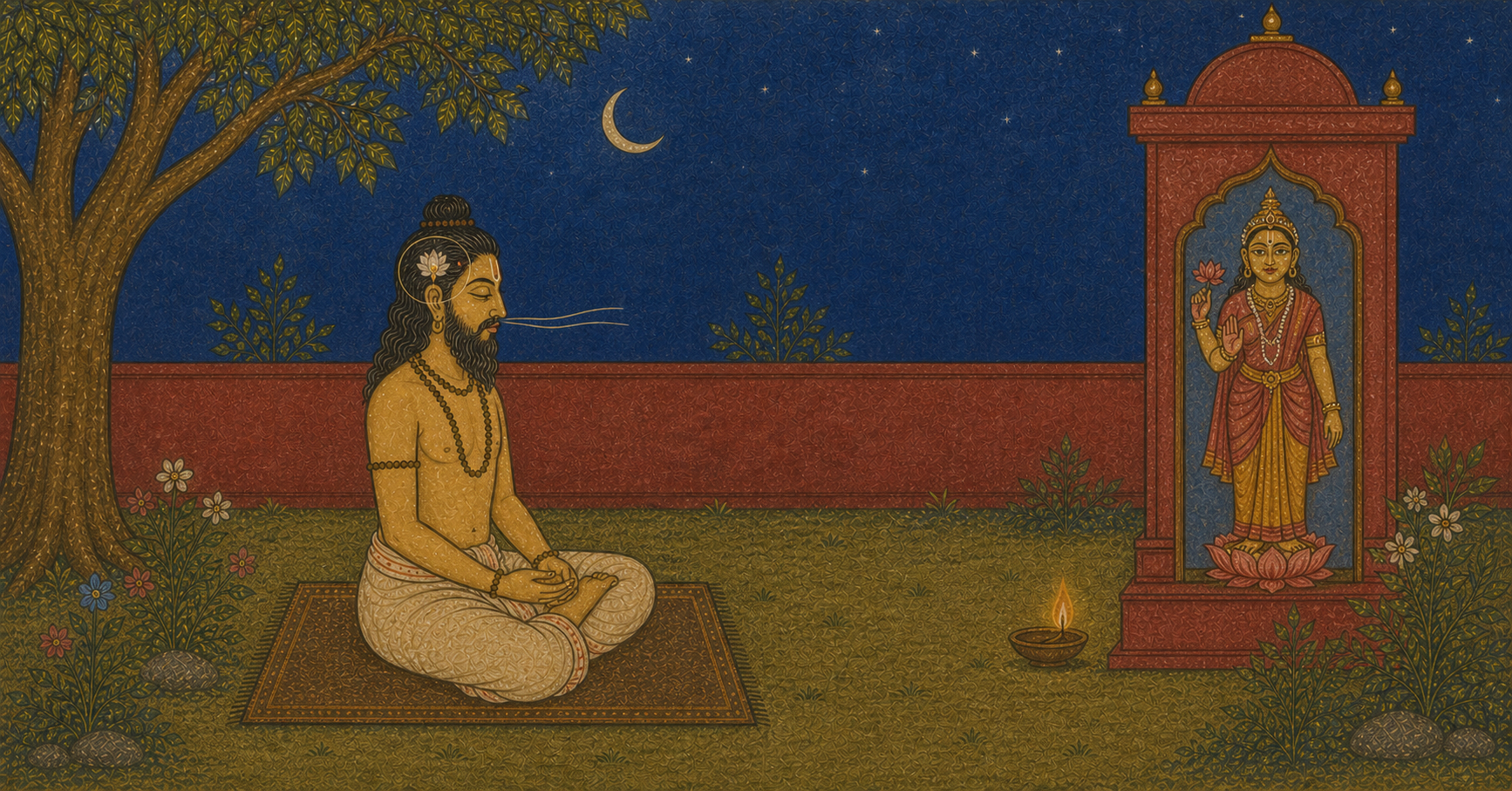
DYS 122–123: Dhyāna
DYS 122–123: Dhyāna

Dattātreyayogaśāstra 122–123: Meditation on a Wish-Granting Deity

After the elemental fixations, the breath is held for a full day while the yogi meditates on a wish-granting deity; this conditioned meditation is said to bestow extraordinary powers.

Dr. Ronald Steiner Dr. Ronald Steiner Nils Jacob Liersch Nils Jacob Liersch
Dattātreyayogaśāstra 122
ब्रह्मणः प्रलये वापि मृत्युस्तस्य न विद्यते |
brahmaṇaḥ pralaye vāpi; mṛtyus tasya na vidyate | Analysis ▾ Analysis ▴
brahmaṇaḥ
genitive singular
substantive masculine
of Brahmā
pralaye
lokative singular
substantive masculine
at the dissolution
vā
particle
or
api
particle
also
mṛtyuḥ
nominative singular
substantive masculine
death
tasya
genitive singular masculine
pronoun
for him
na
particle
not
vidyate
3rd person singular medial present
verbal root
exists
समभ्यसेत्तदा ध्यानं घटिकाः षष्टिमेव च ||122||
samabhyaset tadā dhyānaṃ; ghaṭikāḥ ṣaṣṭim eva ca ||122|| Analysis ▾ Analysis ▴
samabhyaset
3rd person singular aktive optative
previx
previx
verbal root
should practise
tadā
adverb
then
dhyānam
accusative singular
substantive neuter
meditation
ghaṭikāḥ
accusative plural
substantive feminine
ghaṭikās
ṣaṣṭim
accusative singular feminine
numeral
sixty
eva
particle
precisely
ca
particle
and
Metre: Anuṣṭubh
Even (api) at the dissolution (pralaye | loc sg) of Brahmā (brahmaṇaḥ | gen sg), there is no (na) death (mṛtyuḥ | nom sg) for him (tasya | gen sg). Then (tadā) he should practise (samabhyaset | 3p sg act opt) meditation (dhyānam | acc sg) for precisely (eva) sixty (ṣaṣṭim | acc sg) ghaṭikās (ghaṭikāḥ | acc pl).
Dr. Ronald Steiner - 2026 - historically literal
Even at the great cosmic dissolution, death does not seize such a practitioner. The yogi then turns to sustained meditation.
Dr. Ronald Steiner - 2026 - modern transfer
Dattātreyayogaśāstra 123
वायुं निरुध्य ध्यायेत्तु देवतामिष्टदायिनीम् |
vāyuṃ nirudhya dhyāyet tu; devatām iṣṭa-dāyinīm | Analysis ▾ Analysis ▴
vāyum
accusative singular
substantive masculine
breath
nirudhya
absolutus
previx
verbal root
having restrained
dhyāyet
3rd person singular aktive optative
verbal root
should meditate on
tu
particle
but
devatām
accusative singular
substantive feminine
deity
iṣṭa
tatpuruṣa-compound genitive
substantive neuter
desired things
dāyinīm
accusative singular feminine
adjective
bestowing
सगुणं ध्यानमेतत्स्यादणिमादिगुणप्रदम् ||123||
sa-guṇaṃ dhyānam etat syād; aṇimādi-guṇa-pradam ||123|| Analysis ▾ Analysis ▴
sa
previx
with
guṇam
nominative singular neuter
substantive masculine
attributes
dhyānam
nominative singular
substantive neuter
meditation
etat
nominative singular neuter
pronoun
this
syāt
3rd person singular aktive optative
verbal root
should be
aṇimā
dvandva-compound
substantive masculine
aṇimā, minuteness
ādi
tatpuruṣa-compound genitive
substantive masculine
and so forth
guṇa
tatpuruṣa-compound genitive
substantive masculine
powers
pradam
nominative singular neuter
adjective
bestowing
Metre: Anuṣṭubh
Having restrained (nirudhya | abs) the breath (vāyum | acc sg), he should meditate (dhyāyet | 3p sg act opt) on the deity (devatām | acc sg) who grants what is desired (iṣṭa-dāyinīm | acc sg f). This (etat | nom sg n) is to be (syāt | 3p sg act opt) conditioned meditation (sa-guṇaṃ dhyānam | nom sg n), bestowing powers beginning with becoming infinitesimal (aṇimādi-guṇa-pradam | nom sg n).
Dr. Ronald Steiner - 2026 - historically literal
With the breath restrained, the yogi meditates on a chosen deity who grants the desired aim. This is conditioned meditation, said to confer powers such as becoming infinitesimal.
Dr. Ronald Steiner - 2026 - modern transfer
saguṇaṃ dhyānam etat JM2024 ] saguṇadhyānam evaṃ DYŚ
Critical Apparatus

Continue with AYI Free

Illustrations: AI-generated.

Editor

Dr. Ronald Steiner

From Ulm

The "Yoga Doc" - Dr. Ronald Steiner is the founder of the AYI method. This method links traditional Ashtanga Yoga with innovative Yogatherapy and living Philosophy. This forms a practice that is personal for each and... more ›

Nils Jacob Liersch

Meine Begeisterung für Yoga, indische Philosophie und Sanskrit führte mich zum Studium der Indologie und Religionswissenschaft an der Universität Heidelberg. Seit 2004 befinde ich mich auf meinem persönlichen Yogaweg... more ›

Messages and ratings
4 messages Ø

Please log in to write a message. Go to login

An den 12 Tagen zweifle ich etwas... aber Versenkung ohne Eigenschaften ist definitiv erstrebenswert, egal wie lange es dauert.......
Ja, das kann man so nicht umsetzen. Ich denke es macht auch aus heutiger Sicht gar keinen Sinn. Wir können mit genau dieser Technik ein wirklich tiefes meditatives Erlebnis haben mit kürzeren Zeiten. Z.B. 2,5 bis 10 Minuten pro Chakra.
- So leite ich die Meditation an und praktiziere sie. So ist sie eine meiner Lieblings-Meditationen.
Oh, danke für die Antwort. Das bedeutet, dass wir aus heutiger Sicht über ein Ideal sprechen, da es nicht alltagstauglich ist. Wir verbringen unsere Tage ja nicht sitzend auf einem Kissen, sondern mit Beruf, Familie, evtl. sonstigen Verpflichtungen. Kann es trotzdem sein, dass es vereinzelt Yogis gab, die das so praktiziert haben und demnach über eine tatsächliche Erfahrung sprechen?
Die Gesamte Meditation ist ja noch länger:
1) 5 Elemente (i.a. Chakren) je 2,5h => 12,5 Stunden
2) Das göttliche in uns (i.a. im Kopf) 24 Stunden
3) Verbindung mit dem absoluten göttlichen 12 Tage
Mit diesen Zeitangaben meditieren wir also 13 1/2 Tage. Ob das die Yogis damals wirklich so gemacht haben?