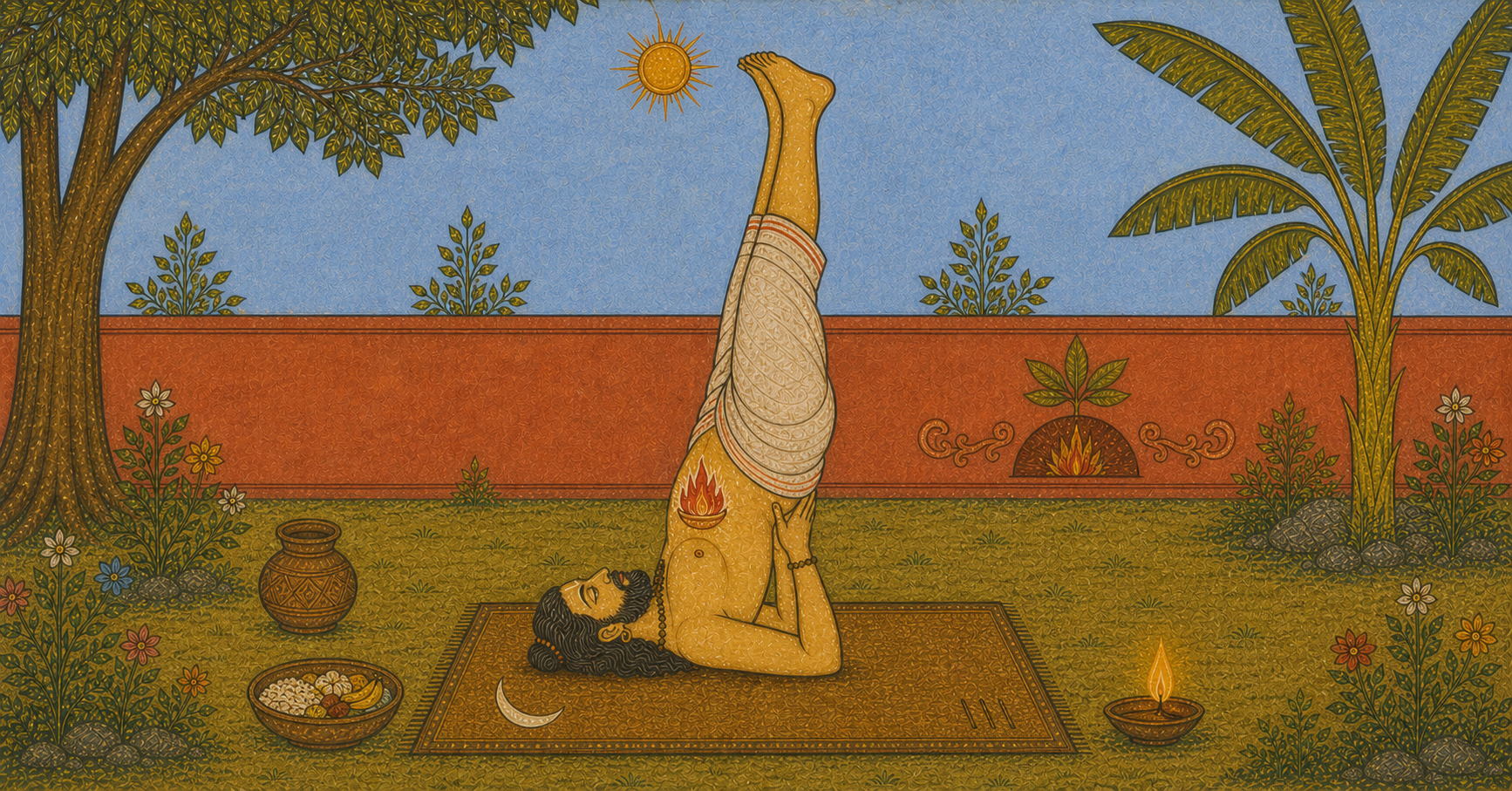
DYS 146–149: Viparītakaraṇa

Dattātreyayogaśāstra 146–149: Reversing Sun and Moon

The inversion strengthens digestive fire and is lengthened daily; sufficient food protects the body while grey hair and wrinkles are said to disappear.

Dr. Ronald Steiner Dr. Ronald Steiner Nils Jacob Liersch Nils Jacob Liersch
Dattātreyayogaśāstra 146
करणं विपरीताख्यं सर्वव्याधिविनाशनम् |
karaṇaṃ viparītākhyaṃ; sarva-vyādhi-vināśanam | Analysis ▾ Analysis ▴
karaṇam
nominative singular
substantive neuter
technique
viparīta
karmadhāraya-compound
adjective
inverted
ākhyam
nominative singular neuter
adjective
called
sarva
karmadhāraya-compound
adjective
all
vyādhi
tatpuruṣa-compound genitive
substantive masculine
disease
vināśanam
nominative singular neuter
previx
adjective
destroying
नित्यमभ्यासयुक्तस्य जठराग्निर्विवर्धते ||146||
nityam abhyāsa-yuktasya; jaṭharāgnir vivardhate ||146|| Analysis ▾ Analysis ▴
nityam
adverb
regularly
abhyāsa
bahuvrīhi-compund
substantive masculine
practice
yuktasya
genitive singular masculine past participle passive
verbal root
engaged
jaṭhara
tatpuruṣa-compound lokative
substantive neuter
digestive
agniḥ
nominative singular
substantive masculine
fire
vivardhate
3rd person singular medial present
previx
verbal root
increases
Metre: Anuṣṭubh
The technique (karaṇam | nom sg n) called the Inverter (viparītākhyam | nom sg n) destroys all diseases (sarva-vyādhi-vināśanam | nom sg n). The digestive fire (jaṭhara-agniḥ | nom sg) of one constantly (nityam) engaged in its practice (abhyāsa-yuktasya | gen sg) increases (vivardhate | 3p sg med pres).
Dr. Ronald Steiner - 2026 - historically literal
Viparītakaraṇī, the inverted practice, is said to destroy disease and strengthen the digestive fire when cultivated regularly.
Dr. Ronald Steiner - 2026 - modern transfer
Dattātreyayogaśāstra 147
आहारो बहुलस्तस्य संपाद्यः सांकृते ध्रुवम् |
āhāro bahulas tasya; saṃpādyaḥ sāṃkṛte dhruvam | Analysis ▾ Analysis ▴
āhāraḥ
nominative singular
substantive masculine
food
bahulaḥ
nominative singular masculine
adjective
abundant
tasya
genitive singular masculine
pronoun
for him
saṃpādyaḥ
nominative singular masculine future participle passive
previx
verbal root
to be provided
sāṃkṛte
vokative singular
substantive masculine
O Sāṃkṛti
dhruvam
adverb
certainly
अल्पाहारो यदि भवेदग्निर्देहं दहेत्क्षणात् ||147||
alpāhāro yadi bhaved; agnir dehaṃ dahet kṣaṇāt ||147|| Analysis ▾ Analysis ▴
alpa
karmadhāraya-compound
adjective
little
hāraḥ
nominative singular
substantive masculine
food
yadi
particle
if
bhavet
3rd person singular aktive optative
verbal root
there is
agniḥ
nominative singular
substantive masculine
fire
deham
accusative singular
substantive masculine
body
dahet
3rd person singular aktive optative
verbal root
may burn
kṣaṇāt
ablative singular
substantive masculine
in an instant
Metre: Anuṣṭubh
O Sāṃkṛti (sāṃkṛte | voc sg), abundant (bahulaḥ | nom sg) food (āhāraḥ | nom sg) must certainly (dhruvam) be provided (saṃpādyaḥ | nom sg) for him (tasya | gen sg). If (yadi) food is scant (alpa-āhāraḥ | nom sg), the fire (agniḥ | nom sg) may burn (dahet | 3p sg act opt) the body (deham | acc sg) in an instant (kṣaṇāt | abl sg).
Dr. Ronald Steiner - 2026 - historically literal
The practitioner is told to eat sufficiently, because too little food allows the intensified inner fire to consume the body.
Dr. Ronald Steiner - 2026 - modern transfer
saṃpādyaḥ JM2024 ] sampādyaḥ DYŚ

dehaṃ dahet kṣaṇāt JM2024 ] dāhaṃ karoti vai DYŚ
Critical Apparatus
Dattātreyayogaśāstra 148
ऊर्ध्वं भानुरधश्चन्द्रस्तद्यथा शृणु सांकृते |
ūrdhvaṃ bhānur adhaś candras; tad yathā śṛṇu sāṃkṛte | Analysis ▾ Analysis ▴
ūrdhvam
adverb
above
bhānuḥ
nominative singular
substantive masculine
sun
adhaḥ
adverb
below
candraḥ
nominative singular
substantive masculine
moon
tat
accusative singular neuter
pronoun dem
that
yathā
adverb
how
śṛṇu
2nd person singular aktive imperative
verbal root
listen
sāṃkṛte
vokative singular
substantive masculine
O Sāṃkṛti
अधःशिराश्चोर्ध्वपादः क्षणं स्यात्प्रथमे दिने ||148||
adhaḥ-śirāś cordhva-pādaḥ; kṣaṇaṃ syāt prathame dine ||148|| Analysis ▾ Analysis ▴
adhaḥ
karmadhāraya-compound
adverb
downward
śirāḥ
nominative singular
substantive neuter
head
ca
particle
and
ūrdhva
karmadhāraya-compound
adjective
upward
pādaḥ
nominative singular
substantive masculine
feet
kṣanam
accusative singular
substantive masculine
a moment
syāt
3rd person singular aktive optative
verbal root
should remain
prathame
lokative singular neuter
adjective
on the first
dine
lokative singular
substantive neuter
day
Metre: Anuṣṭubh
Listen (śṛṇu | 2p sg act imp), O Sāṃkṛti (sāṃkṛte | voc sg), to how (yathā) this (tat | acc sg) is understood: the sun (bhānuḥ | nom sg) is above (ūrdhvam), the moon (candraḥ | nom sg) below (adhaḥ). On the first day (prathame dine | loc sg), he should remain (syāt | 3p sg act opt) briefly (kṣaṇam | acc sg) with head down (adhaḥ-śiraḥ | nom sg n) and (ca) feet up (ūrdhva-pādaḥ | nom sg).
Dr. Ronald Steiner - 2026 - historically literal
Dattātreya explains to Sāṃkṛti the bodily reversal of sun and moon. On the first day the inverted position is held only briefly.
Dr. Ronald Steiner - 2026 - modern transfer
adhaḥśirāś JM2024 ] adhaḥ śiraś DYŚ
Critical Apparatus
Dattātreyayogaśāstra 149
क्षणाच्च किं चिदधिकमभ्यसेच्च दिने दिने |
kṣaṇāc ca kiṃ cid adhikam; abhyasec ca dine dine | Analysis ▾ Analysis ▴
kṣaṇāt
ablative singular
substantive masculine
from a moment
ca
particle
and
kim
nominative singular neuter
pronoun
something
cit
suffix
perhaps
adhikam
adverb
more
abhyaset
3rd person singular aktive optative
previx
verbal root
should practise
ca
particle
and
dine
lokative singular
substantive masculine
day
dine
lokative singular
substantive masculine
by day
वलितं पलितं चैव षण्मासोर्ध्वं न दृश्यते ||149||
valitaṃ palitaṃ caiva; ṣaṇ-māsordhvaṃ na dṛśyate ||149|| Analysis ▾ Analysis ▴
valitam
nominative singular
substantive neuter
wrinkling
palitam
nominative singular
substantive neuter
grey hair
ca
particle
and
eva
particle
likewise
ṣaṭ
karmadhāraya-compound
numeral
six
māsaḥ
nominative singular
substantive masculine
months
ūrdhvam
adverb
after
na
particle
not
dṛśyate
3rd person singular passive present
verbal root
is seen
Metre: Anuṣṭubh
Beginning with a moment (kṣaṇāt | abl sg), he should practise (abhyaset | 3p sg act opt) a little (kiṃ cit) longer (adhikam) day by day (dine dine | loc sg). After six months (ṣaṇ-māsordhvam), wrinkling (valitam | nom sg n) and grey hair (palitam | nom sg n) are no longer (na) seen (dṛśyate | 3p sg pas pres).
Dr. Ronald Steiner - 2026 - historically literal
The duration is increased little by little each day. After six months, grey hair and wrinkles are said to disappear.
Dr. Ronald Steiner - 2026 - modern transfer
kṣaṇāc ca kiṃ cid adhikam abhyasec ca JM2024 ] kṣaṇāt tu kiṃ cit adhikam abhyāsena DYŚ
Critical Apparatus

Continue with AYI Free

Illustrations: AI-generated.

Editor

Dr. Ronald Steiner

From Ulm

The "Yoga Doc" - Dr. Ronald Steiner is the founder of the AYI method. This method links traditional Ashtanga Yoga with innovative Yogatherapy and living Philosophy. This forms a practice that is personal for each and... more ›

Nils Jacob Liersch

Meine Begeisterung für Yoga, indische Philosophie und Sanskrit führte mich zum Studium der Indologie und Religionswissenschaft an der Universität Heidelberg. Seit 2004 befinde ich mich auf meinem persönlichen Yogaweg... more ›

Messages and ratings
0 messages

Please log in to write a message. Go to login

No messages yet.