DYS 79–83: Power and Bhūcarasiddhi

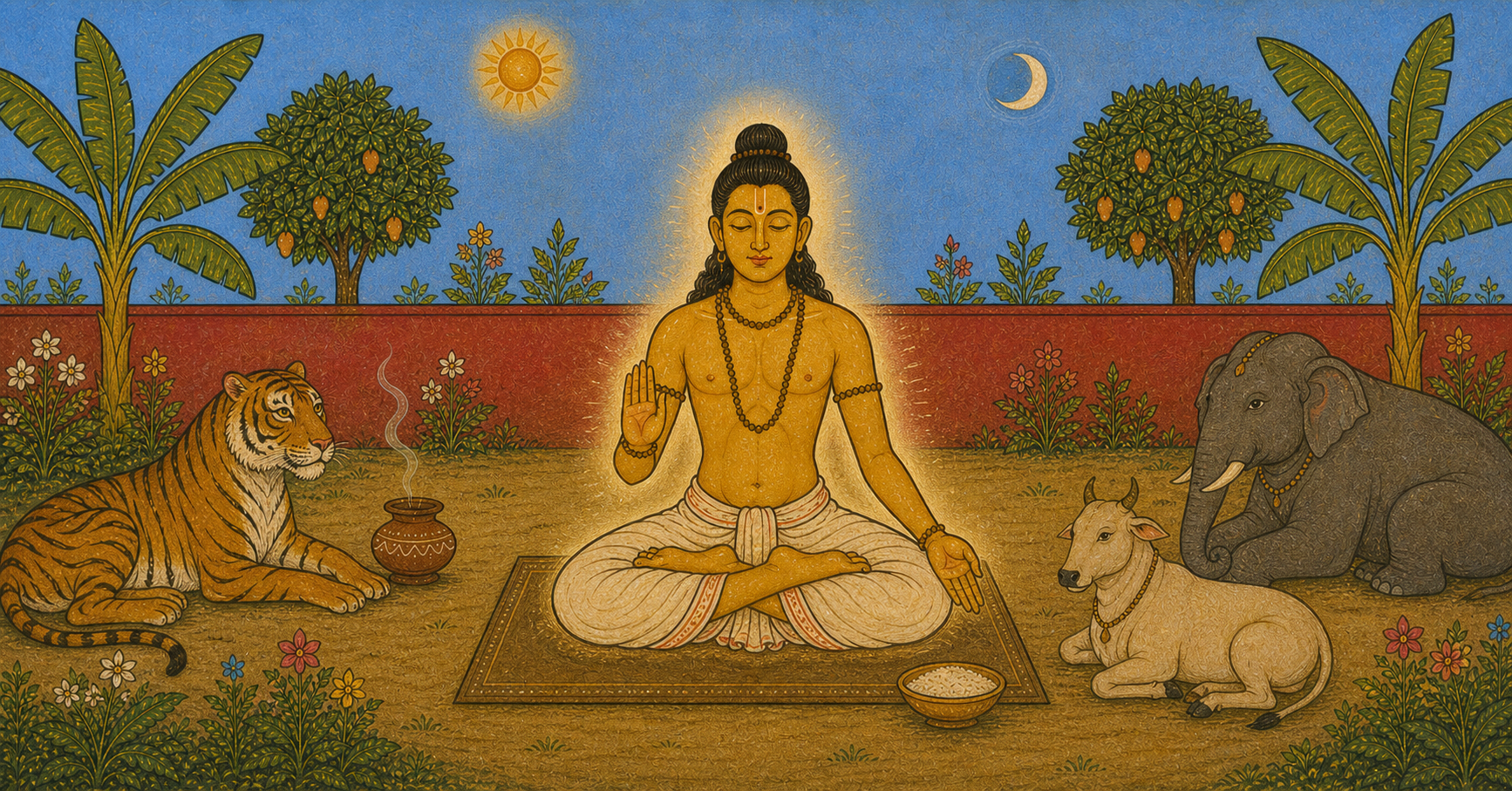
Dattātreyayogaśāstra 79–83: Reduced Needs, Resilience, and Power over Land Animals

The yogi is said to eat little or much without distress, sleep little, and remain free from bodily impurities. As strength grows, the text attributes to him power over wild animals and beauty like that of the god of love.

Dr. Ronald Steiner Dr. Ronald Steiner Nils Jacob Liersch Nils Jacob Liersch
Dattātreyayogaśāstra 79
निराधारो विचित्रं हि तदा सामर्थ्यमुद्भवेत् |
nir-ādhāro vicitraṃ hi; tadā sāmarthyam udbhavet | Analysis ▾ Analysis ▴
nir
bahuvrīhi-compund
previx
without, free from
ādhāraḥ
nominative singular
substantive masculine
support, foundation
vicitram
nominative singular neuter
adjective
amazing, peculiar
hi
particle
indeed
tadā
adverb
then
sāmarthyam
nominative singular
substantive neuter
capability, power
udbhavet
3rd person singular aktive optative
previx
verbal root
should arise
अल्पं वा बहु वा भुक्त्वा योगी न व्यथते तदा ||79||
alpaṃ vā bahu vā bhuktvā; yogī na vyathate tadā ||79|| Analysis ▾ Analysis ▴
alpam
accusative singular neuter
adjective
a little
vā
particle
or
bahu
accusative singular neuter
adjective
much, frequently
vā
particle
or
bhuktvā
absolutus
verbal root
having eaten
yogī
nominative singular
substantive masculine
the yogi
na
particle
not
vyathate
3rd person singular medial present
verbal root
he is troubled
tadā
adverb
then
Metre: Anuṣṭubh
Without support (nirādhāraḥ | nom sg m), an amazing (vicitraṃ | nom sg n) capability (sāmarthyam | nom sg) then (tadā) arises (udbhavet | 3p sg act opt). Whether he has eaten (bhuktvā | abs) a little (alpam | acc sg n) or (vā) a lot (bahu | acc sg n), the yogi (yogī | nom sg) is then (tadā) not (na) troubled (vyathate | 3p sg med pres).
Dr. Ronald Steiner - 2026 - historically literal
Eventually the yogi can remain without visible support. Whether eating little or much, the practitioner is no longer troubled.
Dr. Ronald Steiner - 2026 - modern transfer
vicitraṃ JM2024 ] ’pi citraṃ (cittaṃ?) DYŚ

alpaṃ vā bahu vā JM2024 ] svalpaṃ vā bahu DYŚ
Critical Apparatus
Dattātreyayogaśāstra 80
अल्पमूत्रपुरीषः स्यादल्पनिद्रा च जायते |
alpa-mūtra-purīṣaḥ syād; alpa-nidrā ca jāyate | Analysis ▾ Analysis ▴
alpa
karmadhāraya-compound
adjective
little
mūtra
dvandva-compound
substantive neuter
urine
purīṣaḥ
nominative singular masculine bahuvrīhi-compund
substantive neuter
having little urine and faeces
syāt
3rd person singular aktive optative
verbal root
would have
alpa
karmadhāraya-compound
adjective
little
nidrā
nominative singular
substantive feminine
sleep
ca
particle
and
jāyate
3rd person singular medial present
verbal root
arises
क्रिमयो दूषिका लाला स्वेदो दुर्गन्धता तनोः ||80||
krimayo dūṣikā lālā; svedo dur-gandhatā tanoḥ ||80|| Analysis ▾ Analysis ▴
krimayaḥ
nominative plural
substantive masculine
worms
dūṣikā
nominative singular
substantive feminine
rheum; eye discharge
lālā
nominative singular
substantive feminine
slobber, saliva
svedaḥ
nominative singular
substantive masculine
sweat
dur
karmadhāraya-compound
previx
bad; foul
gandhatā
nominative singular
substantive feminine
odour
tanoḥ
genitive singular
substantive feminine
of the body
Metre: Anuṣṭubh
He should be (syāt | 3p sg act opt) one with little urine and faeces (alpamūtrapurīṣaḥ | nom sg m), and (ca) little sleep (alpanidrā | nom sg) arises (jāyate | 3p sg med pres). Worms (krimayaḥ | nom pl), rheum (dūṣikā | nom sg), slobber (lālā | nom sg), sweat (svedaḥ | nom sg), and bad odour (durgandhatā | nom sg) of the body (tanoḥ | gen sg) [are listed as ailments].
Dr. Ronald Steiner - 2026 - historically literal
Excretion and the need for sleep diminish; ailments such as worms, rheumy eyes, slobber, sweat, and bad body odour are named.
Dr. Ronald Steiner - 2026 - modern transfer
alpamūtrapurīṣaḥ syād alpanidrā JM2024 ] alpamūtrapurīṣas tu svalpanidraś DYŚ
Critical Apparatus
Dattātreyayogaśāstra 81
एतानि सर्वदा तस्य न जायन्ते ततः परम् |
etāni sarvadā tasya; na jāyante tataḥ param | Analysis ▾ Analysis ▴
etāni
nominative plural neuter
pronoun
these
sarvadā
adverb
always
tasya
genitive singular masculine
pronoun
for him
na
particle
not
jāyante
3rd person plural medial present
verbal root
arise
tataḥ
adverb
then
param
adverb
after that, further
ततो ऽधिकतराभ्यासाद्बलमुत्पद्यते भृशम् ||81||
tato 'dhikatarābhyāsād; balam utpadyate bhṛśam ||81|| Analysis ▾ Analysis ▴
tataḥ
adverb
then
adhikatara
karmadhāraya-compound
adjective
further increased
abhyāsāt
ablative singular
substantive masculine
through practice
balam
nominative singular
substantive neuter
strength
utpadyate
3rd person singular medial present
previx
verbal root
arises
bhṛśam
adverb
greatly, intensely
Metre: Anuṣṭubh
From then on (tataḥ param), these (etāni | nom pl n) never (na sarvadā) arise (jāyante | 3p pl med pres) for him (tasya | gen sg m). Through a further increase in practice (adhikatarābhyāsāt | abl sg), great (bhṛśam) strength (balam | nom sg) arises (utpadyate | 3p sg med pres).
Dr. Ronald Steiner - 2026 - historically literal
From then on these ailments no longer arise. With further practice, extraordinary strength develops.
Dr. Ronald Steiner - 2026 - modern transfer
Dattātreyayogaśāstra 82
येन भूचरसिद्धिः स्याद्भूचराणां जये क्षमः |
yena bhū-cara-siddhiḥ syād; bhū-carāṇāṃ jaye kṣamaḥ | Analysis ▾ Analysis ▴
yena
instrumental case singular neuter
pronoun
through which
bhū
tatpuruṣa-compound genitive
substantive feminine
earth, terrestrial
cara
tatpuruṣa-compound genitive
adjective
moving, animal
siddhiḥ
nominative singular
substantive feminine
accomplishment
syāt
3rd person singular aktive optative
verbal root
would be
bhū
tatpuruṣa-compound genitive
substantive feminine
earth, terrestrial
carāṇām
genitive plural masculine
adjective
of animals
jaye
lokative singular
substantive masculine
for overcoming
kṣamaḥ
nominative singular masculine
adjective
capable
व्याघ्रो लुलायो वन्यो वा गवयो गज एव वा ||82||
vyāghro lulāyo vanyo vā; gavayo gaja eva vā ||82|| Analysis ▾ Analysis ▴
vyāghraḥ
nominative singular
substantive masculine
a tiger
lulāyaḥ
nominative singular
substantive masculine
buffalo
vanyaḥ
nominative singular masculine
adjective
wild
vā
particle
or
gavayaḥ
nominative singular
substantive masculine
gayal
gajaḥ
nominative singular
substantive masculine
an elephant
eva
particle
precisely
vā
particle
or
Metre: Anuṣṭubh
Through this (yena | ins sg n), he should gain power over animals (bhūcarasiddhiḥ | nom sg) and become capable (kṣamaḥ | nom sg m) of overcoming (jaye | loc sg) animals (bhūcarāṇām | gen pl): a tiger (vyāghraḥ | nom sg), a buffalo (lulāyaḥ | nom sg), a wild (vanyaḥ | nom sg m) gayal (gavayaḥ | nom sg), or even (eva) an elephant (gajaḥ | nom sg).
Dr. Ronald Steiner - 2026 - historically literal
This strength is said to let the yogi overcome wild animals such as tigers, buffalo, gayals, and elephants.
Dr. Ronald Steiner - 2026 - modern transfer
Dattātreyayogaśāstra 83
सिंहो वा योगिना तेन म्रियन्ते हस्तताडिताः |
siṃho vā yoginā tena; mriyante hasta-tāḍitāḥ | Analysis ▾ Analysis ▴
siṃhaḥ
nominative singular
substantive masculine
a lion
vā
particle
or
yoginā
instrumental case singular
substantive masculine
by the yogi
tena
instrumental case singular masculine
pronoun dem
by that one
mriyante
3rd person plural medial present
verbal root
they are killed, die
hasta
tatpuruṣa-compound instrumental case
substantive masculine
by the hand
tāḍitāḥ
nominative plural masculine past participle passive
verbal root
struck, killed
कन्दर्पस्य यथा रूपं तथा तस्यापि योगिनः ||83||
kandarpasya yathā rūpaṃ; tathā tasyāpi yoginaḥ ||83|| Analysis ▾ Analysis ▴
kandarpasya
genitive singular
substantive masculine
of Kandarpa, the god of love
yathā
adverb
just as
rūpam
nominative singular
substantive neuter
appearance, form
tathā
adverb
likewise
tasya
genitive singular masculine
pronoun
of that one
api
particle
also
yoginaḥ
genitive singular
substantive masculine
of the yogi
Metre: Anuṣṭubh
A lion (siṃhaḥ | nom sg) too (vā) [is included]: these [animals] are killed (mriyante | 3p pl med pres), struck by the hand (hastatāḍitāḥ | nom pl m ppp) of that yogi (yoginā tena | ins sg). Just as (yathā) the appearance (rūpam | nom sg) of Kandarpa (kandarpasya | gen sg), so (tathā) is that (tasya | gen sg m) of the yogi (yoginaḥ | gen sg) too (api).
Dr. Ronald Steiner - 2026 - historically literal
Even a lion is said to fall to a blow from the yogi’s hand. At the same time, the yogi becomes as attractive as the god of love.
Dr. Ronald Steiner - 2026 - modern transfer
hastatāḍitāḥ JM2024 ] hastatāḍanāt DYŚ
Critical Apparatus

Continue with AYI Free

Illustrations: AI-generated.

Editor

Dr. Ronald Steiner

From Ulm

The "Yoga Doc" - Dr. Ronald Steiner is the founder of the AYI method. This method links traditional Ashtanga Yoga with innovative Yogatherapy and living Philosophy. This forms a practice that is personal for each and... more ›

Nils Jacob Liersch

Meine Begeisterung für Yoga, indische Philosophie und Sanskrit führte mich zum Studium der Indologie und Religionswissenschaft an der Universität Heidelberg. Seit 2004 befinde ich mich auf meinem persönlichen Yogaweg... more ›

Messages and ratings
4 messages Ø

Please log in to write a message. Go to login

Ich kann nur erahnen was gemeint ist. Die Frosch Metapher hilft! Bewundernswert im Grunde wenn ein Frosch, besonders die winzigen, riesige Sprünge machen, wenn sie wie der Frosch sonst die meiste Zeit am Boden haften, eine solche Kraft freisetzen.