

asmad अस्मद् – ich; wir
Pronomen · Pronomen pers 1p · Substantiv Maskulin · Worttyp nicht bestimmt
Wörterbuchquellen
AYI Wörterbuch Pronomen · Pronomen pers 1p
Cappeller 1891 Worttyp nicht bestimmt
Originaltext · Englisch · Worttyp nicht bestimmt
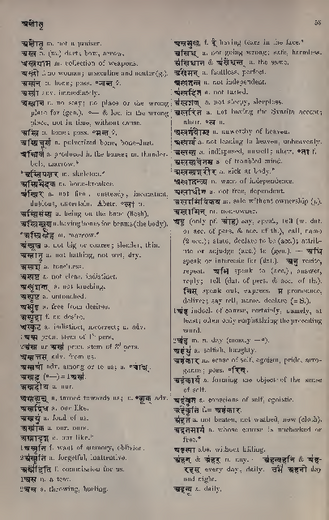
asmad ·(°--) = asmá1.
Monier-Williams 1872 Worttyp nicht bestimmt
Originaltext · Englisch · Worttyp nicht bestimmt
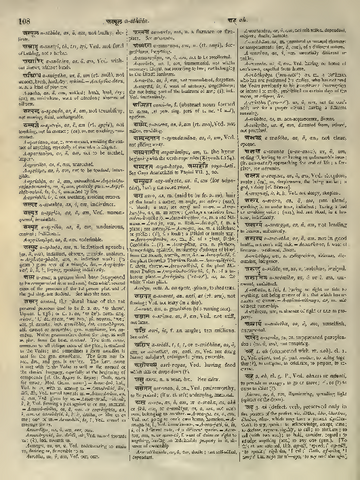
asmad asmad, the plural base of the 1st personal pronoun (said to be fr. 2. as, ‘to throw’, Uṇ-sūt. I. 138; or fr. 1. as, ‘to be’), nom. sing. aham, ‘I,’ du. āvām, ‘we two,’ pl. vayam, ‘we;’ acc. pl. asmān, inst. asmābhis, dat. asmabhyam, abl. asmat or asmattas, gen. asmākam, loc. as- māsu. Native grammarians derive the sing. as well as plur. from the base, asmad. The form asme, common to all oblique cases of the plur., is confined to the Vedas; and sometimes a form asmāka is used for the gen. asmākam. The form nas for acc., dat., and gen. is enclitic. The form asma is met with in the Vedas as well as the asmad of the classical language, especially at the beginning of compounds [cf. Gr. ἄμμες fr. ἄσμες Goth. unsa for usna; Mod. Germ. unser].
Apte 1890 Pronomen · Substantiv Maskulin
Originaltext · Englisch · Pronomen · Substantiv Maskulin
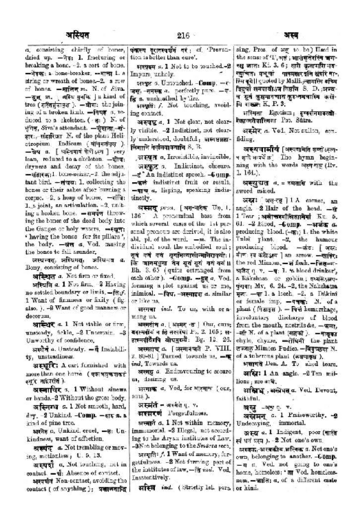
asmad pron. [as-madik Uṇ. 1. 136] A pronominal base from which several cases of the 1st personal pronoun are derived; it is also abl. pl. of the word. — m. The individual soul, the embodied soul; yūyaṃ vayaṃ vayaṃ yūyamityāsīnmatirāvayoḥ . kiṃ jātamadhunā yena yūyaṃ yūyaṃ vayaṃ vayaṃ .. Bh. 3. 65 (quite estranged from each other). Comp. — druh a. Ved. forming a plot against us or me, inimical. — vidha, -asmādṛśa a. similar or like us.
Quelltextfundstellen (106)
DYS 5 Fundstellen
GoS 4 Fundstellen
HP 5 Fundstellen
HTK 1 Fundstelle
HTK 10.34*2–38*1: Asvaṅgaśṛṅkhalā und Kumbhāntaraśṛṅkhalā 1 Fundstelle
Direkt belegt
-
HTK 10.37 Segment 25
IVU 5 Fundstellen
MAN 11 Fundstellen
Bhadram-Śānti-Mantra 4 Fundstellen
Direkt belegt
-
MAN BS 3.1 Segment 2
-
MAN BS 3.2 Segment 2
-
MAN BS 4.1 Segment 2
-
MAN BS 4.2 Segment 2
Pavamāna-Mantra 3 Fundstellen
Direkt belegt
Sahanāvavatu 3 Fundstellen
Direkt belegt
-
MAN SA 1.1 Segment 2
-
MAN SA 1.2 Segment 2
-
MAN SA 2.2 Segment 2
MandUp 1 Fundstelle
SiSa 43 Fundstellen
SiSa 1.32-1.34: Selbst als Ursprung 6 Fundstellen
Direkt belegt
Weitere 16 Quelltextseiten
SiSa 3.1-3.10: Herzlotus und Prāṇa 2 Fundstellen
Direkt belegt
SiSa 5.1-5.2: Hindernisse der Befreiung 2 Fundstellen
Direkt belegt
SiSa 5.48-5.71: Innere Meditation 2 Fundstellen
Direkt belegt
SiSa 5.156-5.181: Sahasrāra 5 Fundstellen
Direkt belegt
-
SiSa 5.160 Segment 6
-
SiSa 5.160 Segment 10
-
SiSa 5.179 Segment 7
-
SiSa 5.180 Segment 9
-
SiSa 5.181 Segment 15
SiSa 5.182-5.190: Sahasrāra-Mond 2 Fundstellen
Direkt belegt
-
SiSa 5.182 Segment 2
-
SiSa 5.190 Segment 12
SiSa 5.191-5.207: Kailāsa und Mahāśūnya 2 Fundstellen
Direkt belegt
-
SiSa 5.206 Segment 4
-
SiSa 5.206 Segment 13
SiSa 5.208-5.222: Rājayoga 5 Fundstellen
Direkt belegt
-
SiSa 5.208 Segment 3
-
SiSa 5.212 Segment 10
-
SiSa 5.213 Segment 25
-
SiSa 5.214 Segment 1
-
SiSa 5.214 Segment 10
SVU 15 Fundstellen
Weitere 4 Quelltextseiten
SVU 4.17-4.22: Erkenntnis und Schutz 6 Fundstellen
Direkt belegt
VBT 16 Fundstellen
VBT 93–100: Schmerz und Wunsch 3 Fundstellen
Direkt belegt
Mit AYI Free weitermachen
Bildquelle: AYI Archiv.