

ta त – participial suffix -ta
adjective · pronoun · substantive feminine · substantive masculine · substantive neuter · suffix · Word type unspecified
Dictionary sources
AYI dictionary suffix
participial suffix -ta
Cappeller 1891 pronoun
Original text · English · pronoun
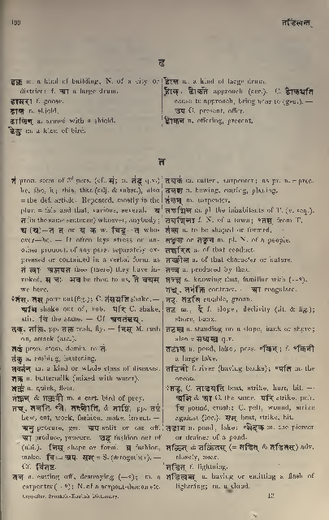
tá ·pron. stem of 3^d pers. (cf. sá; n. tád q.v.) he, she, it; this, that (adj. & subst.), also = the def. article. Repeated, mostly in the plur. = this and that, various, several. ya ta (in the same sentence) whoever, anybody; ya (ya) -- ta ta or ya ka w. cid -- ta whoever-he. -- It often lays stress on an other pronoun of any pers. separately expressed or contained in a verbal form, as taṃ tvā -- ahvaṣata thee (there) they have invoked, sa naḥ--bhava be thou to us, te vayam we here.
Monier-Williams 1872 substantive masculine · Word type unspecified
Original text · English · substantive masculine
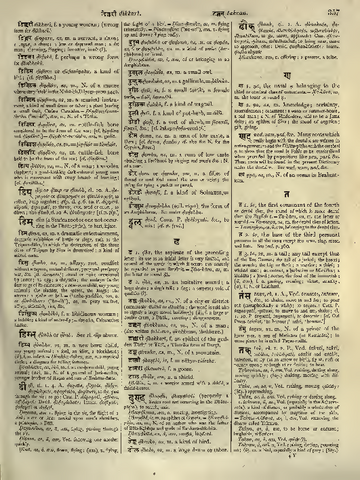
ta 3 . ta, as, m. a tail; any tail except that of the Bos Gaurus; the tail of a jackal; the breast; the womb; the hip or flank; a warrior; a thief; a wicked man; an outcast, a barbarian or Mleccha; a Buddha; a jewel; nectar, the food of the immortals; (ā, am), f. n. passing, crossing; virtue, sanctity; (ā), f., N. of Lakṣmī.
Original text · English · Word type unspecified
ta 1 . ta, the first consonant of the fourth or dental class, the sound of which is more dental than the English t.
Original text · English · Word type unspecified
ta 2 . ta, the base of the third personal pronoun in all the cases except the nom. sing. masc. and fem. See tad, p. 360.
Petersburger 1855 substantive feminine · substantive masculine · substantive neuter · Word type unspecified
Original text · German · substantive feminine · substantive masculine · substantive neuter
2. ta 1〉 m. a〉 Schwanz überh. MED. t. 1. = gauravivarjitapuccha ein anderer Schwanz als der des Bos Gaurus und kroṣṭupuccha der Schwanz eines Schakals EKĀKṢARAK._im_ŚKDR. — b〉 Brust MED. — c〉 Mutterleib ŚABDAR._im_ŚKDR. — d〉 Kämpfer EKĀKṢARAK. — e〉 Dieb MED. — f〉 Bösewicht ŚABDAR. — g〉 ein Mleccha MED. — h〉 ein Buddha (sugata) EKĀKṢARAK. — i〉 Edelstein ebend. — k〉 Unsterblichkeitstrank MED. — 2〉 f. n. a〉 das Ueberschiffen, Uebersetzen. — b〉 reine Werke MED. — 3〉 f. tā N. der Lakṣmī H. 226.

Original text · German · substantive neuter
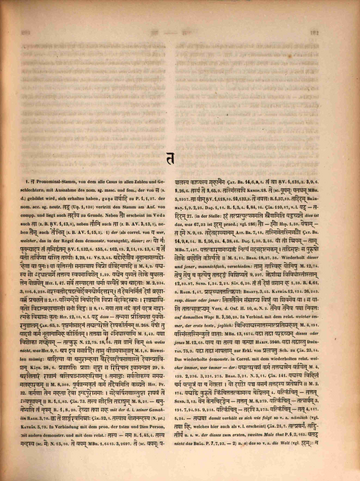
1. ta Pronominal-Stamm, von dem alle Casus in allen Zahlen und Geschlechtern, mit Ausnahme des nom. sg. masc. und fem., der von sa (s. d.) gebildet wird, sich erhalten haben, gaṇa sarvādi zu P. 1,1,27. der nom. acc. sg. neutr. tad (Uṇ. 1,130) vertritt den Stamm am Anf. von compp. und liegt auch tadīya zu Grunde. Neben tau erscheint im Veda auch tā (z. B. ṚV. 1,13,8), neben tā́ni auch tā (z. B. AV. 3,13,1), neben tais auch tébhis (z. B. AV. 1,15,3). 1〉 der (als correl. von ya wer, welcher, das in der Regel dem demonstr. vorangeht), dieser; er: yo nàḥ pṛta̱nyādapa̱ taṃ ta̱middhàtam ṚV. 1,132,6. ṚV. 1,155,4. ṚV. 1,162,19. ṚV. 2,11,19. ṚV. 2,13,1. na tè va̱rtā tavìṣyā asti̱ tasyā̀ḥ ṚV. 5,29,14. VS. 3,45. adroheṇaiva bhūtānāmalpadroheṇa vā punaḥ . yā vṛttistāṃ samāsthāya vipro jīvedanāpadi .. M. 4,2. yadyasya so 'dadhātsarge tattasya svayamāviśet M. 1,29. yadyena yujyate loke budhastattena yojayet HIT. I, 47. sarve tasyādṛtā dharmā yasyaite traya ādṛtāḥ M. 2,234. M. 3,106. M. 4,228. sarasvatīdṛṣadvatyordevanadyoryadantaram . taṃ devanirmitaṃ deśaṃ brahmāvartaṃ pracakṣate .. M. 2,17. yasmindeśe niṣīdanti viprā vedavidastrayaḥ . rājñaścādhikṛto vidvānbrahmaṇastāṃ sabhāṃ viduḥ .. M. 8,11. mayā tanna bhadraṃ kṛtaṃ yadatra mārātmake viśvāsaḥ kṛtaḥ HIT. 12,10, v. l. yad dass — tanmayā prītimatā yuvayoranujñātam ŚAK. 65,3. pṛṣṭhamāṃsādanaṃ tadyatparokṣe doṣakīrtanam H. 268. yeṣāṃ tu yādṛśaṃ karma bhūtānāmiha kīrtitam . tattathā vo 'bhidhāsyāmi M. 1,42. yathā viśokā gaccheyam — tatkuru N. 12,79. N. 18,16. tanna jāne kim ich weiss nicht, was HIT. 9,7. apa eva sasarjādau tāsu vījamavāsṛjat M. 1,8. Bisweilen müssig: ādityā vā asurānhatvā vairadeyādīṣamāṇāste devānprāviśan KĀṬH. 28,6. prajāpatiḥ prajāḥ sṛṣṭvā sa riricāna ivāmanyata KĀṬH. 29,9. arakṣitāraṃ rājānaṃ baliṣaḍbhāgahāriṇam . tamāhuḥ sarvalokasya samagramalahārakam .. M. 8,308. pūrvajanmakṛtaṃ karma taddaivamiti kathyate HIT. Pr. 32. karmaṇā tena mahatā devā indrapurogamāḥ . sadevarṣigaṇāstuṣṭā rāghavaṃ te 'bhyapūjayan .. R. 1,1,83. ŚĀK. 73. tasya sīdati tadrāṣṭram M. 8,21. — anuneṣyati taṃ nṛpam R. 1,8,20. devyā tayā saha mit der d. i. seiner Gemahlin RAGH. 3,70. kva te śārṅgaravamiśrāḥ ŚĀK. 52,1. tasyātha yoganandasya (N. pr.) KATHĀS. 5,79. In Verbindung mit dem pron. der 1sten und 2ten Person, mit andern demonstrr. und mit dem relat.: tasya — mama R. 1,45,4. tasya mandasya (sc. me) N. 15,10. te vayam MBH. 1,6415. MBH. 3,2697. te (sc. vayam) pañcalasya kāpyasya gṛhānaima ŚAT. BR. 14,6,3,1. taṃ tvā ṚV. 1,131,2. ṚV. 3,9,6. ṚV. 9,26,6. tasyà te ṚV. 9,65,9. tasmiṃstvayi KENOP. 18. te (sc. yūyam) yatadhvam MBH. 5,5957. tā vā̀m ṚV. 1,118,10. ṚV. 10,132,2. te bhavantaḥ R. 1,57,19. tadidam BRĀHMAṆ. 1,9. BRĀHMAṆ. 2,25. DAŚ. 1,11. R. 1,5,4. R. 6,84,16. ŚĀK. 110,17, v. l. yad — tadidam ŚĀK. 27. (in der Stelle: idaṃ tatpratyutpannamati straiṇamiti yaducyate dies ist das, was ŚĀK. 67,23 ist idam praed.; vgl. 186) tau — imau HIḌ. 1,38. yeṣām — ta ime N. 9,19. tadetadākhyānam AIT. BR. 7,18. tasminnetasminnagnau ŚAT. BR. 14,9,1,14. R. 1,56,24. R. 4,38,46. DAŚ. 1,30. DAŚ. 2,56. yāṃ tāṃ śriyam — tām MBH. 7,427. yattatkāraṇamavyaktaṃ nityaṃ sadasadātmakam . tadvisṛṣṭaḥ sa puruṣo loke brahmeti kīrtyate .. M. 1,11. BHAG. 18,37. BHAG. 18,38. Wiederholt dieser und jener, mannichfach, verschieden: tāsu tāsviha yoniṣu M. 12,74. teṣu teṣu ca kṛtyeṣu tattadaṅgaṃ viśiṣyate M. 9,297. kleśāṃśca vividhāṃstāṃstān M. 12,80. M. 12,87. SUND. 1,34. SUND. 2,21. SĀV. 6,20. taṃ taṃ deśaṃ jagāma ha SĀV. 1,38. R. 4,61,8. RAGH. 1,47. prārabdhatattatkriyāḥ BHARTṚ. 3,45. KATHĀS. 12,124. KATHĀS. 26,243. resp. dieser oder jener: tilatailena saṃsnāpya viṣṇuṃ vā śivameva vā . sa yāti tattatsārūpyam Verz. d. Oxf. H. 10,a, N. 2. tenaiva tenaiva pathā nivṛttaḥ auf demselben Wege R. 3,50,28. In Verbind. mit dem relat. welcher immer, der erste beste, jeglich: bibhiyādyasmāttasmātpratigrahāt M. 4,191. yasmiṃstasminkule jātāḥ MBH. 13,1674. yadvā tadvā paradravyam dieses oder jenes M. 12,68. yasya vā tasya vā kanyā HARIV. 5940. yadvā tadvāstu DHŪRTAS. 75,9. yadvā tadvā bhāṣatām zur Erkl. von pralapatu Sch. zu ŚĀK. 23,14. Das wiederholte demonstr. in Correl. mit dem wiederholten relat. welcher immer, wer immer — der: yadyatparavaśaṃ karma tattadyatnena varjayet M. 4,159. M. 2,236. M. 3,231. M. 3,275. BHAG. 3,21. N. 5,11. ŚĀK. 141. yadyasya vihitaṃ carma yatsūtraṃ yā ca mekhalā . yo daṇḍo yacca vasanaṃ tattadasya vrateṣvapi .. M. 2,174. yadyaddhi kurute kiṃcittattatkāmasya ceṣṭitam M. 4. yatkiṃcit — tattat SUND. 3,13. yena kenacidaṅgena — tattat M. 8,279. yatkiṃcit — tatsarvam M. 3,191. M. 7,94. M. 7,95. M. 9,218. yatkiṃcit — tadapi M. 3,273. yatkiṃcit — tat M. 4,117. M. 5,24. — tadyathā damit verhält es sich wie folgt so v. a. nämlich (vgl. tathā hi, welches hier auch als v. l. erscheint) ŚĀK. 21,7. tatprathamá, taddvitīyá u. s. w. der dieses zum ersten, zweiten Male thut P. 6,2,162. atad nicht das BHĀG. P. 7,7,23. — 2〉 n. a〉 das so v. a. die Welt (vgl. idam): na tadasti tvayā vinā R. 6,102,25. — b〉 das (im Gegens. zu tvam) zur Bez. Brahmanʼs oder des Absolutum; vgl. u. tattva. — tad, tasmāt, tena s. besonders und vgl. auch tatama, tatara, tatas, tati, tatra, tathā, tadā, tāt.
Original text · German · Word type unspecified
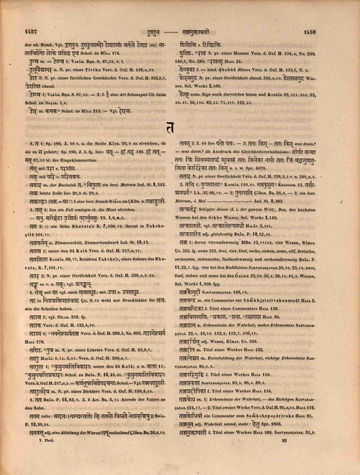
1. ta 1〉 Sp. 189, Z. 10 v. u. die Stelle KĀṬH. 29,9 zu streichen, da sie zu sa gehört; Sp. 190, Z. 5. fg. lies: yat — idaṃ tad 186. idaṃ tat — yat 67,23 st. des Eingeklammerten.
Böhtlingk 1879 adjective · substantive feminine · substantive masculine · substantive neuter · Word type unspecified
Original text · German · adjective
1. tá Pronomialstamm der 3ten Person in allen Casus und Zahlen mit Ausnahme des Nom. Sg. m. und f. Am Anfange eines Comp. tad. — 1〉 Adj. Subst. der (als Correl. von ya, des in das Regel vorangeht), dieser, er. Nicht selten in Verbindung mit dem Pron. oder einem Verbum fin. der 1ten oder 2ten Person, mit einem andern Demonstr. und dem Relat. (in demselben Satze). nach einem Substantiv hebt es dieses in irgend einer Beziehung hervor. MBH. 3,67,10 ist tasya mandasya so v. a. mamama˚. Wiederholt dieser und jener, mannichfach, jeglich, respective dieser oder jener. tenaiva tenaiva pathā ganz auf demselben Wege. In Verbindung mit dem Relat. in demselben Satze (mit oder ohne vā nach jedem Pron.) welcher immer, der erste beste, jeglich. Wiederholt in Correl. mit dem einfachen oder wiederholten Relat. welcher immer, wer immer — der. Statt des zweiten Relativs auch 1. ka mit cid, in welchem Falle auch ein einfaches ta folgt. tadyathā damit verhält es sich wie folgt, nämlich. — 2〉 n. tad — a〉 dieses, so v. a. die Welt. — b〉 im künstlich zerlegten tattvam (asi) als das Brahman gedeutet.
Original text · German · substantive feminine · substantive masculine · substantive neuter
3. *ta — 1〉 m. — a〉 Schwanz, — eines Schakals, jeglicher Schwanz mit Ausnahme des vom Bos gaurus. — b〉 Brust. — c〉 Mutterleib. — d〉 Kämpfer. — e〉 Dieb. — f〉 Bösewicht. — g〉 ein Mleccha. — h〉 ein Buddha. — i〉 Edelstein. — k〉 Nektar. — 2〉 f. ā Bein. der Lakṣmī. — 3〉 f. n. — a〉 das Ueberschiffen, Uebersetzen. — b〉 das Gute, Rechte.
Original text · German · Word type unspecified
2. ta in der enklitischen Form te Gen. Dat. Instr. (VĀMANA 5,2. 11) zu tvam.
Original text · German · Word type unspecified
2. ta, te auch Acc.; s. PISCHEL in Z. d. d. m. G. 33,714. fg. [Nachtrag, Band 3]
Original text · German · Word type unspecified
2. ta III. 3. [Nachtrag, Band 7]
Apte 1890 substantive masculine
Original text · English · substantive masculine
taḥ 1 A tail. 2 The tail of a jackal. 3 The breast. 4 The womb. 5 The hip or flank. 6 A warrior. 7 A thief. 8 A wicked man. 9 An outcast, a barbarian. 10 A Bud dha. 11 A jewel. 12 Nectar. 13 (In prosody) One of the eight syllabic feet. — tā, -taṃ 1 Passing, crossing. 2 Virtue, religious merit. — tā N. of Lakṣmī.
Cappeller 1887 pronoun
Original text · German · pronoun
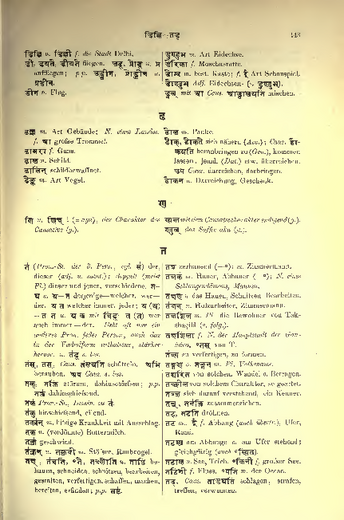
tá (Pron.-St. der 3. Pers., vgl. sá) der, dieser (adj. u. subst.); doppelt (meist Pl.) dieser und jener, verschiedene. taya u. ya—ta derjenige—welcher, wer— der. ya ta welcher immer, jeder; ya (ya) —ta ta u. ya ka mit cid—ta (ta) wer auch immer—der. Hebt oft nur ein anderes Pron. jeder Person, auch das in der Verbalform enthaltene, stärker hervor. n. tád s. bes.
Burnouf 1866 substantive masculine · Word type unspecified
Original text · French · substantive masculine
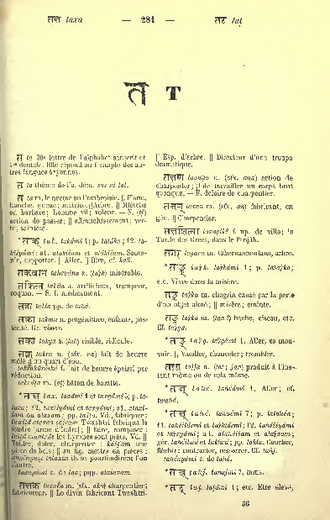
ta ta m. le nectar ou l'ambroisie. Flanc, hanche, queue; matrice. Arbre. Mleccha ou barbare; homme vil; voleur. — N. (tṝ) action de passer; affranchissement; vertu, sainteté.
Original text · French · Word type unspecified
ta ta 30ᵉ lettre de l'alphabet sanscrit et 1ʳᵉ dentale. Elle répond au t simple des autres langues âryennes.
Original text · French · Word type unspecified
ta ta thême de l'a. dém. sas sā tat.
Derived words
Occurrences in source texts (140)
DYS 6 occurrences
DYS 108–111: Suṣumnā 2 occurrences
Occurrences through derived words
GoS 6 occurrences
GoS 81–88: Moon, Fluid and Union 2 occurrences
Occurrences through derived words
GoS 101–101.1: Turning Enjoyment Inwards 1 occurrence
Occurrences through derived words
-
GoS 101 Segment 32
HP 24 occurrences
12 more source pages
HP 4.0*1-4.0*14: Samādhi and Laya 1 occurrence
Occurrences through derived words
-
HP 4.0*11 Segment 1
HP 4.1-4.4: Laya and Breath 2 occurrences
Occurrences through derived words
HP 4.12-4.19: Path of Nāda 2 occurrences
Occurrences through derived words
HP 4.20-4.27: Four Stages of Nāda 2 occurrences
Occurrences through derived words
HP 4.37-4.46: Listening to Nāda 2 occurrences
Occurrences through derived words
HP 4.47-4.55*4: Nāda Binds the Mind 2 occurrences
Occurrences through derived words
HTK 5 occurrences
HTK 10.0*1–5: Sītkā, Śītalī and Sūryabheda 1 occurrence
Occurrences through derived words
-
HTK 10.4 Segment 7
HTK 10.17*2–18: Bhrāmarī: The sound of bees 1 occurrence
Occurrences through derived words
-
HTK 10.18 Segment 17
HTK 10.33*2–34*1: Bhūtaśuddhi: Purifying the elements 3 occurrences
Occurrences through derived words
-
HTK 10.33*2 Segment 2
-
HTK 10.34 Segment 10
-
HTK 10.34*1 Segment 2
IVU 3 occurrences
MAN 1 occurrence
MandUp 1 occurrence
MandUp 3-7: Four modes of awareness 1 occurrence
Occurrences through derived words
-
MandUp 6 Segment 13
PJH 2 occurrences
PYS 29 occurrences
PYS 1.5–11: The Five Vṛtti 2 occurrences
Occurrences through derived words
PYS 2.18–19: The Evolution of Prakṛti 1 occurrence
Occurrences through derived words
-
PYS 2.18 Segment 5
14 more source pages
PYS 3.9–12: Three Transformations of Citta 3 occurrences
Occurrences through derived words
PYS 3.13–14: Three Kinds of Transformation 1 occurrence
Occurrences through derived words
-
PYS 3.13 Segment 2
PYS 3.17–20: Extraordinary Knowledge 3 occurrences
Occurrences through derived words
PYS 3.29–34: Bodily Locations and Knowledge 1 occurrence
Occurrences through derived words
-
PYS 3.34 Segment 2
PYS 3.44–46: Mastery over the Elements 1 occurrence
Occurrences through derived words
-
PYS 3.44 Segment 7
PYS 4.4–5: Created Cittas 2 occurrences
Occurrences through derived words
PYS 4.15–17: Object and Citta 3 occurrences
Occurrences through derived words
PYS 4.18–21: Puruṣa Knows Citta 2 occurrences
Occurrences through derived words
PYS 4.25–26: Citta Flows toward Kaivalya 1 occurrence
Occurrences through derived words
-
PYS 4.26 Segment 6
SiSa 31 occurrences
SiSa 1.1-1.3: Das eine Wissen 2 occurrences
Occurrences through derived words
SiSa 1.35-1.44: Täuschungs-Gleichnisse 1 occurrence
Occurrences through derived words
-
SiSa 1.43 Segment 9
SiSa 1.51-1.64: Selbst als Licht 2 occurrences
Occurrences through derived words
SiSa 1.71-1.81: Avidyā und Elemente 1 occurrence
Occurrences through derived words
-
SiSa 1.72 Segment 1
SiSa 1.93-1.99: Karmische Verkörperung 3 occurrences
Occurrences through derived words
13 more source pages
SiSa 2.13-2.20: Suṣumṇā und Citrā 1 occurrence
Occurrences through derived words
-
SiSa 2.19 Segment 4
SiSa 3.61-3.67: Paricaya und Niṣpatti 2 occurrences
Occurrences through derived words
SiSa 4.26-4.30: Mahāmudrā-Praxis 2 occurrences
Occurrences through derived words
SiSa 5.48-5.71: Innere Meditation 4 occurrences
Occurrences through derived words
SiSa 5.94-5.101: Mūlādhāra-Siddhis 1 occurrence
Occurrences through derived words
-
SiSa 5.96 Segment 4
SiSa 5.182-5.190: Sahasrāra-Mond 1 occurrence
Occurrences through derived words
-
SiSa 5.187 Segment 4
SiSa 5.191-5.207: Kailāsa und Mahāśūnya 4 occurrences
Occurrences through derived words
-
SiSa 5.193 Segment 13
-
SiSa 5.195 Segment 1
-
SiSa 5.199 Segment 5
-
SiSa 5.200 Segment 1
SS 14 occurrences
SS 1.12–1.16: Stages of Wonder 2 occurrences
Occurrences through derived words
SS 1.19–1.21: Śakti and Creation 3 occurrences
Occurrences through derived words
SS 3.4–3.5: Reabsorbing the Elements 3 occurrences
Occurrences through derived words
SVU 9 occurrences
VBT 9 occurrences
VBT 93–100: Pain and Desire 2 occurrences
Occurrences through derived words
VBT 110–120: Everyday as Gate 3 occurrences
Occurrences through derived words
Continue with AYI Free
Image source: AYI archive.