

abhyāsa अभ्यास – Praxis; Übung; Wiederholung; Gewohnheit
Substantiv Maskulin · Worttyp nicht bestimmt
Wörterbuchquellen
AYI Wörterbuch Substantiv Maskulin
Praxis; Übung; Wiederholung; Gewohnheit
Cappeller 1891 Substantiv Maskulin
Originaltext · Englisch · Substantiv Maskulin
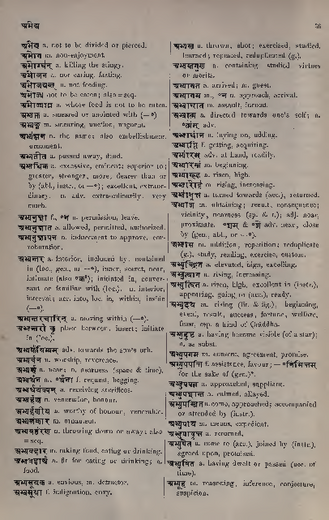
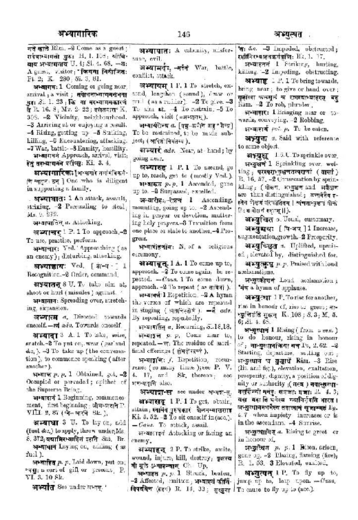
abhyāsa ·m. addition. repetition; reduplicate (g.), study, reading, exercise, custom.
Monier-Williams 1872 Substantiv Maskulin · Worttyp nicht bestimmt
Originaltext · Englisch · Substantiv Maskulin
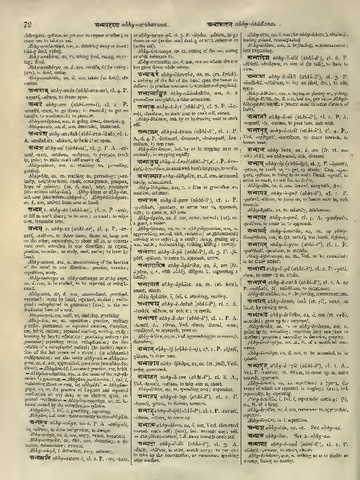
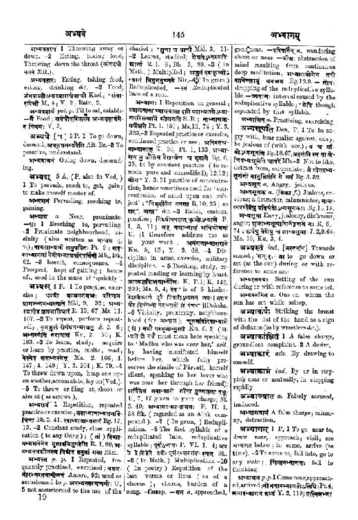
Abhy-āsa, as, m. repetition; practice, military practice, permanent or repeated exercise, discipline, use, habit, custom; repeated reading, reciting, study; learning by heart; education; practising archery; (in grammar) repeating twice, reduplication; the first syllable of a reduplicated radical; (in poetry) repeti- tion of the last verses of a stanza; (in arithmetic) multiplication: see also under abhy-aś.
Originaltext · Englisch · Worttyp nicht bestimmt
abhyāsa abhy-āsa. See 2. abhy-as.
Petersburger 1855 Substantiv Maskulin · Worttyp nicht bestimmt
Originaltext · Deutsch · Substantiv Maskulin
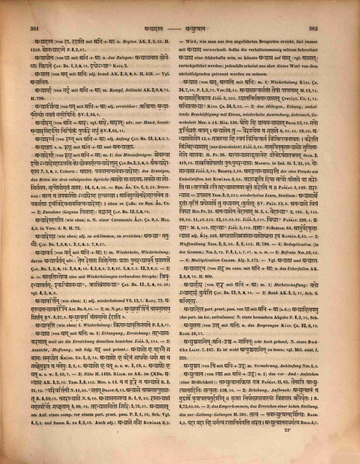
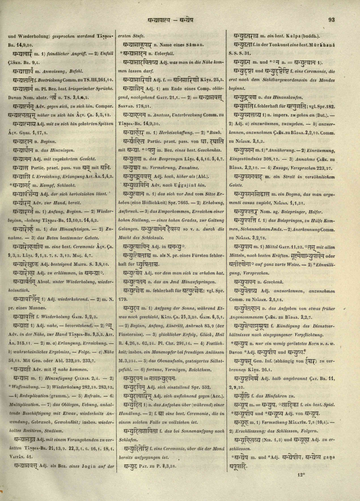
abhyāsa (von as, asyati mit abhi) m. 1〉 Wiederholung KĀTY. ŚR. 24,7,20. P. 1,3,71. VOP. 23,54. abhyāsātkarmaṇāṃ teṣāṃ pāpānām M. 12,74. abhyāsādekaikasya YĀJÑ. 3,323. dhyānanirmathanābhyāsāt ŚVETĀŚV. UP. 1,14. abhiplavābhyā˚ KĀTY. ŚR. 24,3,33. — 2〉 das Obliegen, Uebung, anhaltende Beschäftigung mit Etwas, wiederholte Anwendung, Gebrauch, Gewohnheit MED. s. 14. HĀR. 150. śreyo hi jñānamabhyāsāt BHAG. 12,12. mano durnigrahaṃ calam . abhyāsena tu — vairāgyeṇa ca gṛhyate BHAG. 6,35. BHAG. 6,44. BHAG. 18,36. abhyāsayogena BHAG. 12,9. tatrātmā hi svayaṃ kiṃcitkarma kiṃcitsvabhāvataḥ . karoti kiṃcidabhyāsāt (aus Gewohnheit) YĀJÑ. 3,68. mātṛpitṛkṛtābhyāso guṇitāmeti bālakaḥ H. Pr. 36. asyābhyāsādghṛtasyeha jīvedvarṣaśatatrayam SUŚR. 2,419,19. śastraviśeṣāṇāṃ punaḥpunarabhyāsaḥ MADHUS._in_Ind. St. 1,21,26. yogābhyāsa YĀJÑ. 3,51. BHARTṚ. 1,96. amaṅgalābhyāsarati der eine Freude am Unheilstiften hat KUMĀRAS. 5,65. yadvāñchati divā martyo vīkṣate vā karoti vā . tatsvapne 'pi tadabhyāsāttathā brūte karoti ca .. PAÑCAT. I, 149. śarābhyāsa = upāsana TRIK. 3,3,231. wiederholtes Lesen, Studium: abhyāsārthe drutāṃ vṛttiṃ prayogārthe tu madhyamām (kuryāt) ṚV. PRĀT. 13,9. anabhyāse viṣaṃ vidyā HIT. Pr. 21. anabhyāsena vedānām M. 5,4. vedābhyā˚ M. 2,166. M. 4,148. M. 10,80. M. 11,46. M. 11,245. M. 12,31. M. 12,83. M. 12,92. YĀJÑ. 3,311. vidyā˚ PAÑCAT. 220,4. brahmā˚ M. 4,149. tadabhyā˚ YĀJÑ. 3,112. tattvā˚ SĀṂKHYAK. 64. āyurvedakṛtābhyāsa adj. CĀṆ. 103. andhatāmisravāsābhyāsodyatā iva KATHĀS. 4,63. — 3〉 Waffenübung TRIK. 3,2,20. TRIK. 3,3,442. H. 788. — 4〉 Reduplication (in der Gramm.) NIR. 5,12. P. 6,1,4. P. 6,1,7. P. 6,1,17. u. s. w. — 5〉 Refrain NIR. 10,42. — 6〉 Multiplication COLEBR. Alg. 5. COLEBR. Alg. 171. — Vgl. abhyāśa und abhyasta.
Originaltext · Deutsch · Worttyp nicht bestimmt
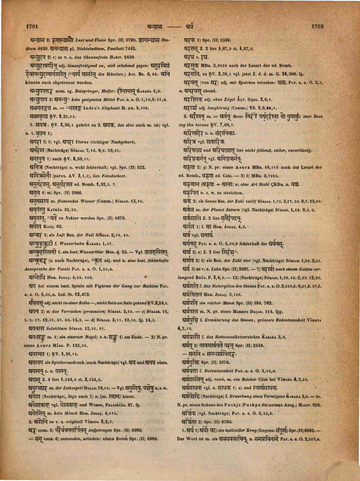
abhyāsa 2〉 rucyabhyāsau Lust und Fleiss Spr. (II) 5790. jñānābhyāsa Studium Spr. (II) 4839. anabhyāsa pl. Nichtstudium, Faulheit Spr. (II) 7442.
Böhtlingk 1879 Substantiv Maskulin
Originaltext · Deutsch · Substantiv Maskulin
abhyāsa m. — 1〉 Hinzufügung ŚULBAS. 2,4. — 2〉 *Waffenübung. — 3〉 Wiederholung Chr. 282,28. Chr. 283,12. — 4〉 Reduplication (gramm.). — 5〉 Refrain. — 6〉 Multiplication. — 7〉 das Obliegen, Uebung, anhaltende Beschäftigung mit Etwas, wiederholte Anwendung, Gebrauch, Gewohnheit; insbes. wiederholtes Recitiren, Studium.
Apte 1890 Substantiv Maskulin · Worttyp nicht bestimmt
Originaltext · Englisch · Substantiv Maskulin
abhyāsaḥ 1 Repetition in general; vyākhyātā vyākhyātā iti padābhyāso' dhyāyaparisamāptiṃ dyotayati Ś. B.; nābhyāsakramamīkṣate Pt. 1. 151; Ms. 12. 74; Y. 3. 323. 2 Repeated practice or exercise, continued practice or use; avirataśramābhyāsāt K. 30, Pt. 1. 133; abhyāsena tu kauṃteya vairāgyeṇa ca gṛhyate Bg. 6. 35, Bg. 6. 44 by constant practice (to remain pure and unmodified); Bg. 12. 12; yoga˚ Y. 3. 51 practice of concentration; hence sometimes used for ‘concentration of mind upon one subject’; ˚nigṛhītena manasā R. 10. 23; so śara˚, astra˚ &c. 3 Habit, custom, practice; mithyopapadāt kṛño'bhyāse P. I. 3. 71; tad yathābhyāsaṃ abhidhīyatāṃ U. 1 therefore address me as is your wont; amaṃgalābhyāsaratiṃ Ku. 5. 65; Y. 3. 68. 4 Discipline in arms, exercise, military discipline. 5 Reciting, study, repeated reading or learning by heart; kāvyajñaśikṣayābhyāsaḥ K. P. 1; K. 146, K. 200; Ms. 5. 4; veda˚ is of 5 kinds: -vedasvīkaraṇaṃ pūrvaṃ vicāro'bhyasanaṃ japaḥ . taddānaṃ caiva śiṣyebhyo vedābhyāso hi paṃcadhā .. Dakṣa. 6 Vicinity, proximity, neighbourhood (for abhyāśa); cūtayaṣṭirivābhyāse (śe) madhau parabhṛtonmukhī Ku. 6. 2; ( abhyāse-śe madhau must mean here speaking to ‘Madhu who was near her,’ scil. by having manifested himself before her, which fully preserves the simile of Pārvatī, herself silent, speaking to her lover who was near her through her friend); arpiteyaṃ tavābhyāse sītā puṇyavratā vadhūḥ U. 7. 17 given in your charge; Śi. 3. 40; abhyāsā-śā-dāgataḥ P. II. 1. 38 Sk. (regarded as an Aluk compound). 7 (In gram.) Reduplication. 8 The first syllable of a reduplicated base, reduplicative syllable; pūrvo'bhyāsaḥ P. VI. 1. 4; atra ye dve vihite tayoḥ pūrvo'bhyāsasaṃjñaḥ syāt Sk. 9 (In Math.) Multiplication. 10 (In poetry) Repetition of the last verses or lines (as of a chorus); chorus, burden of a song. Comp. — gata a. approached, ([Page 0145-c]) gone near. — parivartin a. wandering about or near. — yogaḥ abstraction of mind resulting from continuous deep meditation; abhyāsayogena tato māmicchāptuṃ dhanaṃjaya Bg. 12. 9. — lopaḥ dropping of the reduplicative syllable. — vyavāyaḥ interval caused by the reduplicative syllable; ˚yepi though separated by this syllable.
Originaltext · Englisch · Worttyp nicht bestimmt
abhyāśa -sa see under abhyaś-s.
Cappeller 1887 Substantiv Maskulin
Originaltext · Deutsch · Substantiv Maskulin
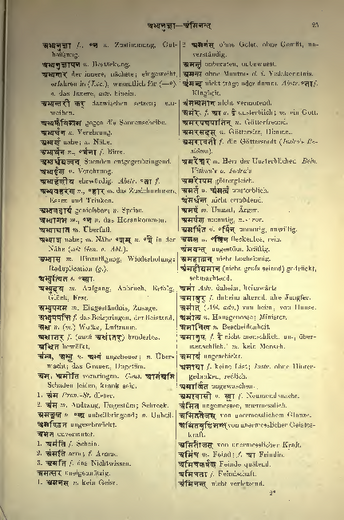
abhyāsa m. Hinzufügung, Wiederholung; Reduplication (g).
Quelltextfundstellen (137)
DYS 35 Fundstellen
DYS 39–42: Praxis zählt 3 Fundstellen
Direkt belegt
Weitere 14 Quelltextseiten
DYS 106–107: Ghaṭa und Paricaya 3 Fundstellen
Direkt belegt
DYS 154–167: Vajrolī für den männlichen Yogi 2 Fundstellen
Direkt belegt
DYS 168–179*1: Vajrolī für die Yoginī 6 Fundstellen
Direkt belegt
GoS 5 Fundstellen
HP 31 Fundstellen
Weitere 16 Quelltextseiten
HP 3.87-3.93*7: Sahajolī und Amarolī 3 Fundstellen
Direkt belegt
HP 3.94-3.102*1: Śakti-Cālana 3 Fundstellen
Direkt belegt
-
HP 3.97*3 Segment 11
-
HP 3.101*1 Segment 13
-
HP 3.102 Segment 1
HTK 3 Fundstellen
PYS 4 Fundstellen
SiSa 58 Fundstellen
SiSa 3.34-3.38: Förderliche Mittel 3 Fundstellen
Direkt belegt
SiSa 3.41-3.48: Atemkraft und Hindernisse 2 Fundstellen
Direkt belegt
SiSa 3.61-3.67: Paricaya und Niṣpatti 2 Fundstellen
Direkt belegt
Weitere 25 Quelltextseiten
SiSa 4.9-4.20: Yonimudrā-Geheimnis 8 Fundstellen
Direkt belegt
SiSa 5.21-5.23: Adhimātra und Haṭhayoga 2 Fundstellen
Direkt belegt
SiSa 5.38-5.47: Nāda-Laya 5 Fundstellen
Direkt belegt
SiSa 5.48-5.71: Innere Meditation 5 Fundstellen
Direkt belegt
SiSa 5.94-5.101: Mūlādhāra-Siddhis 2 Fundstellen
Direkt belegt
-
SiSa 5.96 Segment 12
-
SiSa 5.100 Segment 3
SiSa 5.182-5.190: Sahasrāra-Mond 2 Fundstellen
Direkt belegt
-
SiSa 5.186 Segment 3
-
SiSa 5.190 Segment 2
SVU 1 Fundstelle
Mit AYI Free weitermachen
Bildquelle: AYI Archiv.