

in इन् – possessive/agent suffix -in
verbal root · suffix · Word type unspecified · verb
Dictionary sources
AYI dictionary suffix
possessive/agent suffix -in
Monier-Williams 1872 verb
Original text · English · verb
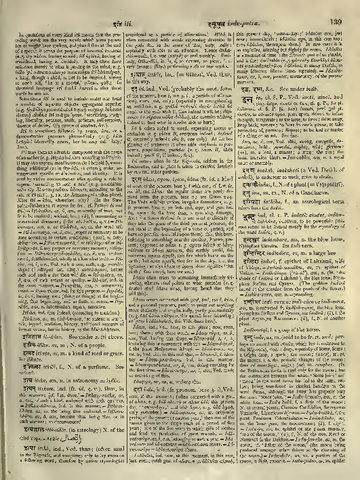
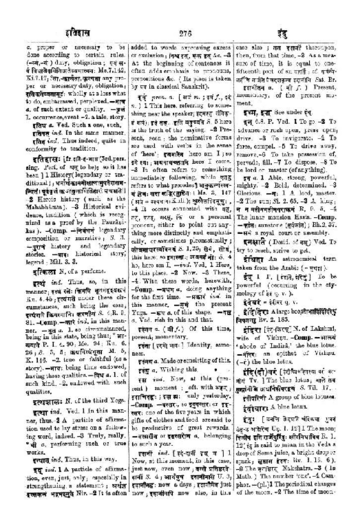
in in, cl. 8. P., Ved. inoti, ainot, 2nd sing. impv. inuhi or inu, cl. 9. P., 1st pl. inīmasi, cl. 6. P. (fr. inv) invati, perf. 3rd pl. invire, to advance upon, press upon, drive; to infuse strength, invigorate; to use force, to force; drive away, keep back, remove; to have in one's power, to take possession of, pervade; dispose; to be lord or master of a thing or an art. See inv.
Petersburger 1855 Word type unspecified
Original text · German · Word type unspecified
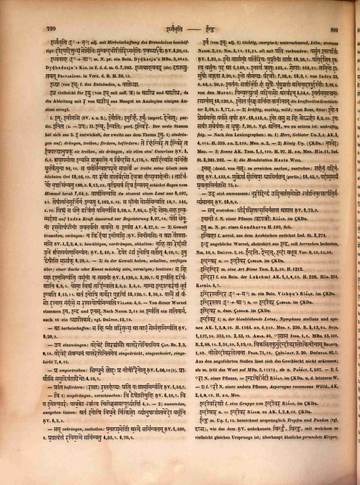
I. in inīmasi (SV. s. u. 2.), inóti; inuhí, inú; imperf. ainot; partic. inita (s. — upa); II. inv, ínvati; perf. invire. Der erste Stamm hat sich aus 3. i entwickelt, der zweite aus dem Thema inu. 1〉 eindringen auf; drängen, treiben; fördern, befördern: te hìnvire̱ ta ìnvire̱ ta ìṣayantyānu̱ṣak sie treiben, sie drängen, sie eilen ohnʼ Unterlass ṚV. 5,6,6. ṛ̱ghā̱yamā̀ṇa invasi̱ śatru̱manti̱ na vìndasi ṚV. 1,176,1. ādìnvasi va̱ninò dhū̱makètunā ṚV. 1,94,10. sa gha̱rmamìnvātpara̱me sa̱dhasthè er treibe seine Gluth zum höchsten Ort ṚV. 10,16,10. yā rucò jā̱tavèdaso deva̱trā hàvya̱vāhànīḥ . tābhìrno ya̱jñamìnvatu ṚV. 188,3. ṚV. 8,13,22. vṛ̱ṣṭimavà di̱va ìnvatam schicket Regen vom Himmel herab ṚV. 7,64,2. vācàminvasi du stossest einen Laut aus ṚV. 9,107,21. teṣā̀mabhi̱gūrtìrna invatu ṚV. 1,162,6. ṚV. 1,162,12. sa dhī̱nāṃ yogàminvati ṚV. 18,7. ṚV. 141,4. ṚV. 1,10. viśva̱ṃ sa dhàtte̱ dravìṇa̱ṃ yaminvàsi ṚV. 5,28,2. ṚV. 7,84,2. indre̱ soma̱ḥ saha̱ inva̱nmadā̀ya auf Indra Kraft äussernd zur Begeisterung ṚV. 9,97,10. payò dhenū̱nāṃ rasa̱moṣàdhīnāṃ ja̱vamarvàtāṃ kavayo̱ ya invàtha AV. 4,27,3. — 2〉 Gewalt brauchen, zwängen: na ki dèvā inīmasi̱ (ṚV. minīmasi) na kyā yòpayāmasi SV. I, 2,2,4,2. bewältigen, verdrängen, abhalten: na̱hi tvā̱ rodàsī u̱bhe ṛ̀ghā̱yamā̀ṇā̱minvàtaḥ ṚV. 1,10,8. dveṣo 'gnà i̱noṣi̱ martā̀t ṚV. 4,10,7. i̱nu dveṣā̀ṃsi sa̱dhryàk ṚV. 9,29,4. — 3〉 in der Gewalt haben, schalten, verfügen über; einer Sache oder Kunst mächtig sein, vermögen; besitzen: sa hi ṣmā̱ dāna̱minvàti̱ vasū̀nāṃ ca ma̱jmanā̀ ṚV. 1,128,5. ṚV. 5,30,7. ya invàti̱ dravìṇāni ṚV. 6,5,1. potā̱ viśva̱ṃ tadìnvati ṚV. 2,5,2. ṚV. 3,4,5. nānya indrā̱tkaràṇa̱ṃ bhūyà invati ṚV. 8,15,11. atà inoṣi̱ karvàrā pu̱rūṇì ṚV. 10,120,7. ṚV. 8,39,5. yasmai̱ tvaṃ vàso dā̱nāya̱ maṃhàse̱ sa rā̱yaspoṣàminvati VĀLAKH. 4,6. — Von dieser Wurzel stammen ina, indra und enas. Nach NAIGH. 2,14 ist invàti ein gatikarma, nach NAIGH. 2,18 ein vyāptikarma; vgl. DHĀTUP. 15,78. — ā herbeischaffen: sa hi ṣmā̀ jari̱tṛbhya̱ ā vāja̱ṃ gomànta̱minvàti ṚV. 9,20,2. — upa einzwängen: yadevedaṃ śiraścāṃsau cāntaropenitamiva ŚAT. BR. 3,3,2,18. yadevedaṃ saṃbandhanaṃ cāntaropenitameva eingedrückt, eingeschnürt, eingekerbt ŚAT. BR. 3,7,1,12. — pra emportreiben: sindhu̱rna kṣoda̱ḥ pra nīcī̀rainot ṚV. 1,66,10 (5). prārṇā̀si samu̱driyā̀ṇyainoḥ ṚV. 4,16,7. — prati befordern: (rājā) rā̱tahàvyaḥ prati̱ yaḥ śāsa̱minvàti ṚV. 1,54,7. — vi 1〉 wegdrängen, verscheuchen: vi dveṣā̀ṃsīnuhi ṚV. 6,10,7. vi ya i̱notya̱jaràḥ pāva̱ko 'śnàsya cicchiśnathatpū̱rvyāṇì ṚV. 6,4,3. — 2〉 aussenden, ausgehen lassen: atà inoṣi vidha̱te cìkitvo̱ vyā̀nu̱ṣagjā̀tavedo̱ vasū̀ni ṚV. 6,5,3. — sam zubringen, zutheilen: pa̱nāyya̱mojò a̱sme samìnvatam ṚV. 1,160,5. pra̱jāvàntaṃ ra̱yima̱sme samìnvatu ṚV. 4,53,7. ṚV. 6,70,6.
Original text · German · Word type unspecified
in mit prati, lies bekräftigen.
Böhtlingk 1879 verbal root
Original text · German · verbal root
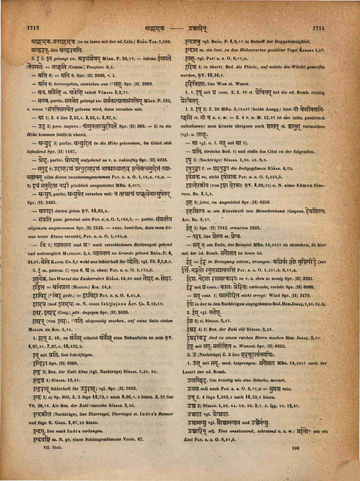
√in s. √inv.
Original text · German · verbal root
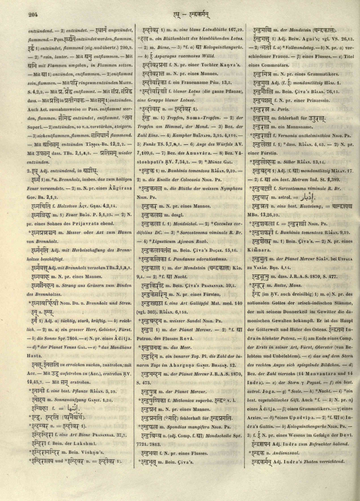
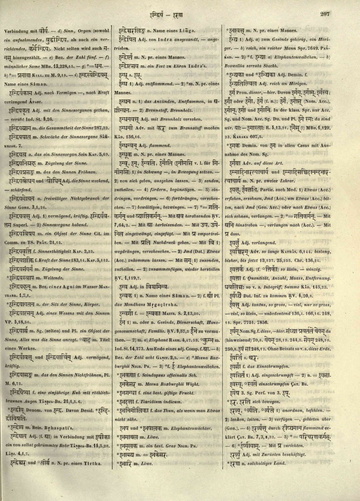
√inv, √in , ínvati, inóti (inīmasi v. l. für minīmasi) — 1〉 in Schwung —, in Bewegung setzen. — 2〉 von sich geben, ausgeben lassen. — 3〉 senden, zutheilen. — 4〉 fördern, begünstigen. — 5〉 eindringen, vordringen. — 6〉 fortdrängen, verscheuchen. — 7〉 bewältigen, bezwingen. — 8〉 *= gatikarman und ˚yāptikarman — Mit ava herabsenden ṚV. 7,64,2. — Mit ā herbeisenden. — Mit upa, upenita eingezwängt, eingefügt. — Mit pra emportreiben. — Mit prati Nachdruck geben. — Mit vi — 1〉 wegdrängen, verscheuchen. — 2〉 Jmd (Dat.) Etwas (Acc.) zukommen lassen. — Mit sam 1〉 zusenden, zutheilen. — 2〉 zusammenfügen, wieder herstellen ṚV. 1,119,7.
Whitney Roots 1885 verbal root
Original text · English · verbal root
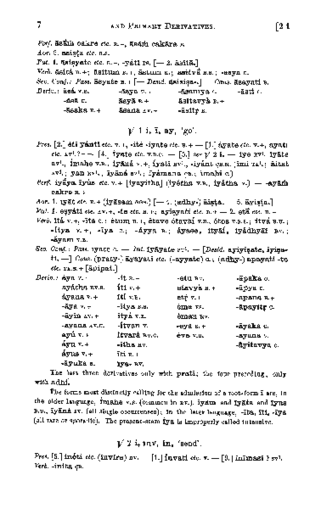
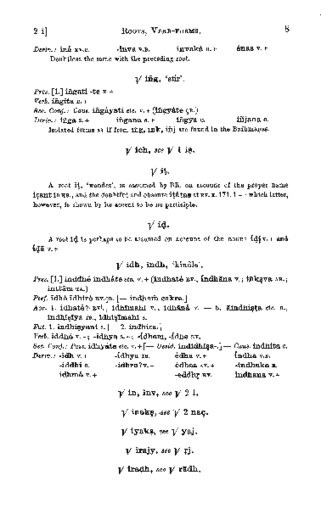
i [2], inv, in — send
Original text · English · verbal root
in, inv → i
Apte 1890 Word type unspecified
Original text · English · Word type unspecified
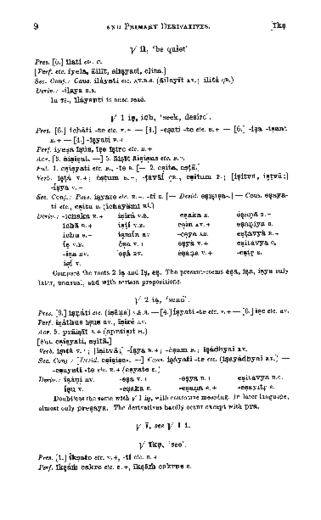
in 6 8 P. Ved. 1 To go. 2 To advance or rush upon, press upon; drive. 3 To invigorate. 4 To force, compel. 5 To drive away, remove. 6 To take possession of, pervade, fill. 7 To dispose. 8 To be lord or master (of anything).
Cappeller 1887 suffix
Original text · German · suffix
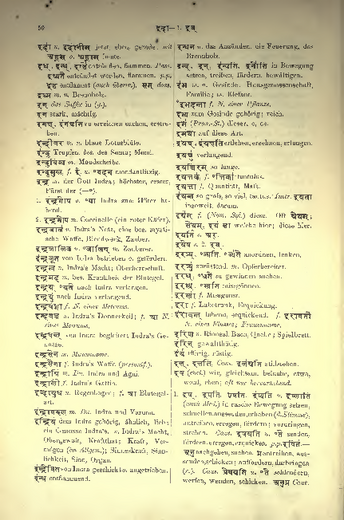
in das Suffix in (g.)
Derived words
More direct derivatives (13)
Further derivatives (2)
Occurrences in source texts (276)
DYS 35 occurrences
DYS 1–1*1: Viṣṇu and Nṛsiṃha 3 occurrences
Occurrences through derived words
DYS 73–78: Kevala Kumbhaka 2 occurrences
Occurrences through derived words
DYS 79–83: Power and Bhūcarasiddhi 3 occurrences
Occurrences through derived words
14 more source pages
DYS 84–86: Preserving Bindu 2 occurrences
Occurrences through derived words
DYS 89–93: Stages of Development 2 occurrences
Occurrences through derived words
DYS 94–97: Pratyāhāra 2 occurrences
Occurrences through derived words
DYS 98–100: Siddhis 2 occurrences
Occurrences through derived words
DYS 112–121: Five Elements 6 occurrences
Occurrences through derived words
DYS 150–153*3: Vajrolī: Secret Teaching 2 occurrences
Occurrences through derived words
DYS 168–179*1: Vajrolī for the Yoginī 1 occurrence
Occurrences through derived words
-
DYS 179*1 Segment 6
DYS 180–183*1: Amarolī and Sahajolī 1 occurrence
Occurrences through derived words
-
DYS 183 Segment 12
DYS 184–187: Rāja Yoga and Perfection 1 occurrence
Occurrences through derived words
-
DYS 186 Segment 15
GoS 6 occurrences
GoS 20–28: Setting Sarasvatī in Motion 1 occurrence
Occurrences through derived words
-
GoS 27 Segment 4
GoS 50–63: Three Locks 3 occurrences
Occurrences through derived words
HP 62 occurrences
HP 1.4-1.10: Lineage of Siddhas 2 occurrences
Occurrences through derived words
HP 1.17-1.32: Āsana 2 occurrences
Occurrences through derived words
31 more source pages
HP 1.44-1.49: Padmāsana 2 occurrences
Occurrences through derived words
HP 1.50–54: Siṃhāsana and Bhadrāsana 2 occurrences
Occurrences through derived words
-
HP 1.50–52 Segment 40
-
HP 1.53–54 Segment 34
HP 1.55-1.57: Transition to Kumbhaka 1 occurrence
Occurrences through derived words
-
HP 1.57 Segment 4
HP 2.1-2.6: Introduction to Prāṇāyāma 3 occurrences
Occurrences through derived words
HP 3.19-3.25: Mahābandha 2 occurrences
Occurrences through derived words
HP 3.33-3.48*1: Khecarī and Soma 4 occurrences
Occurrences through derived words
-
HP 3.34 Segment 12
-
HP 3.34*1–34*2 Segment 29
-
HP 3.41 Segment 7
-
HP 3.46 Segment 33
HP 3.49-3.57: Mūlabandha 2 occurrences
Occurrences through derived words
HP 3.66-3.72: Jālandhara and the Bandhas 1 occurrence
Occurrences through derived words
-
HP 3.70 Segment 13
HP 3.73-3.78: Viparīta Karaṇī 2 occurrences
Occurrences through derived words
HP 3.87-3.93*7: Sahajolī and Amarolī 3 occurrences
Occurrences through derived words
HP 3.94-3.102*1: Śakti Cālana 5 occurrences
Occurrences through derived words
-
HP 3.96 Segment 4
-
HP 3.97*1 Segment 4
-
HP 3.100 Segment 11
-
HP 3.101 Segment 5
-
HP 3.101*1 Segment 14
HP 3.103-3.107*2: Conclusion of the Mudrā Teaching 1 occurrence
Occurrences through derived words
-
HP 3.106 Segment 7
HP 4.0*1-4.0*14: Samādhi and Laya 2 occurrences
Occurrences through derived words
HP 4.9-4.11*4: Gaze and Lunar Nectar 1 occurrence
Occurrences through derived words
-
HP 4.10 Segment 7
HP 4.20-4.27: Four Stages of Nāda 2 occurrences
Occurrences through derived words
HP 4.35*1-4.36: Signs of Samādhi 5 occurrences
Occurrences through derived words
HP 4.47-4.55*4: Nāda Binds the Mind 1 occurrence
Occurrences through derived words
-
HP 4.50 Segment 12
HP 4.56-4.66: The Middle Path 2 occurrences
Occurrences through derived words
HP 4.78-4.78*1: Conclusion and Tīrtha 1 occurrence
Occurrences through derived words
-
HP 4.78*1 Segment 12
HTK 5 occurrences
HTK 10.6*2–9*1: Ujjāyī / Ujjāyikā and Sūryabheda 1 occurrence
Occurrences through derived words
-
HTK 10.8 Segment 16
HTK 10.9*2–11*1: Sītkā / Sītkārī and Śītalī 1 occurrence
Occurrences through derived words
-
HTK 10.10 Segment 32
HTK 10.17*2–18: Bhrāmarī: The sound of bees 1 occurrence
Occurrences through derived words
-
HTK 10.18 Segment 12
HTK 10.18*1–19*1: Mūrcchā / Manomūrcchanā 1 occurrence
Occurrences through derived words
-
HTK 10.19 Segment 22
HTK 10.19*2–21*1: Plāvanī: Supported on water 1 occurrence
Occurrences through derived words
-
HTK 10.20 Segment 13
PJH 4 occurrences
PJH 12-14: Understanding the Five Acts 1 occurrence
Occurrences through derived words
-
PJH 12 Segment 6
PYS 16 occurrences
PYS 2.3–9: Five Kleśas 3 occurrences
Occurrences through derived words
PYS 2.15–17: Everything Is Suffering 1 occurrence
Occurrences through derived words
-
PYS 2.15 Segment 12
PYS 2.49–51: Prāṇāyāma as Breath Suspension 1 occurrence
Occurrences through derived words
-
PYS 2.51 Segment 4
PYS 3.9–12: Three Transformations of Citta 1 occurrence
Occurrences through derived words
-
PYS 3.10 Segment 3
7 more source pages
PYS 3.13–14: Three Kinds of Transformation 2 occurrences
Occurrences through derived words
PYS 3.23–25: Powers and Distant Knowledge 1 occurrence
Occurrences through derived words
-
PYS 3.24 Segment 2
PYS 3.49–51: Omniscience or Kaivalya 1 occurrence
Occurrences through derived words
-
PYS 3.51 Segment 1
PYS 4.25–26: Citta Flows toward Kaivalya 1 occurrence
Occurrences through derived words
-
PYS 4.25 Segment 2
SiSa 139 occurrences
SiSa 1.20-1.31: Karma und Erkenntnis 1 occurrence
Occurrences through derived words
-
SiSa 1.31 Segment 5
SiSa 1.65-1.70: Māyā-Aufhebung 2 occurrences
Occurrences through derived words
SiSa 1.82-1.90: Guṇas und Gegenstände 3 occurrences
Occurrences through derived words
SiSa 2.13-2.20: Suṣumṇā und Citrā 5 occurrences
Occurrences through derived words
49 more source pages
SiSa 2.44-2.48: Erkenntnisweg 3 occurrences
Occurrences through derived words
SiSa 3.1-3.10: Herzlotus und Prāṇa 1 occurrence
Occurrences through derived words
-
SiSa 3.10 Segment 11
SiSa 3.21-3.31: Nāḍī-Reinigung 5 occurrences
Occurrences through derived words
SiSa 3.32-3.33: Praxis-Hindernisse 2 occurrences
Occurrences through derived words
SiSa 3.34-3.38: Förderliche Mittel 2 occurrences
Occurrences through derived words
SiSa 3.39-3.40: Kumbhaka-Kraft 4 occurrences
Occurrences through derived words
SiSa 3.41-3.48: Atemkraft und Hindernisse 6 occurrences
Occurrences through derived words
SiSa 3.51-3.54: Prāṇāyāma-Siddhis 2 occurrences
Occurrences through derived words
SiSa 3.55-3.60: Ghaṭāvasthā 3 occurrences
Occurrences through derived words
SiSa 3.61-3.67: Paricaya und Niṣpatti 5 occurrences
Occurrences through derived words
SiSa 3.68-3.80: Vāyusādhana 3 occurrences
Occurrences through derived words
SiSa 3.95-3.97: Svastikāsana 2 occurrences
Occurrences through derived words
SiSa 4.9-4.20: Yonimudrā-Geheimnis 1 occurrence
Occurrences through derived words
-
SiSa 4.13 Segment 3
SiSa 4.26-4.30: Mahāmudrā-Praxis 1 occurrence
Occurrences through derived words
-
SiSa 4.30 Segment 12
SiSa 4.31-4.36: Mahāmudrā-Wirkung 3 occurrences
Occurrences through derived words
SiSa 4.37-4.42: Mahābandha 4 occurrences
Occurrences through derived words
SiSa 4.43-4.50: Mahāvedha 3 occurrences
Occurrences through derived words
SiSa 4.60-4.63: Jālandharabandha 1 occurrence
Occurrences through derived words
-
SiSa 4.63 Segment 11
SiSa 4.64-4.68: Mūlabandha 2 occurrences
Occurrences through derived words
SiSa 4.72-4.77: Uḍḍyānabandha 3 occurrences
Occurrences through derived words
SiSa 4.81-4.90: Bindu-Bewahrung 5 occurrences
Occurrences through derived words
SiSa 4.91-4.94: Vajrolī-Siddhi 3 occurrences
Occurrences through derived words
SiSa 4.95-4.100: Sahajolī und Amarolī 3 occurrences
Occurrences through derived words
SiSa 4.105-4.111: Śakticālana 2 occurrences
Occurrences through derived words
-
SiSa 4.107 Segment 12
-
SiSa 4.110 Segment 12
SiSa 5.38-5.47: Nāda-Laya 2 occurrences
Occurrences through derived words
SiSa 5.48-5.71: Innere Meditation 11 occurrences
Occurrences through derived words
SiSa 5.121-5.127: Viśuddha 2 occurrences
Occurrences through derived words
-
SiSa 5.123 Segment 3
-
SiSa 5.124 Segment 4
SiSa 5.132-5.143: Innere Vārāṇasī 2 occurrences
Occurrences through derived words
-
SiSa 5.133 Segment 6
-
SiSa 5.137 Segment 17
SiSa 5.144-5.155: Ājñā und Khecarī 3 occurrences
Occurrences through derived words
-
SiSa 5.146 Segment 4
-
SiSa 5.148 Segment 3
-
SiSa 5.154 Segment 9
SiSa 5.156-5.181: Sahasrāra 4 occurrences
Occurrences through derived words
-
SiSa 5.163 Segment 14
-
SiSa 5.174 Segment 14
-
SiSa 5.179 Segment 6
-
SiSa 5.181 Segment 6
SiSa 5.182-5.190: Sahasrāra-Mond 2 occurrences
Occurrences through derived words
-
SiSa 5.183 Segment 4
-
SiSa 5.190 Segment 21
SiSa 5.191-5.207: Kailāsa und Mahāśūnya 7 occurrences
Occurrences through derived words
-
SiSa 5.194 Segment 12
-
SiSa 5.195 Segment 12
-
SiSa 5.196 Segment 11
-
SiSa 5.197 Segment 5
-
SiSa 5.199 Segment 11
-
SiSa 5.200 Segment 6
-
SiSa 5.200 Segment 14
SiSa 5.208-5.222: Rājayoga 5 occurrences
Occurrences through derived words
-
SiSa 5.212 Segment 6
-
SiSa 5.213 Segment 24
-
SiSa 5.215 Segment 10
-
SiSa 5.218 Segment 12
-
SiSa 5.222 Segment 20
SiSa 5.223-5.233: Praxis im Leben 1 occurrence
Occurrences through derived words
-
SiSa 5.233 Segment 10
SiSa 5.234-5.252: Tripurā-Mantra 3 occurrences
Occurrences through derived words
-
SiSa 5.236 Segment 13
-
SiSa 5.251 Segment 4
-
SiSa 5.251 Segment 12
SiSa 5.253-5.260: Haushalter-Abschluss 2 occurrences
Occurrences through derived words
-
SiSa 5.254 Segment 5
-
SiSa 5.257 Segment 13
SS 2 occurrences
VBT 7 occurrences
VBT 18–21: Śakti and Śiva 2 occurrences
Occurrences through derived words
Continue with AYI Free
Image source: AYI archive.