

ud उद् – auf; empor; heraus
Partikel · Präfix · Verbalwurzel · Worttyp nicht bestimmt · Verb
Wörterbuchquellen
AYI Wörterbuch Präfix · Verbalwurzel
Cappeller 1891 Worttyp nicht bestimmt · Verb
Originaltext · Englisch · Worttyp nicht bestimmt
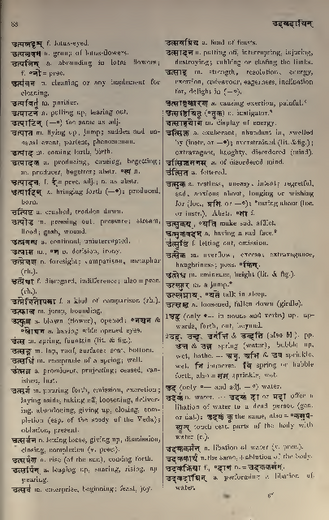
ud1 ·(only °-- in nouns and verbs) up, upwards, forth, out, beyond.
Originaltext · Englisch · Worttyp nicht bestimmt
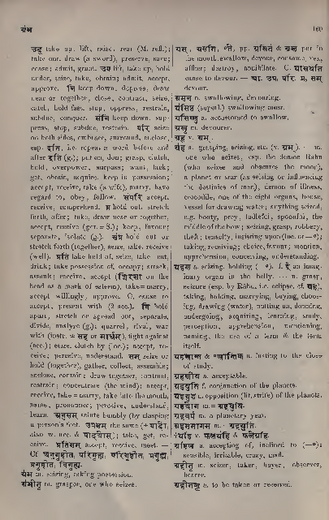
ud ·take up, lift, raise, rear (M. refl.); take out, draw (a sword), preserve, save; cease; admit, grant. upa life, take up, hold under, seize, take, obtain; admit, accept, approve. ni keep down, depress, draw near or together, close, contract, seize, catch, hold fast, stop, oppress, restrain, subdue, conquer. saṃni keep down, suppress, stop, subdue, restrain. pari seize on both sides, embrace, surround, enclose, esp. iti, i.e. repeat a word before and after iti (g.); put on, don; grasp, clutch, hold, overpower, surpass; want, lack; get, obtain, acquire, keep in possession; accept, receive, take (a wife), marry, have regard to, obey, follow. saṃpari accept, receive, comprehend. pra hold out, stretch forth, offer; take, draw near or together, accept, receive (ger. = S.); keep, favour; separate, isolate (g.). saṃpra hold out or stretch forth (together), seize, take, receive (well). prati take hold of, seize, take = eat, drink; take possession of, occupy; attack, assault; receive, accept (śirasā on the head as a mark of esteem), take = marry, accept willingly, approve. C. cause to accept, present with (2 acc.). vi hold apart, stretch or spread out, separate, divide, analyze (g.); quarrel, rival, war with (instr. ±saha or sārdham), fight against (acc.); seize, clutch by (loc.); accept, receive; perceive, understand. sam seize or hold (together), gather, collect, assemble; enclose, contain; draw together, contract, restrain; concentrate (the mind); accept, receive, take = marry, take into the mouth, name, pronounce; perceive, understand, learn. anusam salute humbly (by clasping a person's feet. upasam the same (±pādau, also w. acc. & pādayos); take, get, receive. pratisam accept, receive, meet. -- Cf. anugṛhīta, parigṛhya, parigṛhīta, pragṛhya, pragṛhīta, vigṛhya.
Originaltext · Englisch · Worttyp nicht bestimmt
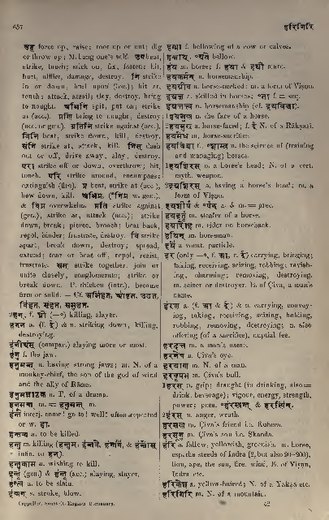
ud ·force up, raise; root up or out; dig or throw up; M. hang one's self. upa beat, strike, touch; stick on, fix, fasten; hit, hurt, afflict, damage, destroy. ni strike in or down, hurl upon (loc.); hit at, touch; attack, assail; slay, destroy, bring to nought. abhini spit, put on; strike at (acc.). praṇi bring to nought, destroy (acc. or gen.). pratini strike against (acc.). vini beat, strike down, kill, destroy. saṃni strike at, attack, kill. nis dash out or off, drive away, slay, destroy. parā strike off or down, overthrow; hit, touch. pari strike around, encompass; extinguish (fire). pra beat, strike at (acc.), hew down, kill. abhipra, (*nipra w. gen.), & vipra overwhelm. prati strike against (gen.), strike at, attack (acc.); strike down, break; pierce, broach; beat back, repel, hinder; frustrate, destroy. vi strike apart, break down, destroy; spread, extend; tear or beat off, repel, resist, frustrate. sam strike together, join or unite closely, conglomerate; strike or break down. P. thicken (intr.), become firm or solid. -- Cf. abhíhata, ā́hata, úddhata, víhata, saṃhata, samuddhata.
Originaltext · Englisch · Verb
ud und unátti2 ·v & undati (also M.), pp. utta & unna spring (water), bubble up, wet, bathe. -- anu, abhi & upa sprinkle, wet. ni immerse. vi spring or bubble forth, also = sam sprinkle, wet.
Monier-Williams 1872 Worttyp nicht bestimmt
Originaltext · Englisch · Worttyp nicht bestimmt
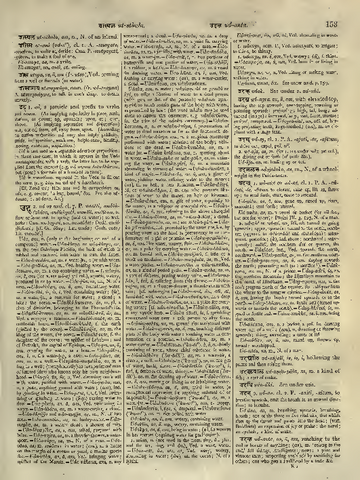
ud 1 . ud, a particle and prefix to verbs and nouns. (As implying superiority in place, rank, station, or power) up, upwards; upon, on; over, above. (As implying separation and disjunction) out, out of, from, off, away from, apart. (According to native authorities ud may also imply publicity, pride, indisposition, weakness, helplessness, binding, loosing, existence, acquisition.)
Originaltext · Englisch · Worttyp nicht bestimmt
Ud is not used as a separable adverb or preposition; in those rare cases, in which it appears in the Veda uncompounded with a verb, the latter has to be sup- plied from the context (e. g. ud utsam śatadhāram, out (pour) a fountain of a hundred streams).
Originaltext · Englisch · Worttyp nicht bestimmt
Ud is sometimes repeated in the Veda to fill out the verse (e. g. kiṃ na ud ud u harṣase). [Cf. Zend uś; Hib. uas and in composition os, ois, e. g. os-car, ‘a leap, bound,’ &c. See also ut- tama, 1. ut-tara, &c.]
Originaltext · Englisch · Worttyp nicht bestimmt
ud 2 . ud or und, cl. 7. P. unatti, undāñ- cakāra, undiṣyati, aundīt, unditum, to flow or issue out, to spring (said of water); to wet, bathe: Caus. undayati, aor. aundidat: Desid. undi- diṣati; [cf. Gr. ὕδωρ Lat. unda; Goth. vato; Lit. wandū́.]
Petersburger 1855 Worttyp nicht bestimmt
Originaltext · Deutsch · Worttyp nicht bestimmt
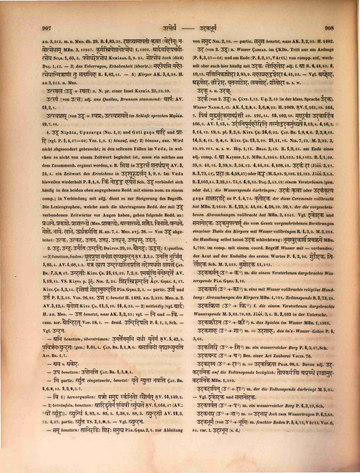
1. ud Nipāta, Upasarga (NIR. 1,3) und Gati gaṇa cādi und prādi (vgl. P. 1,4,57—P. 1,4,60) VOP. 1,8. 1〉 hinauf, auf; 2〉 hinaus, aus. Wird nicht abgesondert gebraucht; in den seltenen Fällen im Veda, in welchen es nicht von einem Zeitwort begleitet ist, muss ein solches aus dem Zusammenh. ergänzt werden, z. B. siñca in udutsàṃ śa̱tadhā̀ram AV. 3,24,4. ein Zeitwort des Erreichens in udāyu̱rudbalàm AV. 5,9,8. Im Veda bisweilen wiederholt P. 8,1,6. kiṃ nodudu harṣase Sch. ud verbindet sich häufig in den beiden oben angegebenen Bedd. mit einem nom. zu einem comp.; in Verbindung mit adjj. dient es zur Steigerung des Begriffs. Die Lexicographen, welche auch die übertragenen Bedd. der mit ud verbundenen Zeitwörter vor Augen haben, geben folgende Bedd. an: pradhāne, prakāśe, prāgalbhye (MED. prābalye), asvāsthye, śaktau, vibhāge, bandhane, mokṣe, bhāve, lābhe, ūrdhvakarmaṇi H. an. 7,4. MED. avy. 38. — Von ud abgeleitet: utka, utkaṭa, uttama, uttara, uttaram, uttarām, udvat.
Originaltext · Deutsch · Worttyp nicht bestimmt
2. ud , und, unàtti (undati) DHĀTUP. 29,20. aunad; ūdus; 1〉 quellen. — 2〉 benetzen, baden: ghṛ̱ta̱pruṣā̱ manàsā ha̱vyamu̱ndan ṚV. 2,3,2. u̱natti̱ bhūmìm ṚV. 5,85,4. AV. 6,68,1. AV. 6,68,2. yatra hyāpa undantyastiṣṭhanti tadoṣadhayo jāyante ŚAT. BR. 7,5,2,47. undatīḥ KĀTY. ŚR. 25,11,22. KĀTY. ŚR. 7,2,9. śmaśrū̀ṇi̱ yeno̱ndatè AV. 5,19,14. VS. KĀṆVA p. 86 NIR. 2,24. śirastrirundati ĀŚV. GṚHY. 1,17. KĀTY. ŚR. 5,2,14. dakṣiṇaṃ godānumandati PĀR. GṚHY. 2,1. — partic. unná und uttá P. 8,2,56. VOP. 26,98. unna 1〉 benetzt H. 1492. H. an. 2,259. MED. n. 2. AV. 3,12,4. ghṛtonna KĀTY. ŚR. 15,5,10. KĀTY. ŚR. 16,4,35. — 2〉 mitleidig (vgl. ārdra) H. an. MED. — utta benetzt, nass AK. 3,2,55; vgl. — ni und — vi. — caus. aor. aundidat VOP. 18,1. — desid. undidiṣati P. 6,1,3, Sch. — Vgl. undana. — abhi benetzen, überströmen: u̱nattaìnama̱bhi madhvā̀ ghṛ̱tenà ṚV. 5,42,3. pa̱vitràmabhyunda̱taḥ (gen.) ṚV. 9,61,4. ŚAT. BR. 3,1,2,6. asāvimāṃ vṛṣṭyābhyunatti AIT. BR. 1,7. — ava s. avoda. — upa benetzen: uponatti ŚAT. BR. 1,3,3,4. — ni partic. nyùtta eingetaucht, benetzt: ghṛte nyuttā bhavanti ŚAT. BR. 6,6,2,13. ŚAT. BR. 9,2,2,3. ŚAT. BR. 9,2,2,7. — vi 1〉 hervorquellen: yatrā̀ samu̱dra skàbhi̱to vyaunàt ṚV. 10,149,2. — 2〉 beträufeln, benetzen: ādidghṛ̱tenà pṛthi̱vī vyùdyate ṚV. 1,164,47 (AV.: ˚vīṃ vyū̀duḥ). vyundhì ṚV. 5,83,8. ṚV. 5,85,3. ṚV. 1,38,9. ṚV. 1,88,5. vyu̱nda̱tī AV. 18,3,72. AV. 18,4,57. partic. vyùtta TS. 3,1,9,3. — Vgl. vyundana. — sam benetzen: tābhiradbhiḥ śiraḥ samudya PĀR. GṚHY. 2,1. zur Ableitung von samudra NIR. 2,10. — partic. samunna benetzt, nass AK. 3,2,55. H. 1492.
Originaltext · Deutsch · Worttyp nicht bestimmt
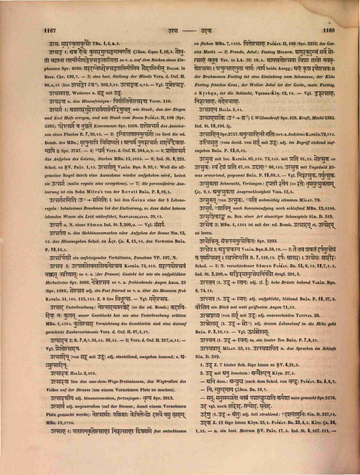
1. ud Z. 7 hinter Sch. füge hinzu zu ṚV. 4,21,9.
Originaltext · Deutsch · Worttyp nicht bestimmt
2. ud mit anu benetzen: anvaundan KĀṬH. 27,5. — abhi dass.: abhyudya (nach dem Schol. von vand) PAÑCAV. BR. 6,8,7. — ni, nyundamāna ŚĀṄKH. BR. 16,7. — sam, samunnamagrato vastraṃ paścācchudhyati karmaṇā nass gemacht Spr. 5176.
Originaltext · Deutsch · Worttyp nicht bestimmt
ud vgl. noch kṣāroda, gandhoda, ghṛtoda.
Originaltext · Deutsch · Worttyp nicht bestimmt
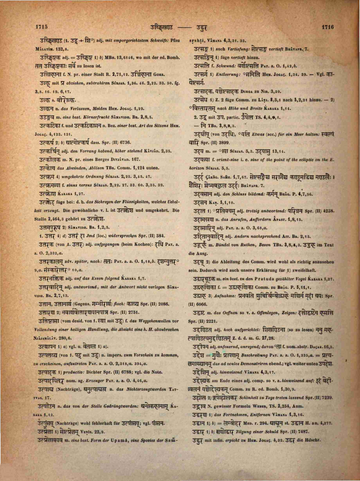
2. ud mit upa, partic. úpotta TS. 4,4,9,1. — ni TBR. 3,8,2,3.
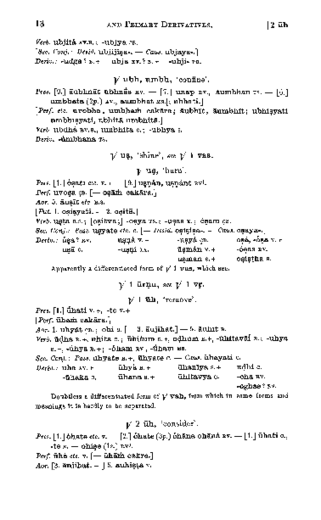
Böhtlingk 1879 Verbalwurzel
Originaltext · Deutsch · Verbalwurzel
1. √ud in Verbindung mit Verben und in Comp. mit Nominibus — 1〉 hinauf, auf. — 2〉 hinaus, aus. — Zu ud mit einem nachfolgenden Acc. ist ein Zeitwort zu ergänzen.

Originaltext · Deutsch · Verbalwurzel
2. √ud, √und , unátti und undati (auch Med.) — 1〉 quellen. — 2〉 benetzen, baden. — Partic. — 1〉 unna — a〉 benetzt, nass. — b〉 *mitleidig. — 2〉 *utta benetzt, nass. — Mit anu und abhi benetzen. — Mit ava, in avoda. — Mit upa benetzen. Partic. úpotta. — Mit ni eintauchen. Partic. nyùtta eingetaucht, benetzt. — Mit vi — 1〉 hervorquellen. — 2〉 beträufeln, benetzen. Partic. vyùtta. Mit sam benetzen. Partic. samunna benetzt, nass gemacht Spr. 6863.
Whitney Roots 1885 Verbalwurzel
Originaltext · Englisch · Verbalwurzel
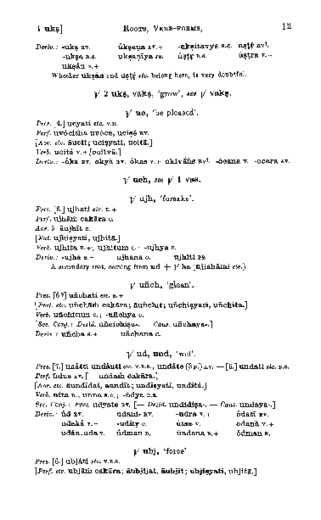
ud, und — wet
Apte 1890 Partikel · Worttyp nicht bestimmt
Originaltext · Englisch · Partikel
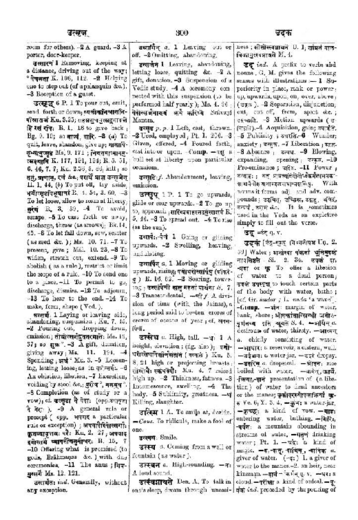
ud ind. A prefix to verbs and nouns. G. M. gives the following senses with illustrations:- 1 Superiourity in place, rank or power; up, upwards, upon, on, over, above; (udbala). 2 Separation, disjunction; out, out off, from, apart &c.; udgacchati. 3 Motion upwards ( uttiṣṭhati). 4 Acquisition, gain; upārjati. 5 Publicity; uccarati. 6 Wonder; anxiety; utsuka. 7 Liberation; udgata. 8 Absence; utpatha. 9 Blowing, expanding, opening; utphulla. 10 Pre-eminence; uddiṣṭa. 11 Power; utsāhaḥ; ut prābalyaviyogordhvakarmalābhaprakāśāścaryamokṣaṇābhāvadalaprādhānyaśāktiṣu. With nouns it forms adj. and adv. compounds; udarcis, ucchikha, udbāhu, unnidraṃ, utpathaṃ, uddāmaṃ &c. It is sometimes used in the Veda as an expletive simply to fill out the verse.
Originaltext · Englisch · Worttyp nicht bestimmt
ud = uṃd q. v.
Cappeller 1887 Worttyp nicht bestimmt · Verb
Originaltext · Deutsch · Worttyp nicht bestimmt
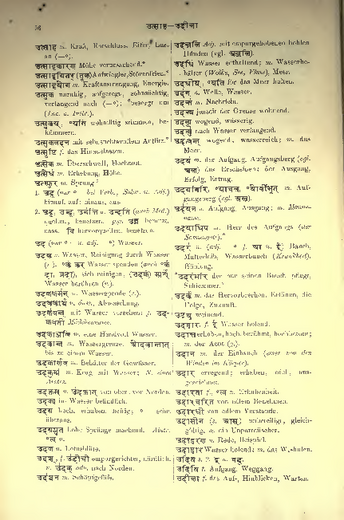
1. ud (nur ˚— bei Verb., Subst. u. Adj.) hinauf, auf; hinaus, aus.
Originaltext · Deutsch · Verb
2. ud und, unátti u. undati (auch Med.) quellen, benetzen. p.p. unna benetzt, nass. vi hervorquellen, benetzen.
Abgeleitete Wörter
Weitere direkte Ableitungen (11)
Weitere Ableitungen (1)
Quelltextfundstellen (164)
DYS 15 Fundstellen
GoS 14 Fundstellen
HP 41 Fundstellen
HP 1.44-1.49: Padmāsana 4 Fundstellen
Direkt belegt
-
HP 1.45–46 Segment 26
-
HP 1.48 Segment 23
Über Ableitungen belegt
-
HP 1.45–46 Segment 1
-
HP 1.45–46 Segment 11
Weitere 20 Quelltextseiten
HP 3.94-3.102*1: Śakti-Cālana 3 Fundstellen
Direkt belegt
HP 4.9-4.11*4: Blick und Mondnektar 2 Fundstellen
Direkt belegt
HP 4.37-4.46: Nāda-Hören 3 Fundstellen
Direkt belegt
HTK 4 Fundstellen
HTK 10.30–33*1: Nāḍī-viśudhy-ākhyaka-kumbha und Nāḍīśuddhi 1 Fundstelle
Direkt belegt
-
HTK 10.33 Segment 19
IVU 1 Fundstelle
MAN 3 Fundstellen
PJH 5 Fundstellen
PYS 8 Fundstellen
PYS 3.9–12: Drei Wandlungen des Citta 3 Fundstellen
Über Ableitungen belegt
SiSa 34 Fundstellen
SiSa 2.44-2.48: Erkenntnisweg 4 Fundstellen
Direkt belegt
SiSa 3.1-3.10: Herzlotus und Prāṇa 3 Fundstellen
Direkt belegt
-
SiSa 3.6 Segment 17
Über Ableitungen belegt
Weitere 19 Quelltextseiten
SiSa 3.88-3.91: Padmāsana 4 Fundstellen
Direkt belegt
Über Ableitungen belegt
SS 5 Fundstellen
SS 1.19–1.21: Śakti und Schöpfung 2 Fundstellen
Über Ableitungen belegt
SVU 4 Fundstellen
VBT 30 Fundstellen
VBT 14–17: Höchste Wirklichkeit 3 Fundstellen
Direkt belegt
Über Ableitungen belegt
-
VBT 14 Segment 6
VBT 24–31: Atem und Śakti 6 Fundstellen
Direkt belegt
Über Ableitungen belegt
Weitere 10 Quelltextseiten
VBT 57–64: Zwischenräume und Gleichheit 2 Fundstellen
Über Ableitungen belegt
VBT 93–100: Schmerz und Wunsch 4 Fundstellen
Direkt belegt
Mit AYI Free weitermachen
Bildquelle: AYI Archiv.